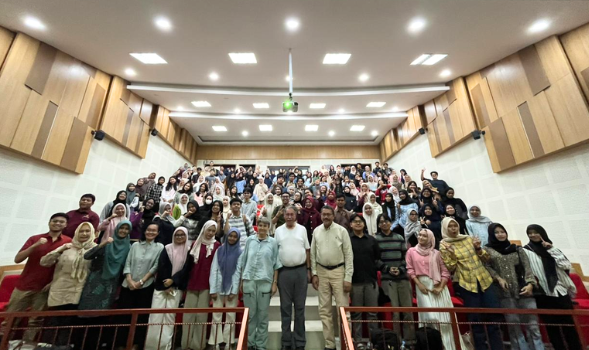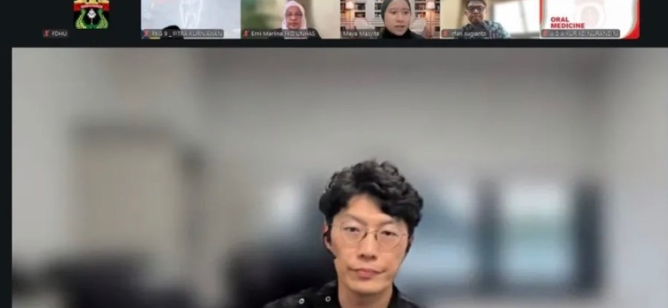
The Faculty of Dentistry (FKG), Hasanuddin University (UNHAS), once again presented an international academic forum through a talk show on the maritime history between Indonesia and Japan. The event, held on Saturday, 18 April 2026, at the Molar Room, carried the theme “Rethinking Japan’s Isolation: Indonesian Traces in Dejima–Batavia Maritime Trade 1641–1854.” This program was a collaborative effort between FDHU, Japan Corner UNHAS, and the Indonesian Alumni Association from Japan (Persada). Starting at 09:00 WITA, the event drew enthusiastic participation from students across various faculties including faculty of dentistry and faculty of cultural studies.
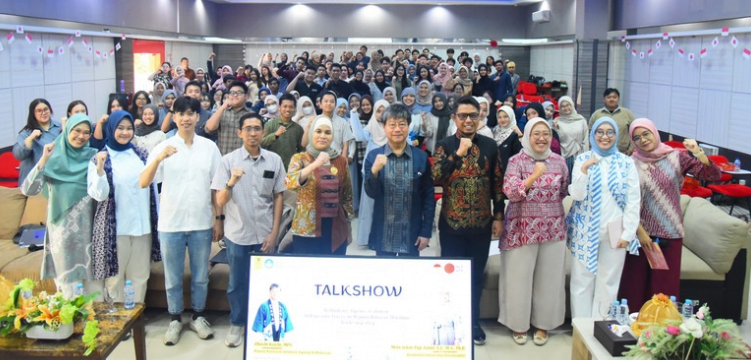
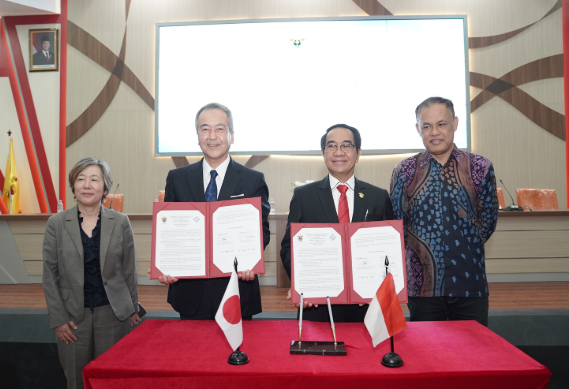
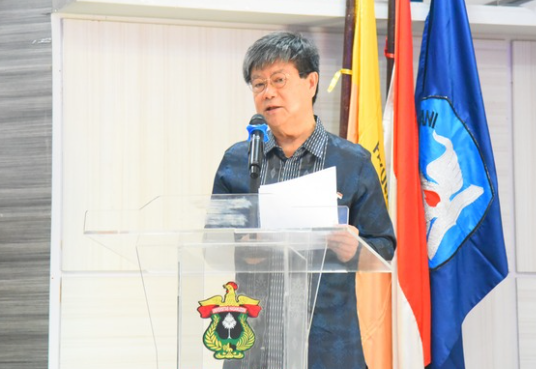
In his opening remarks, the Dean of FKG UNHAS, Irfan Sugianto, drg., M.Med.Ed., Ph.D., Sp.RKG, emphasized the importance of broadening students’ perspectives through interdisciplinary studies and global historical insights. He also expressed his appreciation for the presence of the Head of the Japanese Consular Office in Makassar, Dr. Ohashi Koichi, M.P.A., as well as the keynote speaker, Meta Sekar Puji Astuti, S.S., M.A., Ph.D., who is widely recognized for her work in Japanese studies and international relations. He noted that contributions from scholars like Dr. Meta play a significant role in enriching the understanding of international dynamics. On the same occasion, Dr. Ohashi Koichi highlighted the long-standing historical ties between Japan and Indonesia. He stressed that a deep understanding of these historical roots is essential for strengthening future cooperation. The long-established bilateral relationship is expected to continue evolving into a mutually beneficial strategic partnership.
During the main session, Meta Sekar Puji Astuti revisited the concept of sakoku, or Japan’s isolation policy, which is often narrowly interpreted as complete seclusion from the outside world. She explained that, in reality, Japan maintained limited external interactions through the port of Dejima in Nagasaki, particularly with the Dutch, who operated from Batavia under the VOC. This channel served as a crucial link for the continued exchange of goods and knowledge. Batavia, as the VOC’s trading hub in the archipelago, played a significant role in distributing commodities to Japan. Products such as spices and other natural resources became part of a trade network that supported Japan’s needs at the time. This indicates that Indonesia had an indirect yet important contribution to Japan’s economic dynamics during that period. Interestingly, the discussion extended beyond economic and political history to include aspects of popular culture and health. The speaker connected the historical narrative to the Shogun series, which portrays the story of William Adams as an entry point to understanding Japan’s interactions with the outside world.
Additionally, a bioarchaeological approach to Japanese culinary history was introduced to examine the impact of dietary patterns on public health, particularly oral health. The sugar trade route from Java to Japan, known as the “Sugar Road,” was highlighted as having influenced changes in public health patterns, supported by various scientific findings.
The discussion was dynamic and engaging, moderated by drg. Nisrina Ekayani Nasrun, Ph.D., a doctoral graduate from Japan. The Q&A session became one of the most interactive segments, with active participation from students of both the Faculty of Dentistry and the Faculty of Cultural Sciences. The event concluded at 11:00 Central Indonesia Time in a lively academic atmosphere, underscoring the importance of interdisciplinary collaboration in understanding history and its relevance to contemporary life.