Two lecturers from the Department of Political Science, Hasanuddin University (UNHAS), served as speakers at the International Political Science Association (IPSA) Research Committee’s Colloquium held in Bolzano, Italy, from 23 to 26 June 2026. This biennial event served as a global scientific discussion forum attended by approximately 200 participants, researchers, and political scientists from 30 countries across the globe. On this occasion, the UNHAS delegation presented empirical research findings regarding the dynamics of local politics and shifts in regional leadership maps in Indonesia following the 2024 Simultaneous Regional Elections.
The first presentation session was delivered by Dian Ekawaty, S.IP., M.A., who presented a paper titled “Internal Ethnic Consolidation and Political Attitudes in Indonesian Regional Elections 2024: The Case of Massenrempulu Ethnic Group in Parepare.” In her presentation, Dian highlighted in depth how internal consolidation patterns within the Massenrempulu ethnic group influenced and shaped public political attitudes and behavior in the 2024 Parepare regional election. She explained before the forum participants that a unique pattern exists within the Parepare community. As a multicultural society, every ethnic group possesses equal space for contestation, and her study examines how the Massenrempulu consolidate and shape their political choices amidst such competition.
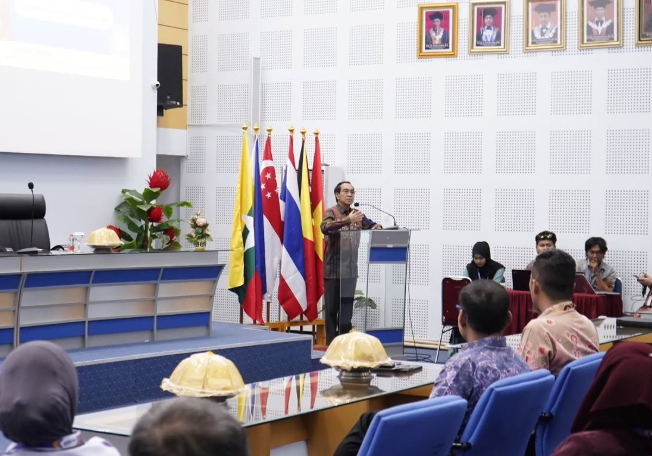
Meanwhile, Prof. Dr. Phil. Sukri, M.Si., presented his research entitled “The Emerging of New Elites and the Ethnicity Existence in Indonesian Local Politics.” This study dissected the phenomenon of shifts in the local political power map in Toraja during the 2024 regional election, where economic capital has begun to displace the dominance of traditional nobility status. Prof. Sukri explained that historically, candidates in Toraja’s political contestation relied heavily on support from traditional institutions, churches, and blessings from ethnic elites rooted in the traditional Toraja caste system or teachings. However, the 2024 regional election demonstrated a significant new trend with the emergence of figures from new economic elite backgrounds. The presence of these economic elites proves a structural shift, where new groups possessing financial power and modern social capital are now able to compete openly to lead local governance, a domain previously almost entirely dominated by caste-based nobility. He concluded by emphasizing that the 2024 local elections signify the emergence of a new elite in Toraja.
The active participation of both UNHAS academics in this international research forum not only presented field findings but also aligned with global commitments to the UN Sustainable Development Goals (SDGs). By presenting empirical research on political inclusivity, democratic participation, and evolving local governance structures, the study directly supports SDG 16 (Peace, Justice, and Strong Institutions). Furthermore, the participation of UNHAS academics in an international research forum fosters global academic knowledge exchange, supporting SDG 4 (Quality Education) and SDG 17 (Partnerships for the Goals). Overall, this step reinforces the tangible contribution of UNHAS in expanding studies on local politics and introducing Indonesia’s rich and complex socio-political dynamics to the international level.