
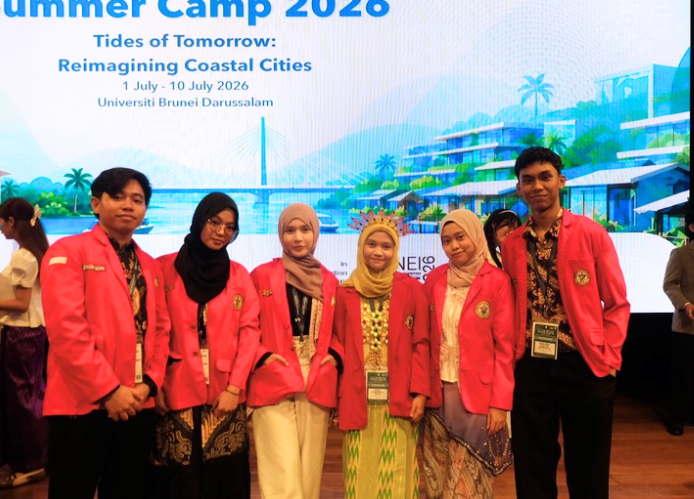
Representing Indonesia on an international stage, a student delegation from Hasanuddin University (UNHAS) active in various academic disciplines participated in the Global Discovery Programme: UBD-AUN Summer Camp 2026, held from 1-10 July 2026, at Universiti Brunei Darussalam (UBD). Centered on the theme “Tides of Tomorrow: Reimagining Coastal Cities,” the 10-day program brought together top youth delegates from leading ASEAN University Network (AUN) institutions. Representing UNHAS across a diverse range of academic disciplines, the student delegation comprised Adelia Rayna Salvia Ubbe and Muh. Idris Irfandi from the Faculty of Medicine, Andi Faiza Azwa Rezky Mahir from the Faculty of Agricultural Technology, Andi Muh Fabyan Abhipraya from the Faculty of Social and Political Sciences, Anita Pratiwi from the Faculty of Forestry, and Riska Almerenda Husni from the Faculty of Economics and Business.
Throughout the 10-day program, the UNHAS delegates joined selected student leaders from top AUN member universities and partner institutions across Southeast Asia and beyond, including Singapore, the Philippines, Cambodia, Thailand, Vietnam, Myanmar, Brunei, Hong Kong, and South Korea. The curriculum integrated interactive academic lectures, high-level panel discussions, field excursions, youth leadership forums, and cross-cultural networking sessions designed to address pressing ecological challenges facing Southeast Asia’s marine and coastal regions. Specialized academic sessions delivered by expert scholars covered critical topics including global marine biodiversity degradation, blue urbanism practices, tropical species conservation, circular economy applications in aquaculture, and the function of mangroves and coastal peatlands as natural blue carbon sinks.
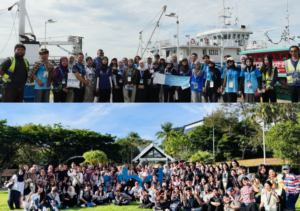
Extending learning beyond the classroom, the delegates undertook extensive field excursions across Brunei Darussalam to examine coastal ecosystems, maritime infrastructure, and cultural heritage sites firsthand. Through experiential field studies, the delegates observed local sociocultural adaptations in traditional stilt settlements and historical landmarks while conducting site visits to strategic maritime agencies, commercial ports, and coastal ecosystems to gain insights into marine governance, industrial logistics, and ecological conservation. A major highlight was their active participation in the Future Ocean Changemakers Youth Forum, which featured an insightful panel session themed “Future Ocean Careers: From Science and Fisheries to Startups and Storytelling.” Working in multicultural, cross-disciplinary teams alongside regional experts, the UNHAS delegates formulated actionable solutions for pressing issues such as water pollution, coastal vulnerability, and sustainable ocean conservation strategies.
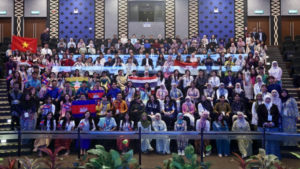
The academic journey culminated in a comprehensive project synthesis, where international student teams developed multiformat outputs, including presentation videos, scientific posters, and exhibition banners. Delegations presented their collaborative sustainability frameworks before a panel of academic judges and faculty members, demonstrating how cross-cultural and disciplinary knowledge can be harnessed to build resilient coastal communities. The 10-day program concluded with an official Closing Ceremony and Certificate Presentation, where participants reflected on their academic growth and the international networks established across the region.
These initiatives align with several United Nations Sustainable Development Goals (SDGs). By focusing on marine biodiversity protection and coastal ecosystem preservation, the program directly supports SDG 14: Life Below Water. The emphasis on climate adaptation, mangrove conservation, and blue carbon sinks advances SDG 13: Climate Action, while the exploration of resilient coastal settlements contributes to SDG 11: Sustainable Cities and Communities. Additionally, the cross-border collaboration among ASEAN institutions embodies SDG 17: Partnerships for the Goals. The successful active engagement of the delegation highlights the ongoing dedication of UNHAS to internationalization, student mobility, and preparing future leaders to address global sustainability challenges within the ASEAN region.