
MAKASSAR – Hasanuddin University (Unhas) once again held a ceremony admitting five professors from various disciplines as members of the Council of Professors. Each professor delivered an inaugural address outlining their research journey and innovative ideas for addressing challenges in health, the environment, and humanity.
The addresses covered topics ranging from bacterial dynamics and biomaterials in dental care, the use of natural materials for periodontal disease and honeybee development to literature as a space for cultural dialogue. This points to a diversity of ideas and thinking that shows the scientific contribution of Unhas in delivering solutions for society.
The event took place on Wednesday (26 August) in the Academic Senate Hall, 2nd floor of the Rectorate Building, Unhas Tamalanrea Campus. The five professors who delivered their inaugural addresses were:
The following is a summary of each professor’s inaugural address.
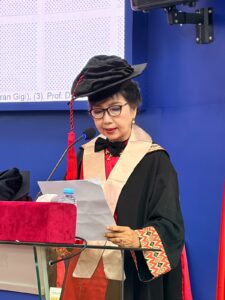
Prof. Dr. drg. Maria Tanumi Hardja, MDSc.,
Professor of Conservative Dentistry and Endodontic Microbiology, Faculty of Dentistry.
Title: “Bacterial Dynamics in Root Canals: Challenges and Hopes Toward Smarter, Safer, More Precise and Evidence-Based Endodontics”
Prof. Maria explained three main approaches: the dynamics of bacteria in root canals, the challenges faced in understanding and controlling endodontic infections, and the hope of moving toward smarter, safer, more precise and evidence-based endodontics.
The course of a root canal infection generally begins with dental caries, which, if not treated promptly, develops into inflammation of the pulp. If the process continues, the pulp tissue can become necrotic. Once the pulp tissue has lost its vitality, the pulp chamber and root canal, which were previously sterile, become an environment that allows microorganisms to enter, grow and form communities.
Bacterial dynamics in the root canal include the shift from a sterile condition to a microbial ecosystem, the formation of polymicrobial communities and biofilms, and changes in the microbial profile during disease progression and after treatment. This understanding is the scientific foundation for determining how to diagnose, clean, disinfect and monitor root canals.
The main problem in endodontics is not only about killing bacteria. It also involves identifying which microorganisms are still alive, reaching complex anatomical systems, controlling biofilms, and evaluating treatment outcomes based on microbiological, clinical and radiographic data as well as patients’ needs.
Amid the complexity of endodontics, scientific progress offers great hope for the future of endodontics. All of these developments are leading toward endodontics that is increasingly evidence-based, precise, and oriented toward quality of life. This direction is in line with the concept of P4 dentistry, namely Personalized dentistry (treatment tailored to the individual patient’s condition), Predictive dentistry (clinical data and technology), Preventive dentistry (from prevention to monitoring), and Participatory dentistry (patients as active partners in decision-making and in maintaining their dental health).
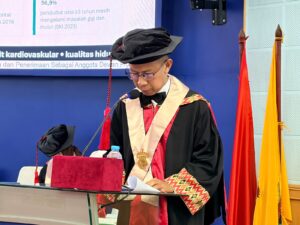
Prof. Dr. Asdar, drg., M.Kes.,
Professor of Periodontology, Faculty of Dentistry
Title: “The Use of Natural Materials as Adjunctive Therapy in the Treatment of Periodontal Disease.”
The global epidemiological picture of periodontal disease shows that it is a complex and multifactorial public health problem. Strategies to control periodontal disease must therefore include integrated promotive, preventive and curative efforts, supported by innovative research.
In terms of pathogenesis, periodontal disease is a chronic inflammatory disease that affects the supporting tissues of the teeth, including the gingiva, periodontal ligament, cementum and alveolar bone. The disease begins with the accumulation of microbial biofilm on the tooth surface, which triggers the host immune response and results in progressive tissue destruction if left untreated.
The clinical implications of periodontal disease are not limited to the oral cavity but also have a systemic impact. Scientific evidence shows that chronic periodontal inflammation can contribute to an increased risk of cardiovascular disease through the mechanisms of systemic inflammation and bacteremia.
Conventional therapy for periodontal disease generally focuses on removing biofilm and calculus through mechanical procedures, particularly scaling and root planing (SRP), which to this day is still regarded as the gold standard. However, one of its main limitations is the inability to deal with subgingival biofilm, which is complex and resistant. The use of natural materials is therefore one way to overcome the limitations of conventional therapy and improve clinical outcomes for periodontal patients.
Scientifically, the rationale for using natural materials is based on the bioactive compounds they contain, which have anti-inflammatory, antibacterial, antioxidant and regenerative properties. Various phytochemicals, such as flavonoids, polyphenols, terpenoids and alkaloids, have been shown to modulate molecular pathways involved in the pathogenesis of periodontal disease.
In the context of periodontal tissue regeneration, natural materials also show promising potential. Several biomaterials based on natural materials, such as hydroxyapatite from seashells, are highly osteoconductive and biocompatible. Natural materials have advantages over synthetic materials in terms of biocompatibility and safety.
Because they come from biological sources, these materials generally have low toxicity and a minimal risk of side effects. The rationale for using natural materials is also strengthened by host modulation therapy in modern periodontology. This therapy aims to regulate the host immune response so that it does not become excessive and damage tissue.
Several natural compounds have been shown to modulate immune pathways, for example by inhibiting the production of matrix metalloproteinases (MMPs), which play a role in collagen degradation, and by increasing the production of anti-inflammatory cytokines such as IL-10.
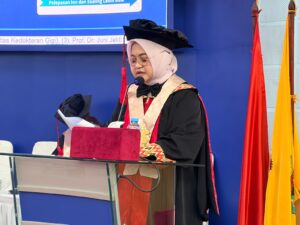
Prof. Dr. Juni Jekti Nugroho, drg., SpKG SubSp KE.,
Professor of Endodontic Biomaterials, Faculty of Dentistry
Title: “The Role of Endodontic Biomaterials in the Preservation and Regeneration of Dental Tissue.”
In vital pulp therapy, particularly when the pulp is accidentally exposed during a treatment procedure, the choice of biomaterial is the main determinant of success. When the pulp is exposed as a result of caries or trauma, or accidentally during treatment, dentists do more than simply close the opening to the pulp.
For decades, calcium hydroxide has been an important material in endodontics. Its alkaline nature has an antibacterial effect and can stimulate the formation of a protective layer of dentin. However, the material also has limitations: its high pH can damage the tissue surface, it is highly soluble, it bonds weakly to dentin, and the layer it forms still has gaps.
These limitations spurred the development of calcium silicate-based biomaterials, such as mineral trioxide aggregate, tricalcium silicate cement and bioceramics. These materials can seal gaps in the dentin more effectively, release calcium ions, and form a layer resembling hydroxyapatite, the main mineral of the hard tissues of the teeth.
These advances have not yet addressed every challenge. Some calcium silicate-based materials still have problems with the application procedure, setting time and cost, as well as calcium ion release that is not yet fully optimal. Research is therefore continuing to improve existing biomaterials so that they are safer, more stable, easier to use and compatible with pulp tissue.
One line of research being developed is the use of Indonesia’s biological resources and natural mineral sources as components of endodontic biomaterials. Indonesia has extraordinary natural wealth. However, many of these resources have not yet been put to optimal use in dentistry, particularly in endodontics.
In addition to organic natural materials, this research also looks at natural minerals, particularly calcium carbonate from shells, which are often regarded as waste. Yet from a biomaterials perspective, shells are rich in calcium carbonate, have a distinctive mineral organization and could potentially be processed into a biomaterial additive.
Endodontic biomaterials determine the quality of healing and connect efforts to preserve tissue, support regeneration, advance materials science and provide human-centered care, in the effort to retain natural teeth for as long as possible.
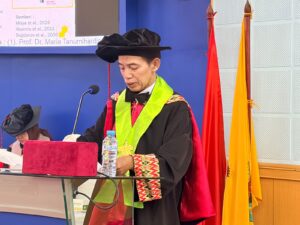
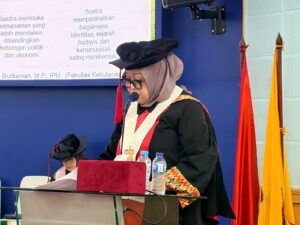
Prof. Dr. Ir. Budiaman, M.P., IPU.,
Professor of Forest Entomology (Honeybees), Faculty of Forestry.
Title: “The Role of Honeybees in National Development.”
Several bee species are widely managed, including the European honeybee, the Asian honeybee and several stingless bee species, as well as solitary bees that can help pollinate plants. Indonesia itself produces 80,000 tonnes of honey a year, 70% of which is forest honey and 30% honey from farmed bees.
Research at Kampung Rimba of the Unhas Faculty of Forestry showed that the honey bee Tetragonula biroi can be mass-propagated through colony splitting, with colonies split both with and without a queen. Research has also shown that honeybee farming can be engineered to produce various types of honey from a variety of fruits formulated as fruit juice for farmed honeybees, a rapid method for producing noni fruit-juice honey using Apis mellifera bees.
Meanwhile, research in the Makassar industrial area showed that stingless bee farming and the honey it produces can be used as a bioindicator of urban environmental pollution. To optimize the production of honey and propolis by Tetragonula biroi, a vertical box prototype that works best for stingless bees has been developed.
Honeybees, in the natural environment of tropical regions including Indonesia — a habitat and a paradise for honeybees and for the growth of various related biological industries — have proven to play a very important role in national development. Unhas can serve as a center for honeybee research and development.
Prof. Dra. Herawaty Abbas, M.Hum., M.A., Ph.D.,
Professor of Literature, Faculty of Cultural Sciences.
Title: “Australian Literature as a Space for Cultural Dialogue: Reading Identity, Memory, Diversity, and Human Harmony in a Pluralistic World.”
One of the greatest benefits of studying Australian literature is its ability to help people understand diversity. Australia is a nation built through encounters among various cultural groups (Aboriginal communities, people of European descent, Asian migrants, Middle Eastern communities, and various other diaspora groups). Helen Thurloe’s novel Promising Azra shows that identity is not something rigid and singular, but something continually shaped through social interaction.
Literature serves as a bridge connecting different cultures. Through Australian works, Indonesian students can understand the lives of a society that is geographically close but often poorly understood culturally. In turn, literary studies open up opportunities for dialogue between Indonesian and Australian experiences.
Literature plays a role in building social harmony. Research on Australian works has found that many social conflicts are rooted in a failure to understand the experiences of others. Discrimination arises when people are unable to see the humanity in those who are different. Literature is not merely the study of texts, but the study of human beings and their future. (*/mir)
Editor: Ishaq Rahman
This article is an English translation of the original Indonesian report.