
MAKASSAR – The Faculty of Animal Science (Fapet) at Hasanuddin University (Unhas) is strengthening organic waste management on campus through a program supported by the Low Carbon Development Initiative–Indonesia Transition Fund (LCDI-ITF). The program is backed by a number of institutions, including the Indonesian Environment Fund (BPDLH), the National Development Planning Agency (Bappenas), UK International Development, Oxford Policy Management and Carbon Trust.
Data from the Unhas Integrated Waste Processing Site (TPST), which is operated by PT Agro Farm Econesia (CycleValue), recorded 2,830 kilograms of organic waste processed as of 18 September 2026. All of the waste collected consisted of food scraps from activities on campus.
Since the first collection on 24 August 2026, organic waste has been collected 18 times. Over the period from 24 August to 18 September 2026, the volume of waste taken in averaged about 134 kilograms per day.
The waste came from three main sources. Unhas Hotel & Convention (UHC) contributed 1,710 kilograms, or 60.4 percent of the total volume; the Unhas Nutrition Fulfillment Service Unit (SPPG) 693 kilograms, or 24.5 percent; and Hadin F&B 427 kilograms, or 15.1 percent.
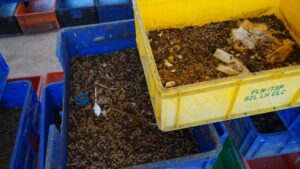
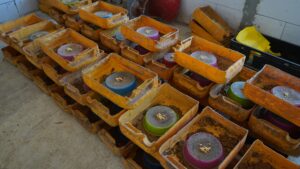
Fapet Unhas is developing the cultivation of maggots, or black soldier fly (BSF) larvae, as part of organic waste processing. The collected organic material is used as a feeding medium in the early growth stage of the larvae. Once they have grown, the larvae are moved to a biopond to continue the grow-out phase.
BSF larvae consume organic matter while producing biomass that can potentially be used as an alternative feed source for livestock and poultry. This approach links the processing of food residues with the development of resources relevant to animal husbandry.
LCDI-ITF Safeguard Coordinator Dr. Ir. Zulkarnaim, S.Pt., M.Si., IPM., explained that the application of maggot farming in organic waste management is aimed at making more optimal use of organic material.
“Managing organic waste through BSF maggot farming offers a biological approach to making use of food scraps. The collected organic material can be used as a feeding medium for the larvae, while the resulting biomass has the potential to help meet feed needs in the livestock sector,” said Zulkarnaim.
This management helps reduce the amount of organic waste that needs to be disposed of, while also opening up opportunities to reuse organic material through biological processes. Volume data from each source can also be used to evaluate waste generation patterns and processing needs on campus.
The program also supports a number of targets under the Sustainable Development Goals (SDGs), particularly SDG 2 (Zero Hunger), through the development of maggots as an alternative feed source for livestock and poultry; SDG 12 (Responsible Consumption and Production), through the reuse of organic waste; SDG 13 (Climate Action), through stronger waste management within a low-carbon development framework; and SDG 15 (Life on Land), through the application of more sustainable environmental management.
With support from LCDI-ITF, Fapet Unhas continues to develop an organic waste processing system based on BSF farming, taking into account the volume of incoming material, the larval rearing process and the use of the resulting biomass. This approach strengthens resource-based waste management practices on campus.(*fapet/aya)
Editor: Ishaq Rahman
This article is an English translation of the original Indonesian report.