
MAKASSAR – A simple question often haunts the academic world: once a study is finished and its results are published in a journal, where does that knowledge go? Amid increasingly complex development challenges—from public health and climate change to economic transformation—the answer to that question can no longer “stop in the laboratory.” Research is now expected to deliver solutions that can be applied and bring real benefits to society.
That spirit is seen as having taken deeper root at Hasanuddin University (Unhas) in recent times. This is reflected in the success of eleven Unhas researchers in passing a competitive selection and securing funding from the Research and Innovation for Advanced Indonesia (RIIM) Program, Competition Wave 11 of 2026.
The successful research spans multiple fields: health, pharmacy, forestry, artificial intelligence, and economics. This funding is an important asset for researchers to develop scientific ideas into solutions that address various development challenges through science and innovation.
What RIIM Is and Why It Matters
RIIM is a strategic government instrument for strengthening the national research ecosystem. The program is managed by the National Research and Innovation Agency (BRIN) through its Deputy for Research and Innovation Facilitation, with support from the Research Endowment Fund managed by the Indonesia Endowment Fund for Education (LPDP), and is designed to accelerate the emergence of impactful research.
Through this scheme, researchers are encouraged to produce innovations, technologies, policy models, and science-based solutions that can be applied to address various national development challenges. Scientific publications remain a mandatory output, but only as a minimum standard. In Competition Wave 11 of 2026, funding recipients were determined by Decree of the Deputy for Research and Innovation Facilitation of the National Research and Innovation Agency Number 106/II.7/HK/2026.
For Indonesian researchers, the RIIM scheme is a competitive gateway that selects ideas based on scientific quality, novelty, and potential impact in the field. The selection process is very strict, so not every proposal makes it through.
*Head of LPPM Unhas: Research for the Nation
The Head of the Hasanuddin University Institute for Research and Community Service (LPPM), Prof. dr. Muh. Nasrum Massi, Ph.D., Sp.MK(K)., sees the achievement as a reflection of the increasingly strong research ecosystem at Unhas. In Prof. Nasrum’s view, success in securing funding under a highly competitive scheme shows that the research developed by the academic community not only has scientific quality but is also relevant to national development needs.
“RIIM funding is not merely a form of recognition for proposals that pass the selection. What matters more is that the research is judged to have the potential to produce solutions to real problems facing society. This shows that Unhas’s research direction is increasingly aligned with the needs of the nation,” Prof. Nasrum explained.
Prof. Nasrum explained that over the past few years, LPPM Unhas has continued to drive a transformation of the research culture at Unhas. Researchers are directed not only to produce reputable publications but also to build impact-driven research that has potential for downstreaming and can be used by government, industry, and the wider public.
This approach is reflected in the diverse themes of the proposals that secured RIIM Wave 11 funding. The supported research covers issues of health, the environment, the green economy, smart manufacturing technology, precision livestock farming, forestry, and the strengthening of public policy. This diversity of themes shows the ability of Unhas researchers to combine various disciplines to address development challenges comprehensively.
According to Prof. Nasrum, today’s development problems can no longer be solved through a single-discipline approach. For this reason, LPPM continues to strengthen collaboration across faculties and disciplines, as well as partnerships with various institutions, so that every study has a greater chance of developing into an applicable innovation.
“Research must generate new knowledge, but at the same time it must also be able to create added value for society. That is why we continue to encourage collaboration that brings together diverse expertise, so that the resulting solutions are more comprehensive and applicable,” Prof. Nasrum added.
Unhas: From Seven Proposals to Eleven
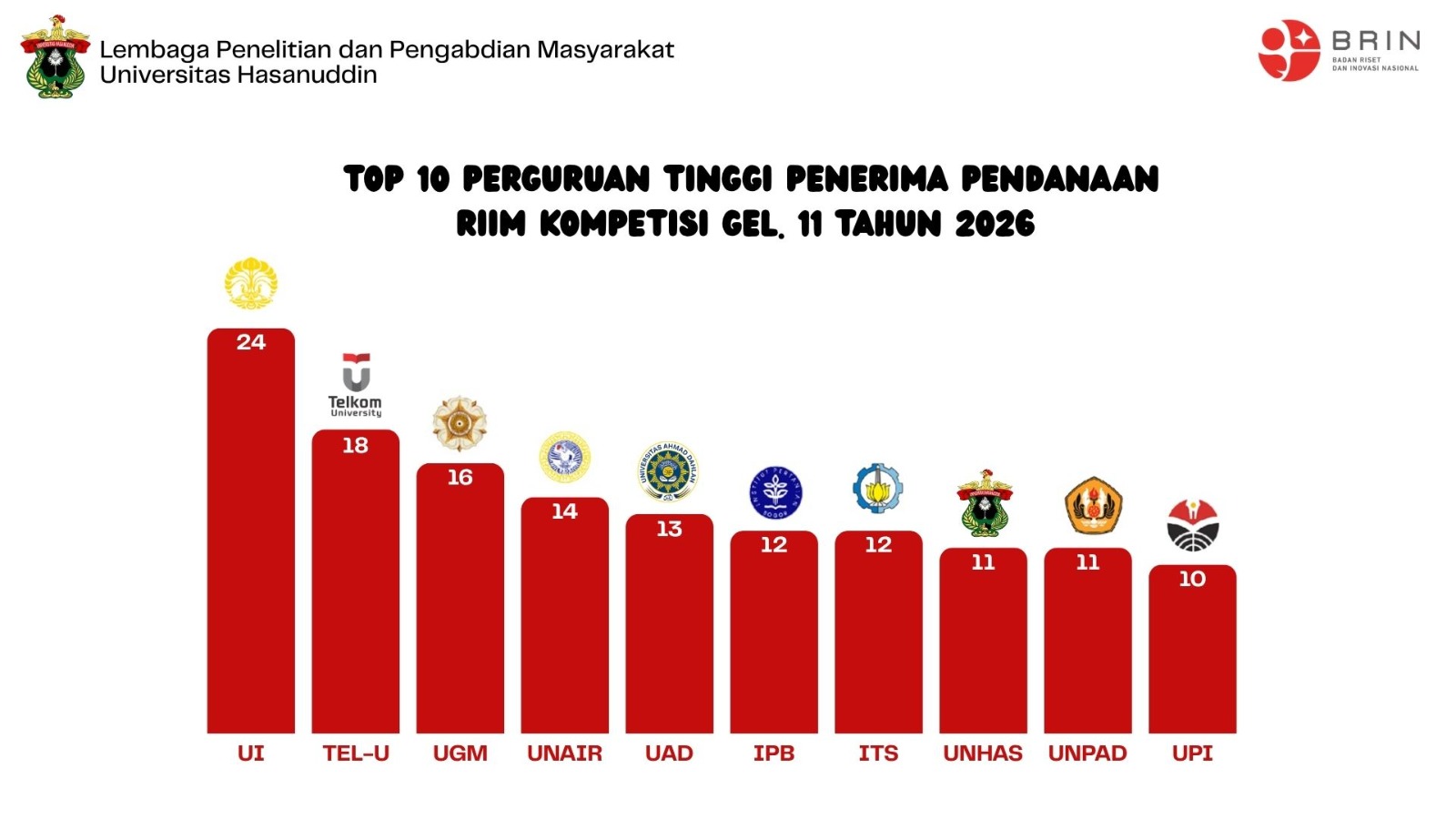
This year’s success also places Hasanuddin University among the 10 universities receiving funding in RIIM Competition Wave 11 of 2026. Behind the eleven proposals that passed this year lies a long process of strengthening the research culture at Unhas.
LPPM data show that Unhas’s RIIM funding record continues to grow. In batch 10, seven proposals received funding, rising to 11 proposals in Batch 11. This shows that Unhas’s success is not incidental, but rather the result of improved research quality, researcher development, and increasingly mature scientific collaboration within the university.
For LPPM Unhas, this achievement is a moment to expand research collaboration networks at both the national and international levels. The funding support is expected to accelerate the emergence of innovations that produce not only academic outputs but also technologies, policy models, products, and scientific recommendations that can be adopted across development sectors.
Prof. Nasrum stressed that securing RIIM funding is not the end goal. It is part of a long process of building an excellent and impactful research culture. Going forward, Unhas will continue to strengthen a research ecosystem that adapts to developments in science and responds to the needs of society, so that every piece of research produced truly becomes the university’s real contribution to supporting Indonesia’s development.
Innovation Directorate: From Ideas to Impact
The Director of Innovation and Intellectual Property at Unhas, Asmi Citra Malina, S.Pi., M.Agr., Ph.D., said the success reflects the research competitiveness of Unhas academics in national funding competitions.
“RIIM funding gives researchers the opportunity to take scientific ideas further, turning them into new knowledge, technologies, and useful innovations. We hope that every supported study will produce quality outputs, strengthen collaboration, and ultimately make a real contribution to solving various problems in society,” said Asmi Citra.
Unhas continues to build a competitive research ecosystem through mentoring in proposal writing, strengthening collaboration networks, and accelerating the downstreaming of research results. These efforts are expected to increase the number of leading research projects able to compete for national and international funding while generating broader impact on development.
Eleven Research Projects Receiving RIIM Grants
1. Prof. dr. Andi Dwi Bahagia Febriani, Ph.D., Sp.A(K) — Microplastic Exposure in Early Life: A Correlation Study Between Preterm Birth and the Abundance of Microplastic Particles in Newborn Feces
2. Dr. Andi Kusumawati, S.E., M.Si., Ak., C.A. — Beyond Carbon Tax: Development and Implementation of an Eco-Incentive Model through Industry–Government Synergy for Building Regional Carbon Assets
3. drg. Erni Marlina, Ph.D., Sp.P.M., Subsp.Inf.Im.(K) — Innovative Formulation of a Saliva-Soluble Mucoadhesive Film Based on Gold Nanoparticles as a Carrier for the Active Compounds of Pandanus conoideus for Oral Cavity Cancer Therapy
4. Prof. Dr. Gita Susanti, M.Si. — A Model for Strengthening Local Institutional Entrepreneurship and Community-Based Organization (CBO) Networks in the Governance of Sustainable Food Diversification for Stunting Prevention in South Sulawesi
5. Dr. Herlina Rante, S.Si., M.Si., Apt. — Discovery of Antibacterial Compounds and Development of a Controlled-Release Thermosensitive Emulgel Formula Based on Secondary Metabolites of Syzygium aromaticum Flowers for Treating Infections Caused by Streptococcus mutans, a Cause of Dental Caries
6. Prof. Dr. Ir. Indrabayu, S.T., M.T., M.Bus.Sys., IPM., ASEAN.Eng. — Smart Conveyor Prototype for Horticultural Products in Downstream Processing
7. Dr. Jamila Mustabi, S.Pt., M.Si., IPM. — Multi-Omics-Based Rumen Bio-Starter Innovation for Precision Nutrient Efficiency in Dairy Goats
8. Dr. Kidung Tirtayasa Putra Pangestu, S.Hut., M.Si. — Improving the Quality of Community Forest Timber through Intercalation of Natural Dye Nanoparticles
9. Prof. Dr. Mursalim Nohong, S.E., M.Si., CRA., CRP., CWM. — Integrating Fiscal Technology and Human Capital into Regional Tax Earmarking Strategies to Mitigate Environmental Externalities and Accelerate the SDGs
10. Prof. Dr. Nunuk Hariani Soekamto, M.S. — Tracing Secondary Metabolites from Macroalgae as Anticancer Candidates
11. Yulia Yusrini Djabir, S.Si., MBM.Sc., M.Si., Ph.D., Apt. — Micro-Modular Array (μMA) as a Microsampling Platform for Point-of-Care Transdermal Therapeutic Drug Monitoring (POC-tTDM) in Patients on Multiple Antiepileptic Drug Therapy.
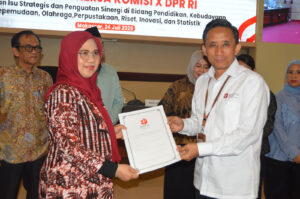
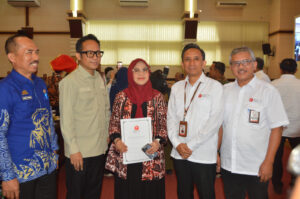
The list of RIIM funding recipients was officially handed over at an event at the South Sulawesi Governor’s Office on Friday (24 July 2026). The decree was presented directly by Dr. Eng. Agus Haryono, BRIN Deputy for Research and Innovation Facilitation, and received by the Director of Innovation and Intellectual Property at Unhas, Asmi Citra Malina, S.Pi., M.Agr., Ph.D., who attended on behalf of the Rector of Unhas.(*/mir)
Editor: Ishaq Rahman
This article is an English translation of the original Indonesian report.