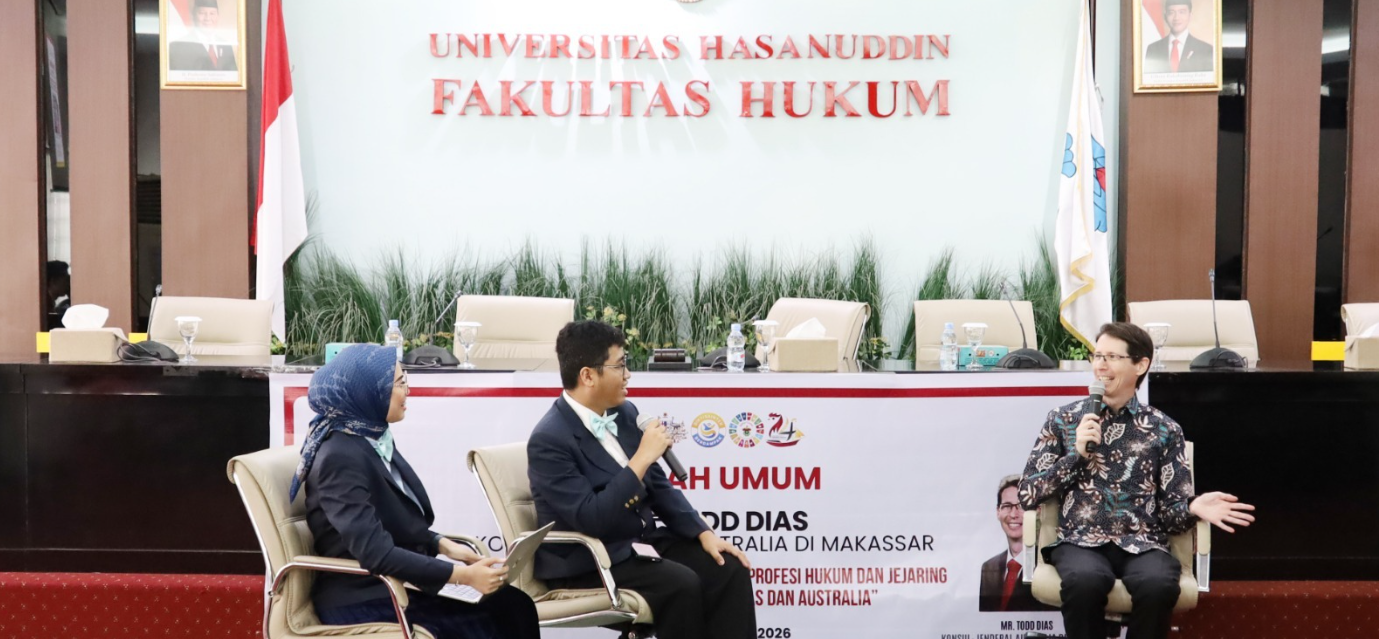
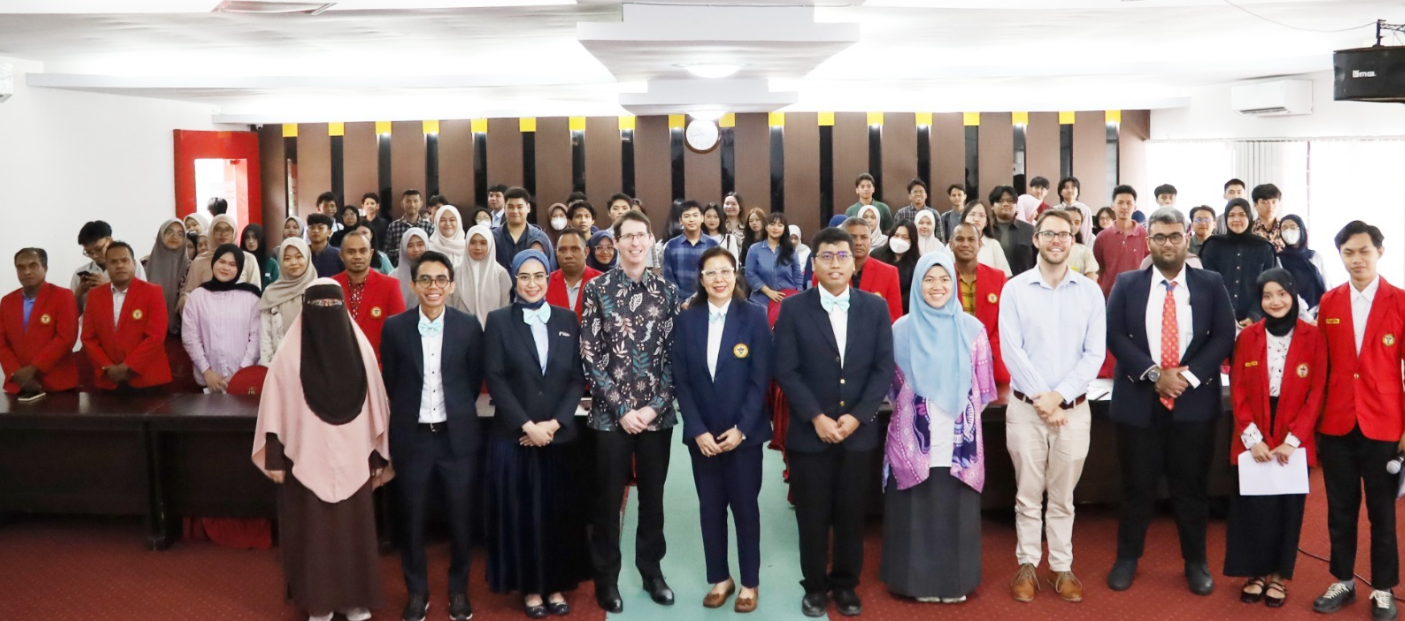
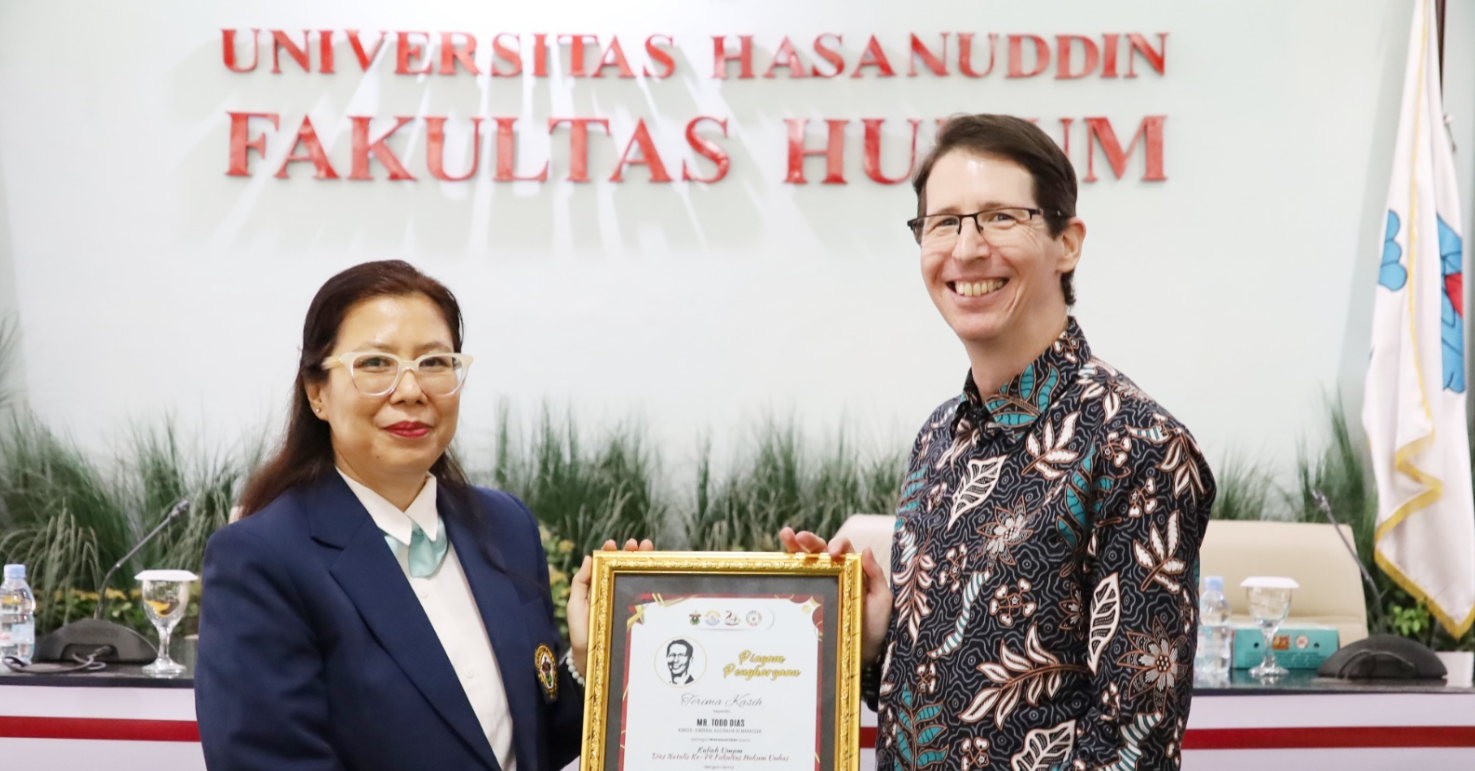
On Tuesday, 19 May 2026, a public lecture was held at the Doctoral Promotion Room, 3rd Floor, Faculty of Law (FH), Hasanuddin University (UNHAS). The event commenced with opening remarks delivered by Prof. Dr. Birkah Latif, S.H., M.H., LL.M., Head of the Department of International Law, Faculty of Law UNHAS, followed by a public lecture presented by the Australian Consul-General in Makassar, Mr. Todd Dias. The discussion session was moderated by Alif Imam Dzaki, S.H., M.I.L. and Nuriyah Fara Muthia, S.H., M.H.
The longstanding relationship between Indonesia and Australia dates back to Indonesia’s early years of independence. This is reflected in Australia’s first international role at the United Nations following World War II, when it supported Indonesia’s diplomatic efforts in securing independence amid the threat of renewed Dutch military aggression.
Today, Indonesia–Australia cooperation continues to flourish, particularly in the fields of education and research. Higher education institutions, including UNHAS as one of the largest universities in Eastern Indonesia, play an important role in strengthening these ties. One tangible example of this collaboration is that several lecturers from the Department of International Law, FH UNHAS, are graduates of Australian universities through the Australian Awards Scholarship (AAS) program.
During his presentation, Mr. Todd Dias addressed a common perception that the Australian Government places greater emphasis on Java Island while giving less attention to other regions, particularly Eastern Indonesia. As a result, many AAS applicants often write scholarship essays discussing their potential contributions to “Eastern Indonesia for Australia.” According to Dias, this perception stems from the assumption that most AAS recipients come from Java.
He further highlighted that research collaboration remains a key priority in Indonesia–Australia relations, especially in Eastern Indonesia. However, most collaborative research projects currently focus on the natural and applied sciences, while social sciences and humanities, including public policy and law, receive less attention. One significant challenge is conducting research on public policy implementation that can serve as a framework for governments across Eastern Indonesia.
Responding to a question on how to strengthen AAS alumni networks to support Indonesia–Australia cooperation, Dias emphasized the importance of encouraging engagement among AAS alumni in Makassar and other regions. In addition to alumni gatherings organized by the Australian Consulate-General, organizations such as IKAMA (Australian Alumni Association) can play a crucial role. One notable member is Prof. Jamaluddin Jompa, Rector of UNHAS, who can help drive collaborative initiatives aimed at advancing development in Eastern Indonesia.
Australia also offers grant programs that enable alumni to implement collaborative projects with direct societal impact. These projects may involve partnerships with Australian institutions such as the University of Sydney and other universities. Such initiatives align with the Australian Government’s objective of generating positive contributions to Indonesia’s development.
When asked about opportunities for students to pursue further studies and employment in Australia, Dias explained that international students are permitted to work while studying. Under current regulations, students may work up to 48 hours per fortnight. This allows students to gain valuable professional experience through employment and internships while completing their studies.
Although Dias noted that he is not a legal expert, he highlighted that several Indonesian citizens have successfully built careers in the Australian legal sector, including a South Sulawesi native who is now practicing as a lawyer in Melbourne. Furthermore, several major Indonesian law firms maintain partnerships with Australian law firms, particularly in the commercial law sector. This cooperation aligns with Australia’s objective of encouraging Indonesian investment in Australia and vice versa. Consequently, significant opportunities exist for Indonesian graduates seeking careers in Australia, especially in commercial law firms that assist Australian investors operating in Indonesia.
Several pathways are available for those interested in working in Australia. The first is the Working Holiday Visa (WHV) program. However, applicants seeking employment in the legal profession may face challenges, as legal practitioners must obtain approval from the relevant legal authorities within Australia’s states and territories. The second pathway is through internship visas, which constitute one of the Australian Government’s primary programs and offer larger intake quotas. The third pathway is exchange programs, which are commonly established between companies or between law firms. These opportunities demonstrate the broad and growing scope of Indonesia–Australia cooperation.
Dias also outlined several strategies to further strengthen connections between Indonesia and Australia. One approach is through social media outreach, particularly via the Instagram account @konjenmakassar, which regularly promotes scholarship opportunities, research collaborations, and exchange programs. Upcoming initiatives, such as the Western Sydney University (WSU) Surabaya Campus program, will also be promoted through these channels.
Additionally, Dias encouraged stakeholders to share ideas for Indonesia–Australia cooperation initiatives. While he may not be able to directly facilitate partnerships between UNHAS and Australian universities, he emphasized his willingness to support communication efforts by providing references, recommendations, and guidance to relevant institutions.
The public lecture generated significant enthusiasm among students, who actively participated in the discussion and expressed their hope that similar academic activities would continue to be organized by the Faculty of Law UNHAS in the future.