
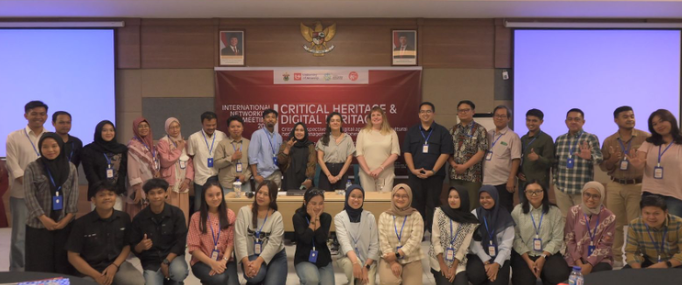
Makassar, Indonesia – For five inspiring days, from 13–17 July 2026, Hasanuddin University (UNHAS) and the University of Antwerp (UAntwerp), Belgium, brought together academics, researchers, government representatives, and heritage practitioners through the UNHAS–UAntwerp Masterclass 2026: Critical Perspectives and Digital Approaches to Cultural Heritage Management in Indonesia. More than an academic Program, the masterclass became a collaborative platform where critical thinking, digital innovation, and cultural heritage converged to explore new directions for sustainable heritage management in Indonesia.
Supported by Hasanuddin University (UNHAS), Yayasan Arsari Djojohadikusumo, and the Sulawesi Archaeological Research Collaboration Center (UNHAS–BRIN), the Program demonstrated the growing importance of international partnerships in addressing contemporary heritage challenges. Participants represented a diverse range of institutions, including the Department of Architecture at Institut Teknologi Sepuluh Nopember (ITS), Universitas Atma Jaya Yogyakarta, Universitas Brawijaya, doctoral students from Universitas Gadjah Mada, the National Research and Innovation Agency (BRIN), the Department of Archaeology of UNHAS, Yayasan Bumi Toala, master’s students from Universitas Udayana, the Takalar Office of Culture, and the Cultural Preservation Offices of South Sulawesi and Central Sulawesi.
Opening the Program, the Dean of the Faculty of Cultural Sciences, Prof. Muh. Akhmar, highlighted the significance of strengthening Indonesia’s engagement in global heritage discourse.
“International Programs like this allow us to understand heritage not only from local perspectives but also within global contexts. Through collaboration with international experts, participants become familiar with globally recognised approaches, including UNESCO-based heritage management standards. This is essential for preparing Indonesian scholars and practitioners to contribute to international heritage management while preserving our own cultural identity.”
The three-day academic Program was carefully designed around an integrated learning pathway that connected critical heritage perspectives, digital heritage management, and field-based application. Participants were introduced to the theoretical foundations of critical heritage studies before translating these concepts into practical solutions through collaborative workshops and field observations.
One of the Program’s highlights was the lecture series led by Prof. Suzie Thomas from the University of Antwerp. Focusing on critical heritage management, she challenged participants to rethink the meaning of heritage beyond monuments and archaeological sites.
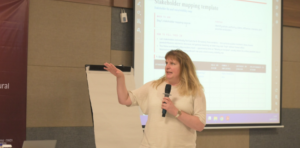
“Many heritage sites today face increasingly complex challenges. Our responsibility is to make these places meaningful not only for researchers or heritage professionals but also for society as a whole. Heritage should become part of people’s everyday lives because it represents their identity.”
Prof. Suzie Thomas also emphasised that governments play an indispensable role in ensuring the long-term sustainability of cultural heritage.
“Public authorities have a major responsibility in ensuring that heritage remains sustainable. Conservation is not only about protecting physical sites but also about encouraging communities to appreciate their cultural identity through heritage. Without public engagement and government commitment, conservation efforts cannot succeed in the long term.”
Building upon these discussions, Prof. Piraye Hacıgüzeller introduced participants to the growing importance of digital heritage and data governance. Her sessions explored how documentation, metadata, and digital infrastructures can strengthen heritage research and improve conservation planning.
“Developing comprehensive systems for storing heritage data and metadata allows us to better understand the condition of heritage resources and identify what needs improvement. Although it may appear highly technical, well-organised data ultimately supports better research and better-informed decision-making.”
She further explained that reliable digital information extends beyond research purposes:
“Structured data enables researchers, heritage managers, and policymakers to make evidence-based decisions. At the same time, it encourages each of us to think more critically because good information is the foundation of good decisions.”
The academic discussions were complemented by workshops where participants developed stakeholder maps, identified heritage challenges, designed digital heritage matrices, and evaluated ethical approaches to documentation and accessibility before applying their ideas during field observations at Fort Rotterdam and Makassar Old Town. Working in interdisciplinary groups, participants connected theoretical concepts with real heritage issues, producing concept notes that integrated critical analysis, digital methodologies, and sustainable management strategies.
Beyond the classroom, the masterclass fostered meaningful professional networks among participants from universities, research institutions, government agencies, and cultural organisations across Indonesia. The exchange of ideas reflected a shared commitment to promoting more inclusive, community-oriented, and evidence-based heritage management.
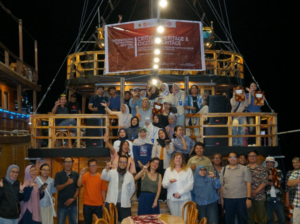
The Program concluded with a memorable Farewell Dinner aboard a traditional Phinisi ship, one of Makassar’s iconic maritime tourism experiences. After several intensive days of lectures, workshops, assignments, and field activities, participants gathered in a relaxed atmosphere while sailing along Makassar’s coastline. The evening became more than a closing ceremony; it celebrated new friendships, future collaborations, and a shared passion for Indonesia’s cultural heritage. For many participants, experiencing the Phinisi offered a powerful reminder that heritage is not merely something to study and conserve—it is something to experience, celebrate, and pass on to future generations.
As the UNHAS–UAntwerp Masterclass 2026 came to a close, it left participants with far more than new academic knowledge. It strengthened international partnerships, inspired interdisciplinary collaboration, and reaffirmed that the future of cultural heritage management lies in combining critical perspectives, digital innovation, and active community engagement. Through initiatives such as this, UNHAS continues to strengthen its role as an internationally connected institution committed to advancing cultural heritage research and contributing to sustainable heritage management in Indonesia and beyond.