
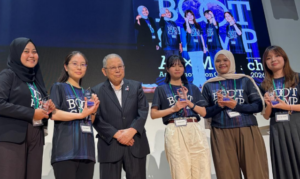
Three Hasanuddin University (UNHAS) students earned first place at the AI × MedTech Asia Innovation Challenge 2026, held at Fujita Health University (FHU) in Aichi, Japan, from July 27 to August 5, 2026.
The UNHAS delegation consisted of Nursyafira Zahra from the Faculty of Nursing, Andi Regina Putri from the Faculty of Dentistry, and Amar Rafii Ansariadi from the Faculty of Engineering.
The international program brought together undergraduate, master’s, and doctoral students from universities across Asia to develop healthcare solutions using artificial intelligence, medical technology, and design thinking.
During the 10-day boot camp, the UNHAS students collaborated with postgraduate students from different countries through expert lectures, design-thinking workshops, hospital observations, interviews with healthcare professionals and patients at Fujita Health University Hospital, mentoring sessions, and prototype development.
Participants also learned from international experts including Prof. Michael Snyder of Stanford University, Dr. Michael Florea of Harvard University and Olden Labs, Prof. Ronjon Nag of Stanford University, and Prof. Qian Zhang of the Hong Kong University of Science and Technology.
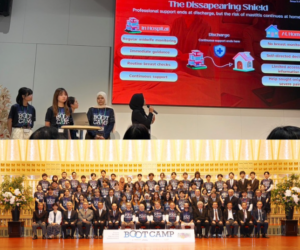
At the final pitching session, the UNHAS team presented FemLink, a healthcare innovation prototype designed to support the early detection of mastitis among breastfeeding mothers. The project received the Bootcamp Winner’s Prize (1st Place), the highest award presented at the AI × MedTech Asia Innovation Challenge 2026.
The achievement demonstrated the students’ ability to combine knowledge from nursing, dentistry, and engineering to address a practical healthcare challenge through technology and interdisciplinary collaboration.
The significance of the achievement extends beyond the competition result. By designing around an identifiable maternal-health need and testing ideas in a clinical environment, the students were exposed to an innovation process in which technology is shaped by the people it is intended to serve. Their experience demonstrates how interdisciplinary education and international collaboration can help young innovators develop healthcare solutions that are more responsive, accessible, and relevant to real-world needs.