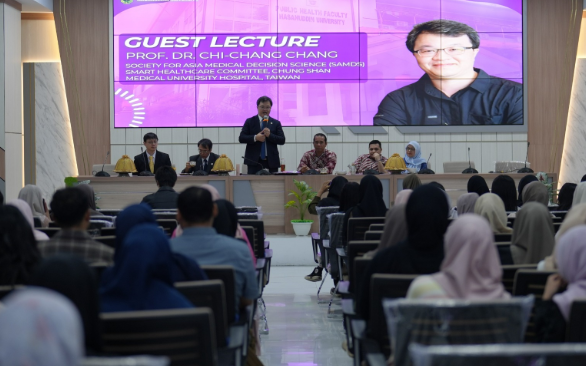
Visiting researcher Prof. Heidi Halbwirth (TU Wien, Austria) delivered a public lecture on “Anthocyanin as a Natural Pigment” at Hasanuddin University (UNHAS) on 27 August 2026, exploring the potential of plant-based pigments in food applications.Held at Lecture Theatre 6 of the Faculty of Agricultural Technology (FATETA), the lecture was organized by the Agricultural Engineering Study Program and introduced students and academics to the chemistry behind anthocyanins, the compounds responsible for many of the red, purple, and blue colors found naturally in plants.
Drawing on phytochemical and biochemical perspectives, Prof. Halbwirth explained how anthocyanin structure influences color formation, absorption characteristics, and potential applications as natural pigments. Variations among anthocyanidins—including cyanidin, pelargonidin, delphinidin, petunidin, and malvidin—can produce different color characteristics, while interactions with copigments and metal ions can further influence pigment formation.
From Natural Sources to Food Applications. The lecture connected fundamental plant chemistry with practical applications in the food industry. Anthocyanins are used as the food colorant E163 in products such as beverages, confectionery, desserts, ice cream, fruit preparations, and jams. Prof. Halbwirth introduced a range of natural anthocyanin sources, including grape skins, blackcurrants, purple corn, red cabbage, black carrots, purple sweet potatoes, elderberries, hibiscus, and butterfly pea flowers.
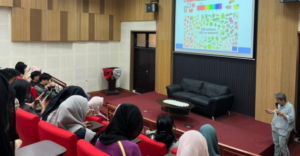
While these natural sources offer considerable potential as alternatives to synthetic colorants, their application also presents challenges, particularly in maintaining pigment stability and managing changes caused by different pH conditions. One example highlighted during the lecture was butterfly pea (Clitoria ternatea), whose highly acylated anthocyanins offer relatively strong color stability. Its distinctive pigment chemistry illustrates how the molecular characteristics of plant-based compounds can determine their suitability for different food applications. By connecting molecular science with real-world food products, the lecture gave students a broader understanding of how research in phytochemistry and biochemistry can contribute to innovation in food processing and the development of natural ingredients.
Strengthening UNHAS–TU Wien Research Collaboration. The public lecture forms part of Prof. Halbwirth’s visiting research program at UNHAS from August 19 to September 2, 2026, conducted within the continuing academic collaboration between UNHAS and TU Wien and supported by ASEA-UNINET.
During her stay, Prof. Halbwirth has engaged with the UNHAS academic and research community, creating opportunities for knowledge exchange and closer interaction between researchers from the two institutions. The visit also builds on previous academic engagement between UNHAS and TU Wien in agricultural engineering and natural product research. For UNHAS, the visiting research program provides a platform to strengthen international research networks, expose students and academics to global scientific perspectives, and develop opportunities for further collaboration between researchers in Indonesia and Austria.