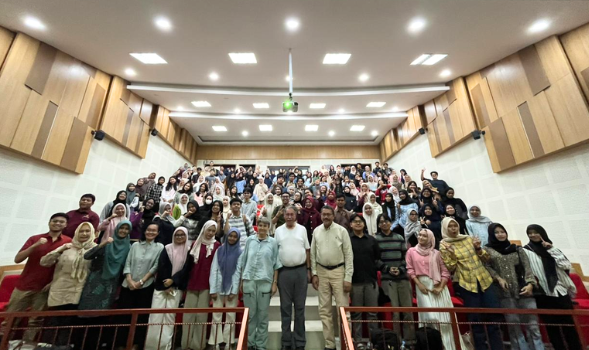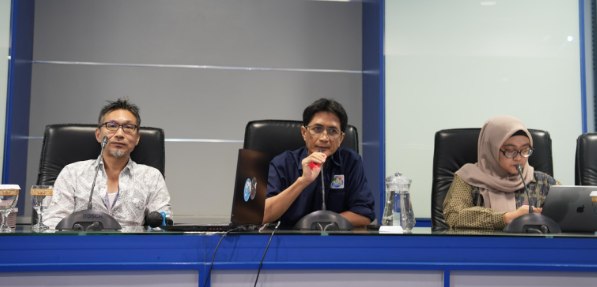
As artificial intelligence and data-driven technologies reshape healthcare, Hasanuddin University (UNHAS) brought together academics from Taiwan to explore how emerging tools such as digital twins and world models could support medical decision-making and hospital management. The Hospital Administration Study Program at the Faculty of Public Health hosted the international guest lecture, “Frontiers of Medical Decision Science: Research Trends in Digital Twins and World Models,” on 26 August 2026, at the Faculty of Public Health in Makassar.
The session featured Prof. Dr. Chi-Chang Chang, Professor in the Department of Medical Informatics at Chung Shan Medical University, Taiwan and President of the Society for Asia Medical Decision Science (SAMDS). He was accompanied by Prof. Hsi-Chieh Lee of National Quemoy University, Associate Prof. Ting-Ying Chien of Yuan Ze University, and Heng-Jui Liu. Chung Shan Medical University lists Prof. Chang’s research interests in areas including clinical decision analysis and shared medical decision-making, while SAMDS confirms his presidency for 2026–2030.
In his lecture, Prof. Chang discussed the evolving field of medical decision science, with particular attention to digital twins and world models. These approaches offer possibilities for modeling and analyzing different scenarios before decisions are implemented in real healthcare settings. Their relevance is growing alongside the expanding use of healthcare data, artificial intelligence and digital systems across clinical services and hospital management. Rather than viewing these technologies solely as technical tools, the lecture encouraged participants to consider how they could contribute to more systematic and evidence-informed decision-making.

“The development of digital twins and world models opens new opportunities in medical decision science,” Prof. Chang said. “These technologies allow us to understand different possible health scenarios through simulation and data-based analysis, enabling decisions to be made in a more measured and precise way.” Prof. Chang also emphasized that technological sophistication alone is not enough to guarantee meaningful improvements in healthcare. Data quality, model validity, information security, ethical considerations, organizational preparedness, and human-resource capacity all play critical roles in determining whether digital technologies can be applied responsibly and effectively.
For students of Hospital Administration, the discussion offered a broader perspective on healthcare transformation. It demonstrated that digital innovation is not only about adopting new technologies, but also about understanding how those technologies can support clinical services, hospital governance, resource management, and organizational decision-making. Expanding Academic Links with Taiwan, The guest lecture also created opportunities for UNHAS academics and students to closely engage with scholars from several Taiwanese institutions.

In his opening remarks, Ansariadi, SKM., M.Sc.PH., Ph.D.,the dean of Faculty of Public Health highlighted the potential for the visit to lead to wider collaboration with universities in Taiwan and to support the study program in responding to emerging developments in the field. The participation of scholars from Chung Shan Medical University, National Quemoy University, and Yuan Ze University added an international dimension to the discussion while opening possibilities for further academic networking, knowledge exchange, and institutional collaboration. National Quemoy University lists Prof. Hsi-Chieh Lee’s expertise in areas including artificial intelligence and biomedical informatics, reflecting the interdisciplinary character of the forum.
Through the guest lecture, UNHAS provided students and academics with direct exposure to emerging conversations at the intersection of healthcare, artificial intelligence, data science, and management. The initiative also supports the university’s broader efforts to strengthen international academic engagement while preparing future health professionals and hospital administrators to respond to increasingly data-driven healthcare systems.