
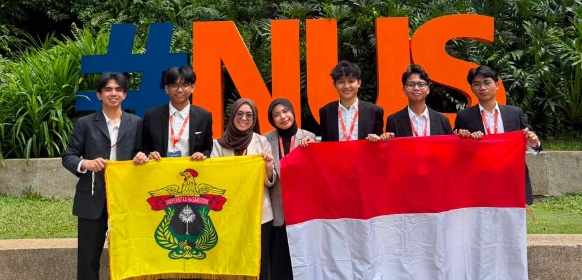
Three students from the Faculty of Mathematics and Natural Sciences (FMIPA), Hasanuddin University (UNHAS), successfully represented the university at the Asian Undergraduate Symposium (AUS) 2026, held from 5–18 July 2026 at NUS College, National University of Singapore (NUS). The delegates were Muhammad Rifhky Arishall from the Statistics Program, alongside Afdhol As Syamardi and Rayhanjahzari Muhammad Nuzilalfikri from the Information Systems Program. They were joined by four other UNHAS students: Hadela Pratiwi S. from the Faculty of Public Health, Andi Husnul Khatimah Sulolipu from the Faculty of Agricultural Technology, Zulfiqri Saputra Samsul from the Faculty of Cultural Sciences, and Nabiyl Ahmad Fawzy M. from the Faculty of Engineering. Together, the seven delegates represented UNHAS among more than 300 undergraduate students from over 50 universities across Asia, reflecting the university’s commitment to fostering globally engaged students capable of collaborating across cultures and disciplines.
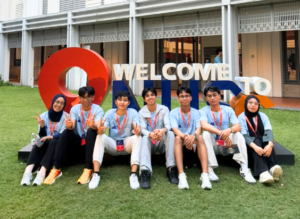
Organised by NUS College, AUS 2026 carried the theme “Communities in Action”, explored through three sub-themes: Sustainability and Innovation, Heritage and Culture, and Inclusivity and Resilience. The two-week Program adopted the I-4 Model—Inspire, Ideate, Intercultural, and Implement—which guided participants from academic discussions to the development of practical, community-oriented solutions. Throughout the symposium, students participated in expert panel sessions, learning journeys across Singapore, design thinking workshops, and intensive collaboration with peers from across the region. One of the Program’s highlights was the panel on Inclusivity and Resilience, featuring Dr Rayner Kay Jin Tan of NUS’s Saw Swee Hock School of Public Health and Indonesian disability inclusion advocate Ms Berti Soli Dima Malingara, whose perspectives on community-based advocacy inspired participants.
The symposium concluded with the Project World Cafe, a hackathon-style competition in which multidisciplinary teams presented project proposals addressing real-world community challenges. All three FMIPA delegates advanced to the Top 30 shortlisted projects. Muhammad Rifhky Arishall served as Workshop Development and Logistics Coordinator for Greenshade, a project proposing the construction of EcoHuts on the campus of Cagayan State University in the Philippines. Built from locally sourced bamboo and recycled materials and inspired by the traditional Filipino bahay kubo, the EcoHuts are designed to provide sustainable shade while reducing heat stress in tropical educational environments. The project also includes bi-monthly educational workshops and has advanced to the final stage, where it will compete for a seed grant of up to SGD 5,000 to support its implementation.
Meanwhile, Afdhol As Syamardi contributed to the WeCreate project, while Rayhanjahzari Muhammad Nuzilalfikri joined the Flashlingo team. Both projects also secured places among the Top 30 shortlisted entries, highlighting the outstanding performance of FMIPA students throughout the symposium. Their achievements demonstrate not only academic excellence but also the ability to collaborate effectively in multicultural and interdisciplinary environments to develop innovative solutions for regional challenges.
The participation of the UNHAS delegation aligns closely with the United Nations Sustainable Development Goals (SDGs), particularly SDG 4: Quality Education and SDG 17: Partnerships for the Goals, by promoting international academic exchange and strengthening cross-border collaboration. In addition, projects such as Greenshade contribute directly to SDG 11: Sustainable Cities and Communities and SDG 13: Climate Action by addressing environmental sustainability through practical, community-based innovation.
The achievements of the seven UNHAS delegates underscore the university’s continued commitment to internationalisation and student development. By actively participating in prestigious regional Programs such as the Asian Undergraduate Symposium, Hasanuddin University continues to empower its students with global perspectives, intercultural competence, and leadership skills, preparing them to contribute meaningfully to society and to address the complex challenges facing the region and the world.