
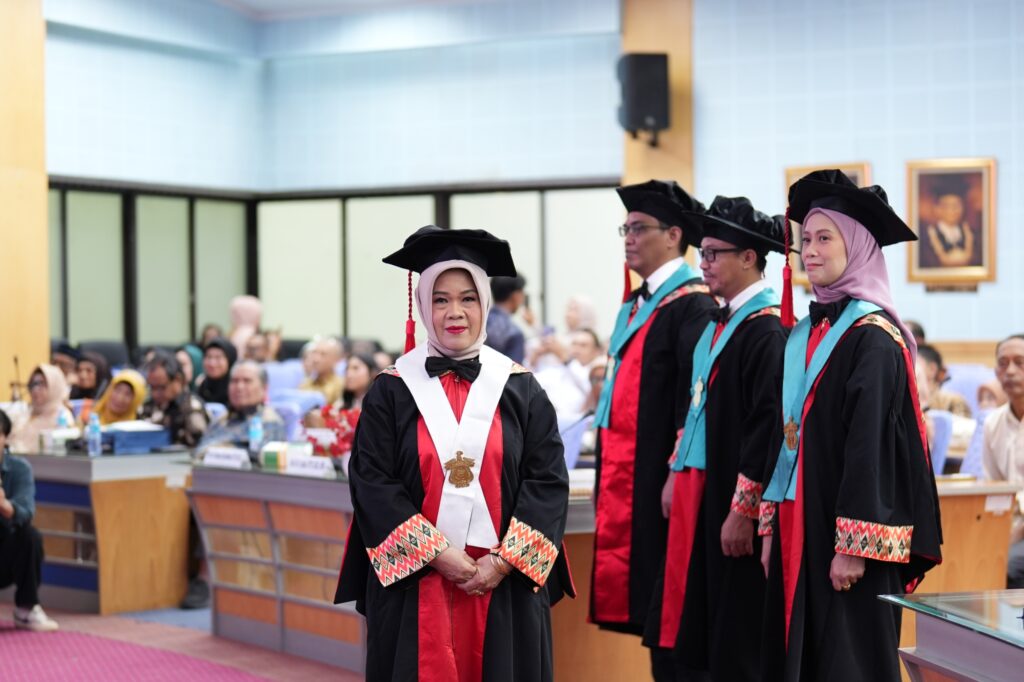
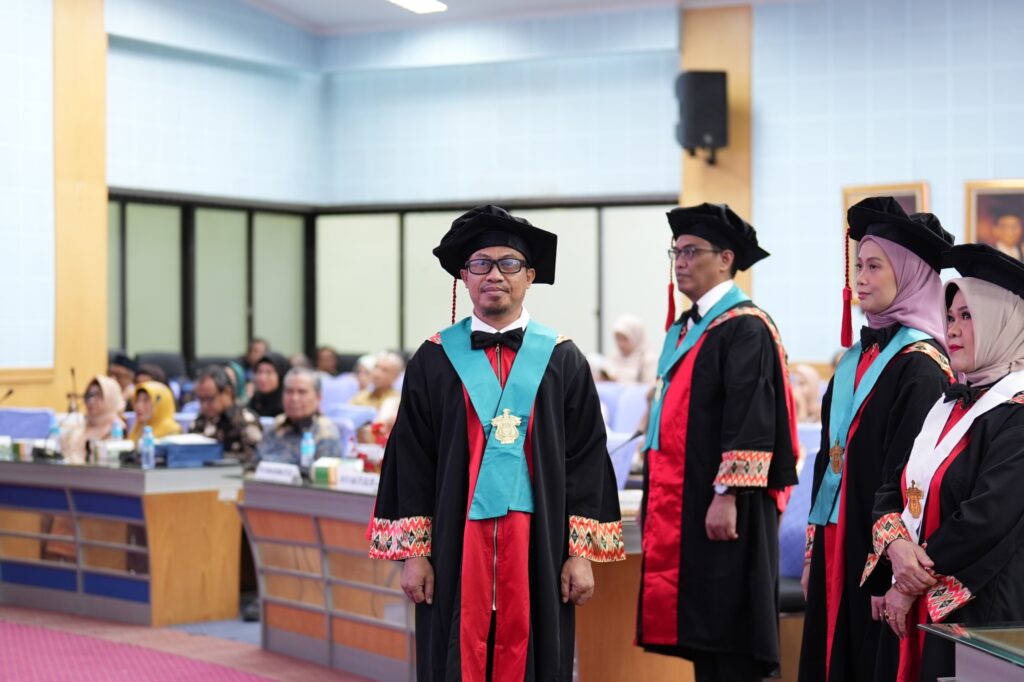
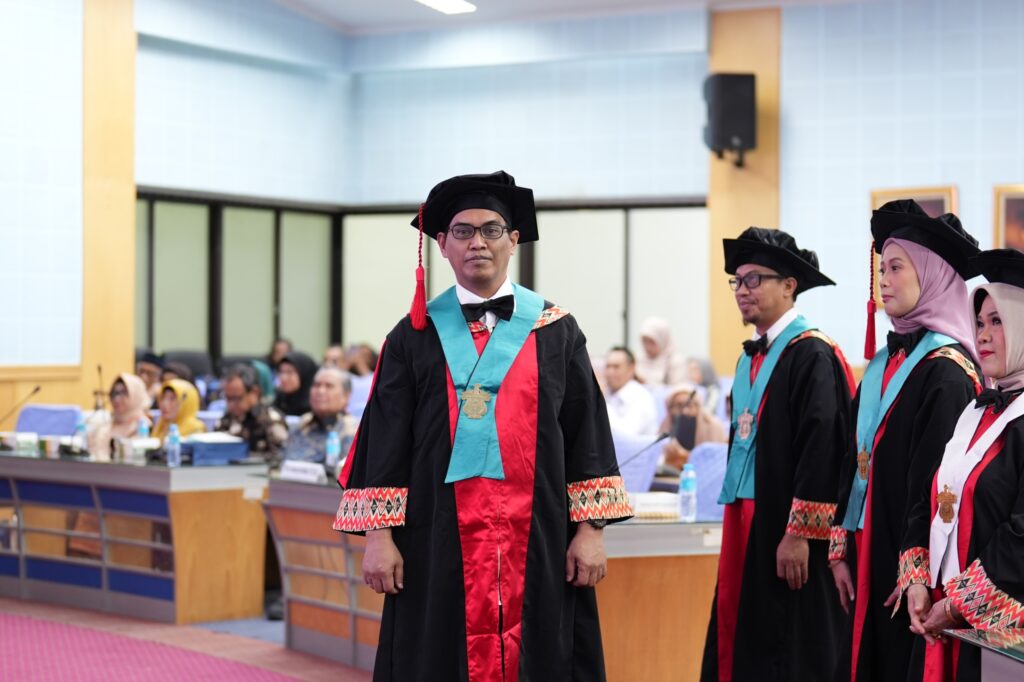
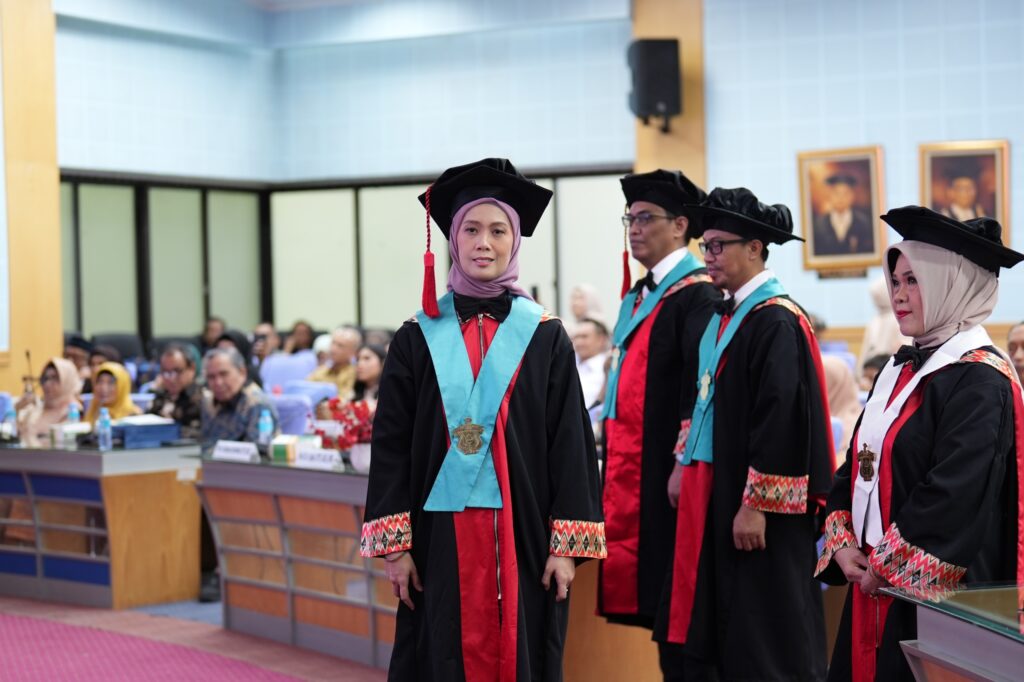
MAKASSAR – Hasanuddin University (Unhas) showcased a range of innovative ideas and strategic scholarly perspectives at a closed plenary session of the Academic Senate for the Professorship Acceptance Ceremony, held in the Unhas Academic Senate Hall, 2nd floor of the Rectorate Building, Tamalanrea Campus, Makassar, on Monday (25 May).
Before being officially inaugurated, four professors from the Faculty of Cultural Sciences and the Faculty of Agricultural Technology delivered inaugural addresses on issues ranging from linguistic politeness in Bugis, post-harvest technology, and innovation in agricultural tools and machinery to environmentally friendly edible packaging as a solution for the future.
Prof. Dr. Kamsinah, M.Hum.,
The inaugural addresses began with Prof. Kamsinah explaining the research conducted on “Revisiting the Universality of Western Politeness Theory: The Value-Saving Model of Politeness from a Bugis Sociopragmatic Perspective.”
Sociopragmatics is a branch of linguistics that examines language use in relation to social and cultural context, power relations, social norms, and the purposes of interaction. The field brings together the pragmatic focus on the meaning of utterances and the sociolinguistic focus on norms, power relations, hierarchy, identity, and cultural values.
One of the central themes in sociopragmatic studies is linguistic politeness. Prof. Kamsinah noted that politeness is not merely a matter of gentle wording, but concerns how people manage social relationships through language.
“Based on a sociopragmatic reading of Bugis cultural data, I propose a theoretical formulation called the Value-Saving Model of Politeness. This model starts from the idea that in society, the main purpose of politeness is not only to save individual face, but also to safeguard the values that enable society to live with dignity,” explained Prof. Kamsinah.
Prof. Kamsinah further added that one of the greatest treasures of Bugis civilization is the Lontara manuscript tradition. Among the important texts are the Lontara Latoa, which was discussed extensively by Mattulada, and a tradition of texts containing precepts on nobility and on the statecraft of Wajo.
According to Prof. Kamsinah, manuscripts such as these should be read not only as literature of the past, but as a historical pragmatic corpus. In other words, they preserve traces of how Bugis society understood a wide range of matters. Through a sociopragmatic approach, these texts become an exceptionally rich theoretical laboratory.
“Speech relations reveal more complex patterns: maintaining authority, upholding legitimacy, conveying criticism, and preserving the shared order. From my reading of these data, I found three main patterns, namely direct speech as dignified closeness, formal speech as institutional authority, and admonition as moral loyalty,” added Prof. Kamsinah.
In the theoretical formulation of the Value-Saving Model of Politeness, Prof. Kamsinah described five pillars that feature several traditional Bugis expressions, which can be read as the empirical foundation of the resulting theory.
The five pillars are Moral Dignity Preservation (Politeness safeguards moral honesty and self-respect), Social Legitimacy Maintenance (Language upholds social order, custom, and institutional legitimacy), Role Accountability (Each person is responsible for carrying out their role steadfastly), Relational Harmony (Social relationships are maintained by humanizing, honoring, and respecting one another), and Collective Honour Protection (Language protects the good name of the family, community, and group).
Prof. Ir. Andi Nur Faidah Rahman, STP., M.Si., Ph.D.,
On the same occasion, Prof. Faidah Rahman explained the research conducted on “Applying Rice Post-Harvest Technology as an Innovative Strategy to Improve Quality, Economic Value, and Food Security for Community Health and Welfare.”
Post-harvest technology is an important part of agricultural systems because it plays a role in maintaining the quality of harvested produce after it has been separated from the parent plant. Improper handling after harvest often leads to high yield losses, reduced quality, physical damage, and lower nutritional content in agricultural products. The application of post-harvest technology is therefore a strategic step in maintaining the quality and quantity of the harvest.
“Rice post-harvest technology is a series of treatments and handling processes applied to paddy or unhusked rice grain after harvest until it becomes rice that is ready for consumption or sale. Its main objectives are to reduce yield losses, maintain physical and nutritional quality, prevent damage during storage, and increase the economic value of rice,” explained Prof. Faidah Rahman.
Health or functional rice is rice that contains bioactive compounds with effects on human health. Applying post-harvest technology through germination can increase the content of Gamma-Aminobutyric Acid (GABA), one of the compounds whose levels rise quite significantly during the germination process.
Research on improving the post-harvest quality of rice through paddy germination explores the potential of germination methods to enhance rice quality after harvest, in terms of both nutritional value and physical quality. Germination is known to trigger significant biochemical changes in grains, including increased levels of bioactive compounds such as vitamins, essential amino acids, and antioxidants.
“The contribution of this research is the development of an innovative method that can improve the quality and economic value of rice while supporting the sustainability of the agricultural sector in Indonesia. These findings are expected to make a tangible contribution to addressing the challenges of harvest quality while increasing the competitiveness of local rice in international markets,” added Prof. Faidah Rahman.
Applying post-harvest technology is not only aimed at improving rice quality, but also brings major benefits to the economic well-being of farmers. With better quality, rice will command higher prices on the market, which in turn can improve farmers’ welfare.
Prof. Dr. Ir. Iqbal, STP., M.Si., IPM
Another inaugural address was delivered by Prof. Iqbal on “Innovation in Agricultural Tools and Machinery to Achieve Sustainable Food Security.” Food security is the main foundation of the nation’s sovereignty and welfare. With a growing population and the challenges of climate change, innovation in agricultural tools and machinery has become crucial to multiplying production efficiently, ensuring quality, and maintaining sustainability.
Agricultural tools and machinery (alsintan) have been one of the driving forces of the green revolution, enabling significant increases in crop yields. In the context of food security, the role of alsintan can be grouped into several aspects, including production efficiency, increased productivity, and risk management.
“Similarly, the results of our various studies show that the use of two-wheel and four-wheel tractors can have positive impacts in the form of greater time efficiency in tillage, lower costs, and improved growth and production of rice crops. Other studies on agricultural tools and machinery that we have also carried out include the modification and performance testing of compost applicators for rice, sugarcane, and horticultural crops,” explained Prof. Iqbal.
Agricultural tools and machinery are the main foundation for building a productive, efficient, and sustainable agricultural system. The concept encompasses the application of technology that suits local conditions, is economically efficient, and is environmentally friendly. In the digital era, now and in the years ahead, agricultural tools and machinery are evolving into agricultural systems based on data, automation, and artificial intelligence, opening up major opportunities for Indonesia to achieve national food sovereignty.
Prof. Dr. Adiansyah Syarifuddin, STP., M.Si.,
On this occasion, Prof. Adiansyah explained the research conducted on “Edible Packaging: An Innovative and Sustainable Strategy for Extending the Shelf Life of Food Products.”
Edible packaging is the third generation of food packaging and is classified into two types: edible films and edible coatings. It is made from edible biopolymers and food-grade additives. This thin layer protects food from physical, chemical, and biological damage, moisture migration, and microbial growth on the surface, and even improves the quality of food products thanks to its ability to act as a barrier against gases, oils, and other volatile compounds.
Prof. Adiansyah explained that edible packaging, as a biopolymer-based packaging innovation, is designed not only to be eaten but also to be readily biodegradable and to support the principles of sustainability. The concept goes beyond producing films or coatings to encompass the entire value chain, from the extraction of raw materials to its contribution to a circular economy system.
“This is a complex system because it involves the complexity of the constituent materials, processing technology, regulation, and consumer behavior. The development of edible packaging is becoming increasingly relevant because of the problem of plastic waste and the demand for environmentally friendly packaging,” explained Prof. Adiansyah.
The challenge facing edible packaging research is material stability, as it determines whether the packaging can maintain its protective function throughout production, distribution, and consumption. This is because edible packaging is made of natural biopolymers such as starch, proteins, and polysaccharides, which are inherently more sensitive to temperature, humidity, and light.
The plenary session of the Academic Senate for the Professorship Acceptance Ceremony ran smoothly and solemnly until 11:30 WITA (Central Indonesia Time). (*/mir)
Editor: Ishaq Rahman
This article is an English translation of the original Indonesian report.