
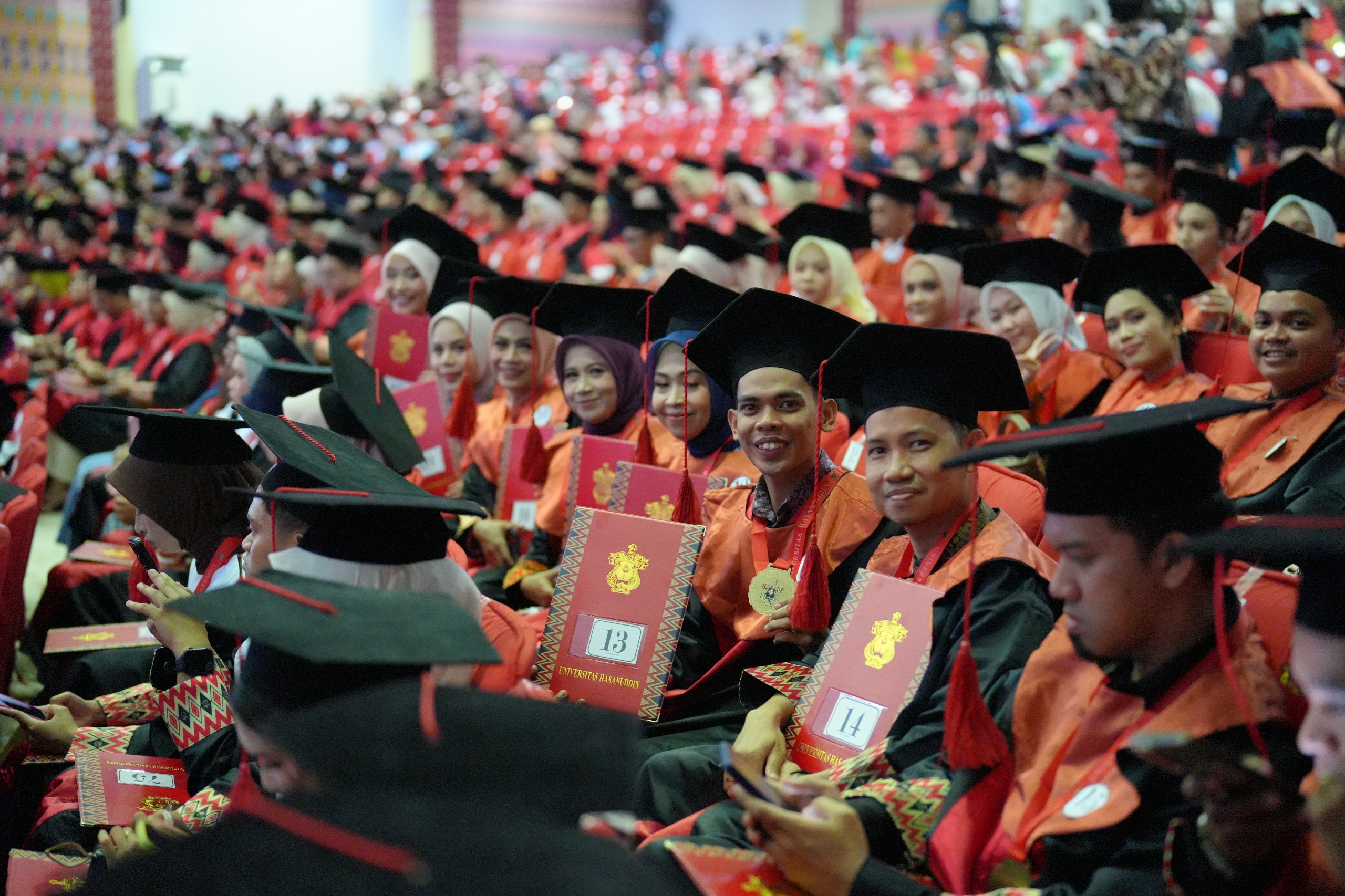
MAKASSAR – Hasanuddin University has once again produced educated human resources through its July 2026 Graduation. A total of 1,355 graduates from all levels of education were officially conferred as new alumni, marking the end of their learning process and the start of their contributions to advancing knowledge, innovation, and solving the many challenges facing society.
The graduation ceremony took place at Baruga A.P. Pettarani, Unhas Tamalanrea Campus, Makassar, and was held in two sessions. The first session on Friday (24 July) involved 668 graduates, while the second session on Saturday (25 July) involved 687 graduates. Of the total, 469 (34.61%) were men and 886 (65.39%) were women.
In the academic report, Unhas Vice Rector for Academic and Student Affairs Prof. Muhammad Ruslin, drg., M.Kes., Ph.D., Sp.B.M.Mf., Subsp.Ortognat.D., explained that raising the on-time graduation rate is one of the focuses of strengthening Unhas’s academic system. The effort aims not only to speed up students’ completion of their studies but also to reduce the number of students who exceed the standard study period, as part of improving the Educational Efficiency Rate (AEE), one of the Key Performance Indicators (IKU) in the Impactful Higher Education, Science, and Technology (Diktisaintek Berdampak) program.
To support this target, Unhas is strengthening academic governance by using a data-based monitoring system integrated with an early warning system. This approach enables early identification of students at risk of delayed study, so that academic advisors and study programs can provide more targeted academic support.
“Academic data is not only an evaluation tool but also the basis for decision-making. Through this approach, we can design more effective support strategies to prevent delayed study and increase students’ success in completing their education,” explained Prof. Ruslin.
The use of a data-based academic monitoring system shows that raising the on-time graduation rate depends not only on student achievement but also on the quality of educational governance. Through continuous evaluation, Unhas keeps strengthening its academic services so that every student receives the support needed to complete their studies optimally.
The summary of graduates by level of education is as follows:
1. Applied Bachelor’s Program: 51 graduates
2. Bachelor’s Program: 914 graduates
3. Professional Program: 65 graduates
4. Master’s Program: 171 graduates
5. Doctoral Program: 49 graduates
6. Specialist-1 Program: 97 graduates
7. Specialist-2 Program: 8 graduates
The average GPA and average length of study of the graduates are as follows:
1. Applied Bachelor’s Program: GPA 3.89 with a study period of 3 years 11 months
2. Bachelor’s Program: GPA 3.73 with a study period of 4 years 3 months
3. Professional Program: GPA 3.91 with a study period of 1 year 5 months
4. Master’s Program: GPA 3.94 with a study period of 2 years 7 months
5. Doctoral Program: GPA 3.96 with a study period of 3 years 8 months
6. Specialist-1 Program: GPA 3.87 with a study period of 3 years 7 months
7. Specialist-2 Program: GPA 3.98 with a study period of 2 years 3 months
The GPA and length of study of the top graduates are as follows:
1. Applied Bachelor’s Program: GPA 3.99, study period 3 years 9 months
2. Bachelor’s Program:
– Exact Sciences: GPA 4.00, study period 3 years 10 months
– Non-Exact Sciences: GPA 3.99, study period 3 years 10 months
3. Master’s Program: GPA 4.00, study period 1 year 3 months
4. Doctoral Program: GPA 4.00, study period 2 years 5 months
5. Professional Program:
– Veterinary Professional Program: GPA 3.97, study period 1 year 5 months
– Accounting Professional Program: GPA 4.00, study period 0 years 10 months
6. Specialist Program (Sp-1)
– Sp-2. Surgery: GPA 4.00, study period 1 year 10 months
– Sp-1. Forensic Medicine: GPA 4.00, study period 2 years 9 months
– Sp-1. Dental Conservation: GPA 3.95, study period 2 years 9 months
Number of Graduates by Faculty:
1. Faculty of Pharmacy: 13 graduates
2. Faculty of Medicine: 183 graduates
3. Faculty of Nursing: 29 graduates
4. Faculty of Animal Science: 31 graduates
5. Faculty of Public Health: 107 graduates
6. Faculty of Law: 114 graduates
7. Faculty of Agricultural Technology: 30 graduates
8. Faculty of Cultural Sciences: 77 graduates
9. Faculty of Social and Political Sciences: 84 graduates
10. Faculty of Economics and Business: 123 graduates
11. Faculty of Dentistry: 15 graduates
12. Graduate School: 30 graduates
13. Faculty of Engineering: 158 graduates
14. Faculty of Marine Science and Fisheries: 90 graduates
15. Faculty of Mathematics and Natural Sciences: 87 graduates
16. Faculty of Agriculture: 74 graduates
17. Faculty of Vocational Studies: 51 graduates
18. Faculty of Forestry: 59 graduates
With the conferral of the graduates as new alumni, Unhas adds once more to the network of academics who will work in many professional fields. The competence, character, and learning experience they gained during their studies are expected to be the foundation for graduates to keep learning, innovating, and making real contributions to society.(*/mir)
Editor: Ishaq Rahman


This article is an English translation of the original Indonesian report.