
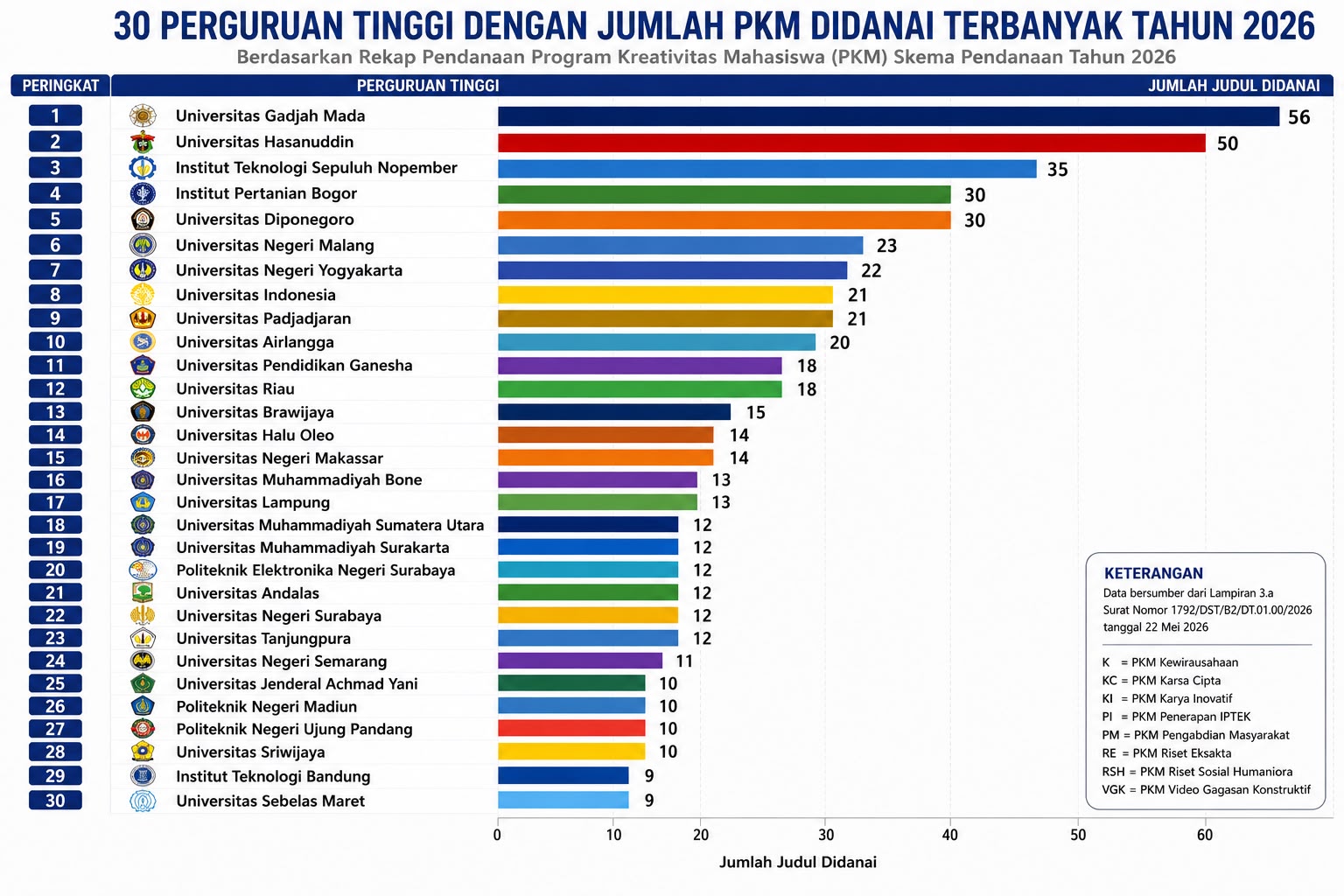
MAKASSAR – Hasanuddin University has shown its consistency as one of the universities with the strongest student innovation cultures in Indonesia. According to the 2026 Student Creativity Program (PKM) funding scheme recap announced by the Ministry of Higher Education, Science, and Technology, Unhas ranked second nationally, with 50 proposals securing funding.
Amid ever tougher competition and a funding quota more limited than in previous years, a top-two national position is a strong indicator that the quality of Unhas student proposals remains competitive nationally.
Director of Student Affairs Abdullah Sanusi, S.E., M.B.A., Ph.D., said the achievement is the result of a long process of consistent, structured mentoring. The success is not only about a position in the rankings, but reflects a growing culture of creativity, innovation, and scientific competition among Unhas students.
“For us, this achievement is not merely about numbers or rankings, but about the quality of the student mentoring process. Last year, Unhas made history by ranking first nationally in PKM funding. So, being in second place nationally this year, we still see it as a very proud achievement that shows Unhas’s consistency among the country’s best universities in student creativity and innovation,” explained Abdullah Sanusi.
In 2026, Unhas submitted 190 PKM proposals at the national level, of which 50 (or 26%) secured funding. The result is very strong, given that the quality of proposals from universities across Indonesia keeps rising. In addition, the funding quota is more limited.
“Staying in the top two nationally amid ever tougher competition is certainly a proud achievement for us. It is also motivation to keep improving the quality of student mentoring on a sustained basis,” Abdullah Sanusi added.
The success, Abdullah Sanusi continued, is inseparable from a mentoring strategy that is intensive, disciplined, and built around an activity timeline. Mentoring begins at the outreach stage to increase student participation, followed by technical guidance on writing proposals and periodic review stages.
Students receive comprehensive support, from strengthening the substance of their ideas and proposal-writing techniques to adjusting formats to national PKM standards. Each proposal goes through repeated evaluation and revision to ensure its quality is more mature before submission.
“The most decisive factor is a mentoring system that is intensive, disciplined, and sustained. Students are not only guided in writing proposals but also accompanied through periodic reviews so that proposal quality keeps improving,” Abdullah Sanusi explained.
Beyond supervising lecturers and internal reviewers, the mentoring process is also strengthened by the involvement of students who have previously succeeded in PKM and the National Student Scientific Week (PIMNAS). This collaborative approach is seen as effective in building a peer-learning ecosystem while improving teams’ readiness for national selection.
Abdullah Sanusi assured that mentoring does not stop at the funding stage. All teams that pass will continue to receive support in implementing their programs, monitoring and evaluating activities, preparing reports, and preparing for the PKP2 stage and PIMNAS.
“We hope the 50 teams that secured funding make the most of this opportunity through good program implementation and high-quality outputs. Of course, we hope these teams will go all the way to PIMNAS, the most prestigious event in the Student Creativity Program,” Abdullah Sanusi said.
On another note, Unhas also expressed appreciation to students whose proposals did not secure funding this year. In Abdullah Sanusi’s view, the courage to try and the learning process in scientific competition remain an important part of developing students’ capacity.
Unhas’s PKM 2026 funding results also show its consistency in maintaining a culture of student research and innovation nationally. After ranking first nationally the previous year and now holding second place, Unhas affirms its role as one of the centers for developing student creativity and innovation in Indonesia. (*/mir)
Editor: Ishaq Rahman
This article is an English translation of the original Indonesian report.