
Unhas Rector, Prof. JJ: “Congratulations to our researchers. Beyond individual achievements, this accomplishment also reflects the academic and research ecosystem we continue to build at Unhas”.
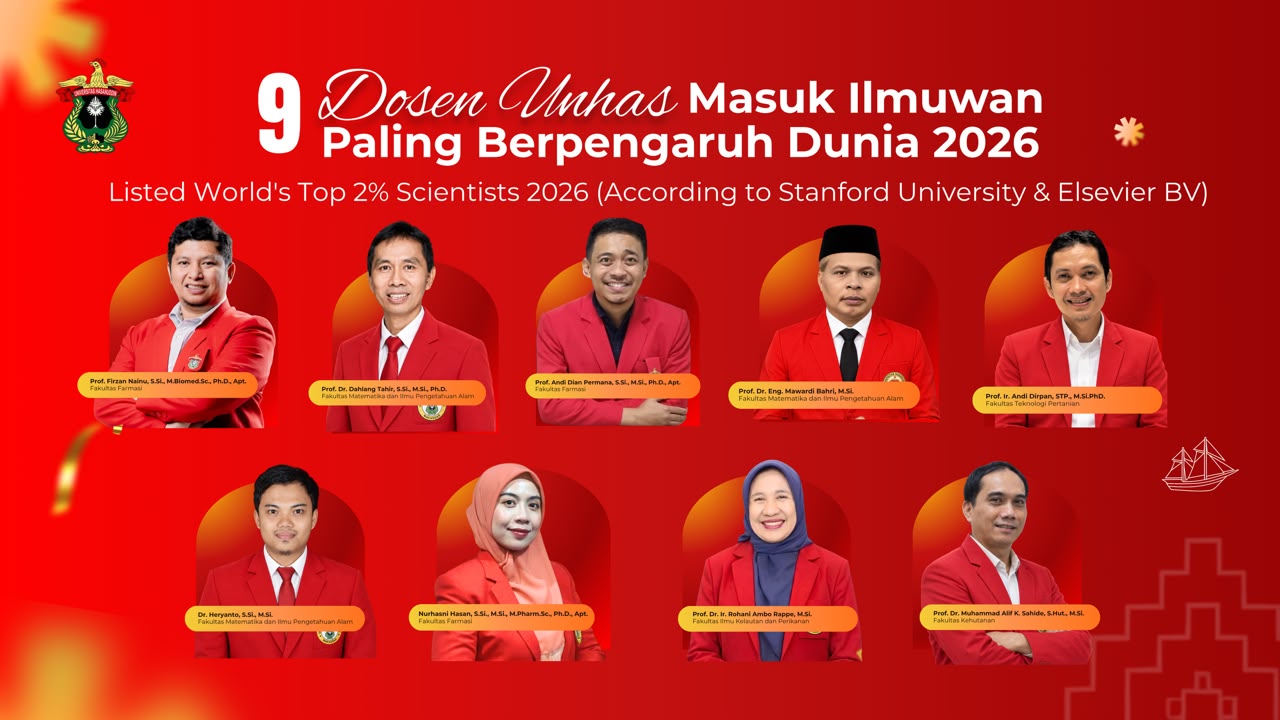
MAKASSAR – The scientific influence of Hasanuddin University (Unhas) researchers is increasingly visible in the global research landscape. Nine Unhas scientists have been included in the World’s Top 2% Scientists 2025, a list compiled by Stanford University in cooperation with the international scientific publisher Elsevier BV and officially released on Thursday (8 October 2026). This recognition continues a rising trend over the past three years, as the number of Unhas scientists on the list grew from 6 in 2024 to 7 in 2025, and now 9 in 2026.
The list is compiled from several publication and citation performance indicators drawn from the Scopus database to map the scientific influence of researchers in their respective fields. Using composite indicators adjusted to the characteristics of each research field, the list gives a picture of the recognition and influence of researchers’ scholarly work in the global academic community.
The nine Unhas scientists on the list come from five faculties, namely:
- Prof. Firzan Nainu, S.Si., M.Biomed.Sc., Ph.D., Apt. (Faculty of Pharmacy)
- Prof. Dr. Dahlang Tahir, S.Si., M.Si. (Faculty of Mathematics and Natural Sciences)
- Prof. Andi Dian Permana, S.Si., M.Si., Ph.D., Apt. (Faculty of Pharmacy)
- Prof. Dr. Eng. Mawardi Bahri, M.Si. (Faculty of Mathematics and Natural Sciences)
- Prof. Ir. Andi Dirpan, S.TP., M.Si., Ph.D. (Faculty of Agricultural Technology)
- Dr. Heryanto, S.Si., M.Si. (Faculty of Mathematics and Natural Sciences)
- Nurhasni Hasan, S.Si., M.Si., M.Pharm.Sc., Ph.D., Apt. (Faculty of Pharmacy)
- Prof. Dr. Ir. Rohani Ambo Rappe, M.Si. (Faculty of Marine Science and Fisheries)
- Prof. Dr. Muhammad Alif K. Sahide, S.Hut., M.Si. (Faculty of Forestry)
Unhas Vice Rector for Partnerships, Internationalization, and Alumni Affairs, Prof. Ir. Suharman Hamzah, S.T., M.T., Ph.D. (Eng), said the rising number of scientists on the list shows the development of Unhas’s academic recognition in recent years.
“This increase shows that across various fields of science, more and more Unhas scientists are gaining recognition in the global academic community. The achievement not only represents individual performance, but also contributes to raising Unhas’s scholarly visibility more broadly,” Prof. Suharman explained.
According to Prof. Suharman, this greater academic visibility can widen opportunities for research collaboration. Recognition of Unhas scientists across various fields opens more room to build networks with researchers at universities and research institutions, both national and international.
“As Unhas researchers and fields of study become better known in the global academic network, opportunities to build collaboration also open up. This can take many forms, from collaborative research and joint publications to student supervision and involvement in academic activities such as serving as external examiners,” Prof. Suharman said.
Prof. Suharman explained that such networks also bring academic value for students. Unhas researchers’ connections with the wider scientific community can give students access to the latest research developments, cross-institutional academic experience, and interaction with researchers from various universities.
“For students, the reputation of researchers and fields of study is part of the academic environment they consider. As more Unhas researchers gain international recognition and networks, this also raises Unhas’s appeal as an educational and research institution,” said Prof. Suharman.
At the institutional level, this greater visibility also strengthens Unhas’s academic reputation. The achievements of scientists in various fields can also increase exposure for the study programs and fields of science being developed, while opening wider partnership opportunities with universities, research institutions, and industry.
“From an institutional perspective, this academic visibility can strengthen Unhas’s reputation and open wider partnership opportunities. As our scientific capacity becomes better known, opportunities to work with universities, research institutions, and industry partners also open up,” Prof. Suharman explained.
Prof. Suharman stressed that the rise in scientific recognition needs to be seen in the context of broader benefits. In Prof. Suharman’s view, strengthening research capacity and networks must ultimately lead to the development of knowledge that is relevant to society’s needs.
The Rector of Unhas, Prof. Dr. Ir. Jamaluddin Jompa, M.Sc, welcomed the achievement warmly and with pride. The increase in the number of Unhas researchers on the list shows that the policies and the model for building a research ecosystem developed at Unhas are on the right track.
“This also reflects the academic and research ecosystem we continue to build at Unhas. Going forward, we want more Unhas researchers to be able to produce quality publications, expand collaboration with international partners, and develop innovations that have an impact on development,” said Prof. JJ.
Prof. JJ reiterated that research achievement will not stop at publications and citations, but must be translated into solutions for society, industry, and national development. This achievement is motivation for the entire academic community, especially young researchers, to keep working with integrity, consistency, and the courage to produce breakthroughs.
“Unhas will and must continue to grow as a research university that is globally competitive, rooted in the needs of the nation, and delivers real impact for society,” said Prof. JJ. (*/dhs)
Editor : Ishaq Rahman
This article is an English translation of the original Indonesian report.