
Erasmus+ at Hasanuddin University
Erasmus+ is the European Union’s programme for education, training, youth and sport. Unhas students, lecturers and staff take part through partnerships with European universities — studying, teaching and training in Europe, welcoming European colleagues in Makassar, and building projects together.
Find your route
Erasmus+ funds people and projects in different ways. Choose who you are to see the routes open to you from Unhas, who applies, and where to start.
Students
One or two semesters in Europe
Under International Credit Mobility, a European university that wins Erasmus+ funding with Unhas as its partner hosts Unhas students for part of their degree. You pay no tuition at the host; Erasmus+ pays €800 to €900 a month, depending on the country, and €1,735 towards travel; and the courses in your learning agreement count towards your Unhas degree.
A master’s degree across Europe
Erasmus Mundus Joint Masters are one- to two-year programmes run jointly by consortia of universities, with students moving between partner campuses. A scholarship pays €1,400 a month for the whole programme to cover travel, visa, settling-in and living costs, and scholarship holders pay no tuition. In 2026, 90 Indonesian students began these programmes, 78 of them on full EU scholarships.
Lecturers
Teach at a European partner
Staff mobility for teaching lets Unhas lecturers teach at a partner university in Europe, share their expertise and develop courses together. Erasmus+ pays €148 to €190 a day, depending on the country, and €1,735 towards travel.
Train or job-shadow
Training mobility covers job shadowing, workshops, courses and staff training weeks at a partner institution, to bring new skills back to your teaching or research. Attending a conference on its own does not count.
Teach and research the European Union
Jean Monnet Actions fund three-year teaching modules, chairs and centres of excellence in European Union studies, with grants of up to €35,000, €60,000 and €100,000 respectively. Higher education institutions anywhere in the world can apply.
Staff
Train at a European partner
Administrative and technical staff can train at a European partner through job shadowing, workshops or staff training weeks, then bring the practice back to their unit. Erasmus+ pays €148 to €190 a day, depending on the country, and €1,735 towards travel.
Welcome European visitors
Faculties, laboratories and hospitals that receive European staff and students can start from the short-course programmes four faculties have already prepared.
Faculties
Join a European university’s mobility project
International Credit Mobility funds are won by European universities, which name partners outside Europe in their applications. When a partner wants to include Unhas, the two sign an inter-institutional agreement that sets places, subjects and how credits are recognised.
Build capacity with a consortium
Capacity Building in Higher Education projects let universities in Europe and beyond modernise curricula, laboratories and management together. Unhas is a partner in three such projects on the EU’s record, including ELEGTEC at the Faculty of Animal Science.
Estimate a mobility grant
For exchanges under International Credit Mobility. Choose how you go, where, and for how long; the estimate uses the rates in the Erasmus+ Programme Guide 2026 for participants travelling from Indonesia.
- Individual support
- —
- Travel
- —
- Estimated total
- —
An estimate, not an offer. The European university that holds the funds confirms the final amount in your grant agreement.
Rates used in this estimate
| Destination countries | Student, per month | Staff, per day |
|---|---|---|
| Group 1Austria, Belgium, Denmark, Finland, France, Germany, Iceland, Ireland, Italy, Liechtenstein, Luxembourg, Netherlands, Norway, Sweden | €900 | €190 |
| Group 2Cyprus, Czechia, Estonia, Greece, Latvia, Malta, Portugal, Slovakia, Slovenia, Spain | €850 | €170 |
| Group 3Bulgaria, Croatia, Hungary, Lithuania, North Macedonia, Poland, Romania, Serbia, Türkiye | €800 | €148 |
| Distance, one way | Amount |
|---|---|
| 8,000 km or more | €1,735 |
Source: Erasmus+ Programme Guide 2026, International Credit Mobility, for participants from third countries not associated to the Programme.
Travel: the band is set by the one-way distance from Makassar to the host city, measured in a straight line as in the European Commission’s distance calculator, and the amount covers the return trip. Every destination here is more than 9,900 km away, so the 8,000 km band applies.
Staff: the full daily rate is paid up to day 14, then 70% of it up to day 60, rounded to the nearest euro. Up to two travel days can be added at the daily rate.
Students with fewer opportunities receive €250 a month more. Doctoral candidates on 5- to 30-day stays receive €79 a day up to day 14 and €56 a day after that.
How an exchange happens
International Credit Mobility, from funding to recognition.
- A European partner wins fundingA European university applies to its Erasmus+ National Agency, naming Unhas as a partner. In 2026 the deadline was 19 February; funded projects start on 1 August and run for 24 or 36 months.
- The universities sign an agreementAn inter-institutional agreement sets the number of places, the subjects, language requirements and how credits will be recognised.
- Unhas opens a callThe International Office announces the places. Candidates are selected in a fair, transparent and documented way, and the host confirms them.
- Agreements before departureStudents sign a learning agreement with Unhas and the host; staff sign a mobility agreement. Every participant also signs a grant agreement.
- The mobilityStudents study for 2 to 12 months; staff teach or train for 5 to 60 days.
- Recognition at UnhasCourses passed under the learning agreement are recognised towards the Unhas degree, and each participant files the EU participant report.
Unhas in Erasmus+
Three EU-funded projects list Unhas as a partner on the Erasmus+ Project Results Platform. Exchange partnerships are registered under the European university that holds the funds, so they appear here only when Unhas has reported them.
Projects on the EU record
ELEGTEC — greener leather technology
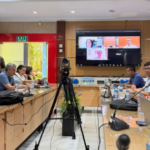
A Capacity Building in Higher Education project for sustainable leather technology in Indonesia, coordinated by Ege University in Türkiye and running from 2024 to 2026 with an EU grant of €797,991. Its final-year meeting in June 2026 brought about 25 consortium members to the Faculty of Animal Science, whose leather processing laboratory received new equipment through the project.
TUNE — Nurture Future Green Leader
A Capacity Building in Higher Education project coordinated by Universiti Teknologi Malaysia, running from November 2024 to October 2027 with an EU grant of €713,103. Unhas’s fellow partners include Universitas Diponegoro, the University of Porto, Vilnius Gediminas Technical University and FH JOANNEUM.
CALOHEA — learning outcomes in Asian higher education
Measuring and comparing what students learn in higher education across Asia: a 2021–2024 Capacity Building project coordinated by the University of Groningen, with an EU grant of €999,178. Unhas was one of the partners.
Recent activity
University of Antwerp
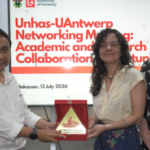
In July 2026 heritage scholars from Antwerp and the Faculty of Cultural Sciences discussed a memorandum of understanding and joint doctoral programmes, naming Erasmus+ among the funding routes.
Hanze University of Applied Sciences
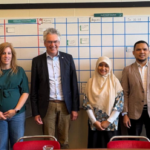
A partner of the Faculty of Nursing since 2018, sending students to Makassar for a semester. In June 2026 a Unhas delegation met Hanze’s Erasmus officers to plan capacity building for lecturers and students.
VU Amsterdam
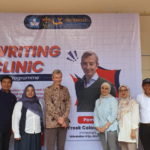
With Erasmus support, Prof. Freek Colombijn, editor of the journal Bijdragen tot de Taal-, Land- en Volkenkunde, led a three-day writing clinic for 16 lecturers of the Faculty of Cultural Sciences in February 2026.
International Office
In November 2025 the International Office began preparing the templates and documents for an Erasmus mobility proposal covering lecturers, administrative staff and students.
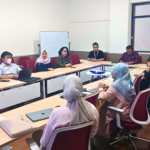
APPLIED SOCIO
The Faculty of Vocational Studies joined Osnabrück University of Applied Sciences, Saxion University of Applied Sciences and Indonesian partners in an October 2025 workshop to prepare a proposal in applied social sciences for the Capacity Building in Higher Education call.
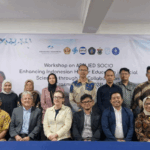
Short courses for European visitors
Four faculties have prepared programmes for staff and students visiting from European partner universities, first drawn up with VU Amsterdam. Open a course to see who it is for and what it covers.
Cancer PathologyFaculty of Medicine · 15 days, travel included
A grounding in neoplastic disease and the techniques used to diagnose it, taught to Unhas students from bachelor’s to specialist level.
- Undergraduate lectures: principles of oncology, tumour classification, histopathology and cytology
- Postgraduate sessions: molecular pathology, biomarkers and immunohistochemistry, with a workshop
- Specialist lectures on reproductive, breast, head-and-neck and digestive tumours
- A guest seminar and a research collaboration session
Global Nursing Education and Healthcare System in IndonesiaFaculty of Nursing · 15 days, travel included
For academic or administrative staff of VU Amsterdam with a master’s degree in nursing, public health or a related field, and experience in nursing education, healthcare administration or research.
- Indonesian and Dutch nursing education, curricula and accreditation compared
- Visits to the Unhas teaching hospital, a public health centre and a community clinic
- Five guest lectures by VU Amsterdam, manuscript coaching, and planning for joint research and curricula
Public HealthFaculty of Public Health · 15 days, travel included
Public health in theory and in the field, run with Unhas students at bachelor’s, master’s and doctoral level.
- Epidemiology, outbreak investigation, One Health, maternal and child health, and data analysis in SPSS and R
- Laboratory training: disease vectors, ELISA biomarkers, toxicology, microbiology, heavy-metal analysis and PCR
- Field visits to a community health centre, the KIMA industrial estate and Maros Regency
DentistryFaculty of Dentistry · 10 days in Makassar
Clinical teaching and live surgery for dentists and specialists, with sessions for Unhas dentistry students and residents.
- Lectures in oral and maxillofacial surgery, endodontics, radiography, prosthodontics and orthodontics
- Two days of cleft lip and palate surgery at the Unhas Dental Hospital
- Sessions on cleft surgery and quality of life for residents
Questions
Can I apply for an Erasmus+ exchange on my own?
No. Exchange places come from agreements between Unhas and European universities, so you apply through Unhas when the International Office opens a call. Erasmus Mundus Joint Masters are the exception: you apply directly to the programme.
Do I pay tuition at the European university?
Not on an exchange. Exchange students pay no tuition, registration or examination fees at the host, and stay enrolled at Unhas throughout.
Will my courses count at Unhas?
Yes, if they are in your learning agreement. Agree the courses with your faculty and the host before you leave, and amend the agreement formally if your plans change while abroad.
What English level do I need?
Each host sets its own language requirement in its agreement with Unhas and may ask for proof such as a TOEFL or IELTS score. Check the call before you apply.
Is Erasmus University Rotterdam part of Erasmus+?
Not by name. Erasmus University Rotterdam and its medical centre, Erasmus MC, are Dutch institutions named — like the programme — after the scholar Desiderius Erasmus. An exchange with them, such as the Faculty of Medicine’s student programme, is funded under its own agreement, not automatically by Erasmus+.
How long will Erasmus+ run?
The current programme covers 2021 to 2027, with a budget of €26.2 billion. In July 2025 the European Commission proposed a successor for 2028 to 2034 with €40.8 billion; the European Parliament and the Council are still negotiating it. Until then, each year’s calls follow the Programme Guide published the previous November.
Talk to the International Office
Ask about open calls, agreements with European partners, or hosting European guests at your faculty.