
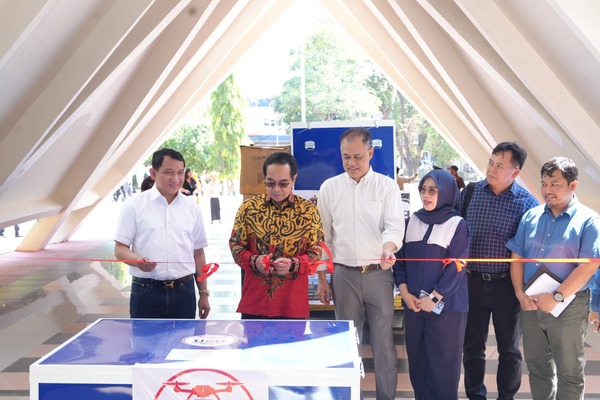
MAKASSAR – Not every university research result makes it beyond the laboratory to have a direct impact on society. Hasanuddin University has once again shown that role through the Unhas Sprayer-Spreader Drone (USD), an agricultural technology innovation that is now being rolled out nationwide in collaboration with the Ministry of Agriculture to support agricultural modernization and strengthen the food self-sufficiency program.
The USD was developed as a precision agriculture technology that combines a Global Positioning System (GPS)-based navigation system with automatic spraying and seed-spreading mechanisms. The technology allows seeds to be distributed more evenly, materials to be used more efficiently, and fieldwork time to be much shorter than with conventional methods.
The Ministry of Agriculture‘s confidence in the Unhas innovation is reflected in procurement support worth a total of Rp11 billion. Each USD unit has gone through a series of tests to ensure the effectiveness of both spraying and seed spreading on various land characteristics before being distributed to different regions.
In the initial phase, 50 USD units are being prepared for distribution to 46 regencies and cities across Sumatra, Java, Kalimantan, South Sulawesi, East Nusa Tenggara, and Papua. The distribution is a first step in spreading the Unhas innovation so that farmers in many regions can use it more widely.
To mark the start of this rollout, Unhas Rector Prof. Dr. Ir. Jamaluddin Jompa, M.Sc., symbolically sent off 15 USD units. The send-off took place on the ground floor of the Rectorate Building, Unhas Tamalanrea Campus, Makassar, on Saturday (25 July).
Prof. JJ said the USD shows how university research can meet the needs of a constantly evolving agricultural sector. In Prof. JJ’s view, agricultural modernization cannot be separated from the use of technology that can increase both efficiency and productivity.
“Modern agriculture needs modern equipment. Technology must be a real solution to support food self-sufficiency. This drone is no longer just a prototype but a concrete step toward strengthening the modern agricultural industry,” explained Prof. JJ.
Prof. JJ added that all components of the USD were developed by Unhas as a homegrown creation. This success proves that Indonesian universities have the capacity to produce strategic technology that can compete while meeting national needs.
“This is a drone made by our own people, made by Unhas. It proves that our people can develop their own technology. We want to build technological self-reliance as the foundation for Golden Indonesia,” Prof. JJ added.
Head of the Subdirectorate for Incubator and Science Techno Park (STP) Management at Unhas and developer of the Unhas Sprayer-Spreader Drone (USD), Dr. Eng. Andi Amijoyo Mochtar, S.T., M.Sc., explained that the innovation is the result of technology development designed to meet farmers’ need for a seed-spreading system that is more efficient, precise, and easy to operate.
“Next year we will optimize development and move into the manufacturing stage. The identity of this drone is Unhas. We are building a shared commitment so that this innovation keeps growing through collaboration among many parties,” explained Dr. Andi Amijoyo.
Behind its nationwide rollout, the USD is a technology development specifically designed to address the challenge of efficiency in rice cultivation. Equipped with a large-capacity seed tank, the device can cover a wide planting area with simple, automatic operation. Its operating system is designed to be easy to use with automatic controls, so farmers can operate it without in-depth technical knowledge.
Going forward, Unhas will continue to develop the USD so that it is used more widely in the national agricultural sector. In this downstream commercialization process, Unhas has partnered with PT Ener Sky Innovation as an industry partner to support development toward the manufacturing stage and strengthen production capacity.
The development of the USD is also aligned with the Sustainable Development Goals (SDGs), particularly SDG 2 (Zero Hunger) by raising agricultural productivity, SDG 9 (Industry, Innovation, and Infrastructure) by strengthening domestic technological innovation, and SDG 17 (Partnerships for the Goals) through collaboration among universities, government, and industry. By bringing technology from the laboratory to the rice field, Unhas shows that research not only produces new knowledge but also creates real solutions for the future of Indonesian agriculture.(*/mir)
Editor: Ishaq Rahman
This article is an English translation of the original Indonesian report.