
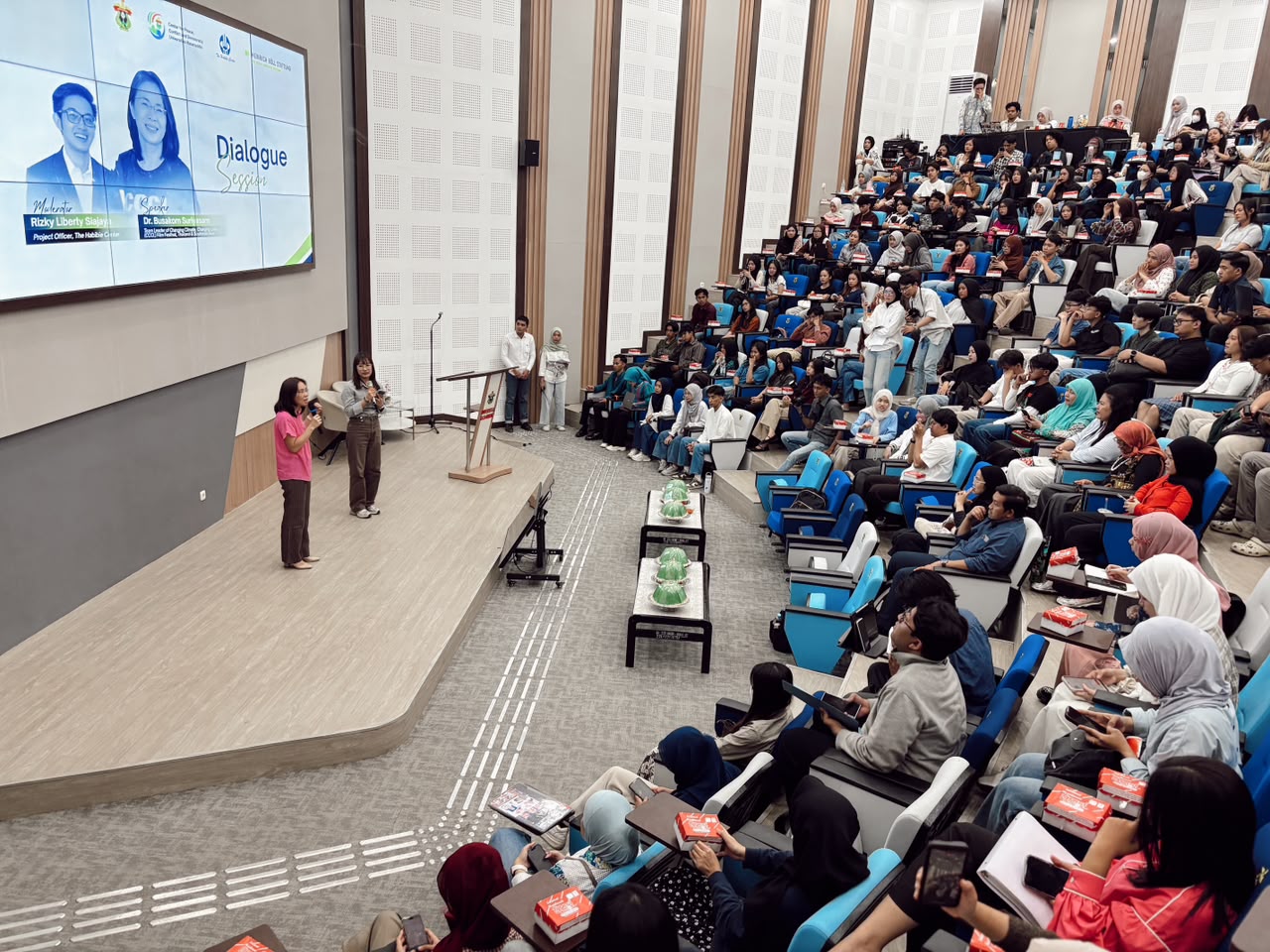
MAKASSAR – A film can open a conversation about a future that may not yet be visible, but whose effects are already being felt today. That perspective was brought to the Movie Screening & Dialogue “Borrowed Futures: Intergenerational Justice, Youth Leadership and Climate Responsibility in ASEAN” at the Arsjad Rasjid Lecture Theater, Hasanuddin University (Unhas), on Tuesday (15 September 2026).
The event, organized by The Center for Peace, Conflict, and Democracy (CPCD) Unhas in cooperation with The Habibie Center and Heinrich Böll Stiftung – Die Grüne Politische Stiftung, used film as a medium to invite participants to look at climate change from the perspective of communities and young people in the ASEAN region.
The forum featured Dr. Busakorn Suriyasarn, Team Leader of Changing Climate, Changing Lives (CCCL) Film Festival, Thailand & Southeast Asia, and Julia Novrita, Ph.D., Director of Program and Development at The Habibie Center.
CPCD Unhas Secretary Andi Ahmad Yani, S.Sos., M.Si., MPA., M.Sc., said the film screening was designed as an entry point to a more open conversation about climate change and the role of young people.
“After watching the film, we want participants to bring their critical questions into the dialogue. Film is a medium for seeing how climate change is felt in people’s lives and how young people can take a role in responding to it,” said Yani.
The program began with a movie introduction that gave context to the film and the issues it raises. Participants then watched a movie screening from the Changing Climate, Changing Lives (CCCL) Film Festival before moving on to an interactive dialogue session with the speakers.
In that session, Dr. Busakorn Suriyasarn shared a perspective on climate change and the CCCL Film Festival’s experience in using audiovisual works to bring environmental stories and issues to the public, especially young people.
Participants were invited to see climate change not as a global problem but through experiences closer to their own lives. The dialogue opened with a reflective question, “How do you feel about climate change?” asking how they feel when they think about climate change.
The conversation then turned to environmental conditions in their own communities through the question, “What is the biggest climate/environmental problem in your community/island?” The question gave participants room to share their firsthand experiences of environmental problems.
Julia Novrita also took the discussion to a broader perspective on youth engagement and the importance of dialogue spaces in building awareness of issues that will affect future generations.
The central idea of “Borrowed Futures” found its relevance in the discussion. The future is seen as something being prepared by today’s generation. Choices about the environment, patterns of development, and the way society responds to climate change will determine the conditions passed on to the next generation.
For this reason, the discussion of climate change in this forum was placed alongside the issues of youth leadership and intergenerational justice. Young people are positioned not only as a group that will face the impacts of climate change, but also as an important part of shaping the response to it.
Through the film screening and open dialogue, CPCD Unhas and its partners provided a space for participants to connect stories from the screen with the realities of their own communities. The conversation is expected to broaden young people’s perspectives on climate change and to encourage their involvement in discussing and addressing environmental challenges in the ASEAN region. (*/dhs)
Editor : Ishaq Rahman
This article is an English translation of the original Indonesian report.