
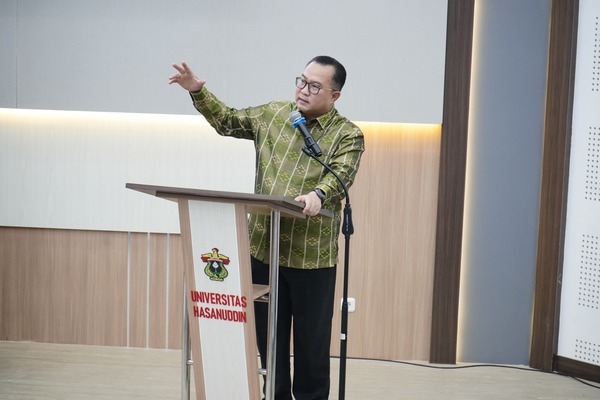
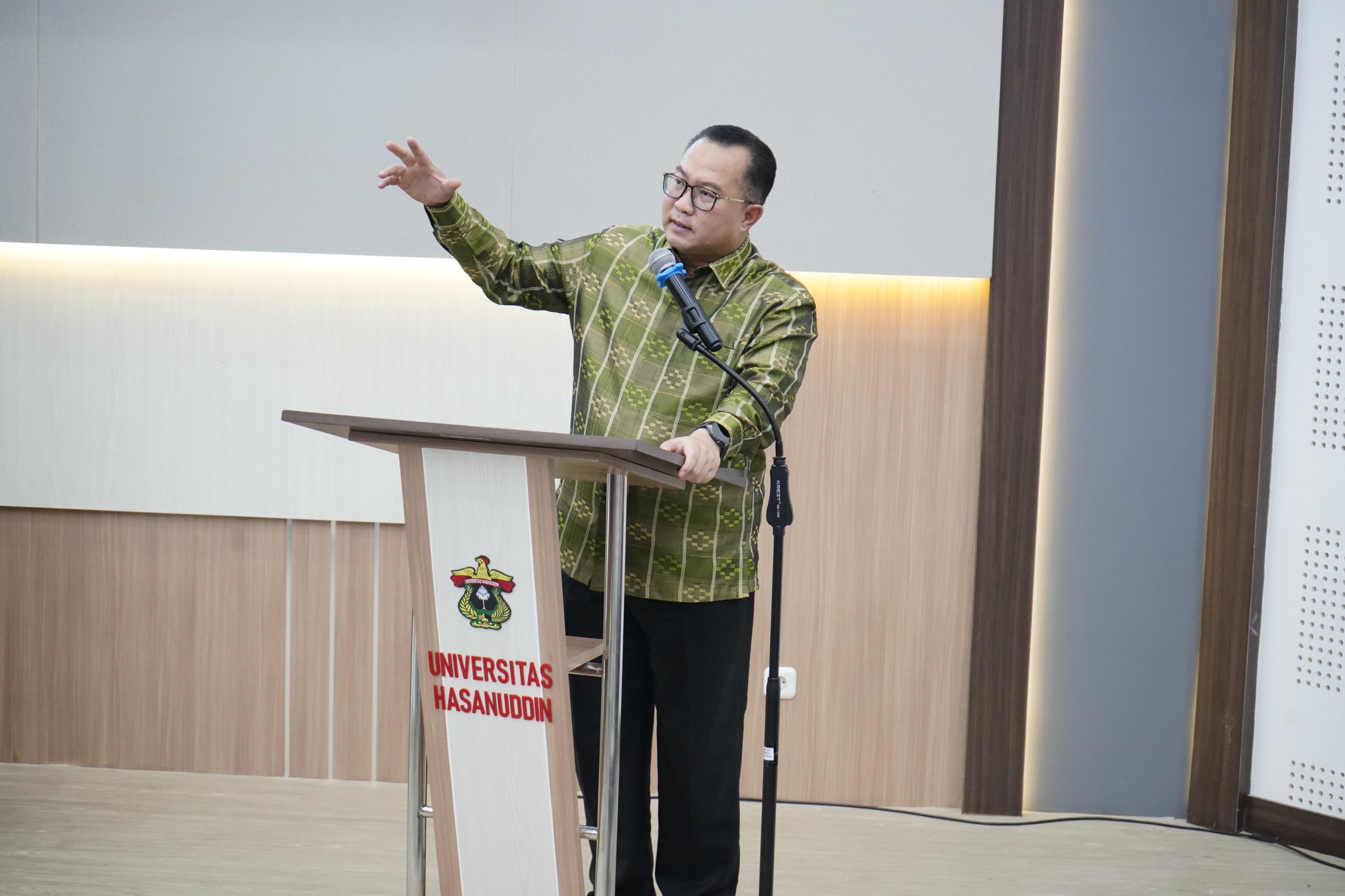
Rector Prof. JJ presents the plan to establish the BRIN Unhas Innovation Center (BRIONIC), to integrate research, innovation, industry, and technology-based entrepreneurship in a single ecosystem that supports innovative solutions to Indonesia’s development challenges, particularly in the eastern region.
MAKASSAR – Indonesia produces thousands of research results every year from its universities and research institutions. But the biggest challenge today is no longer producing research; it is ensuring that those findings can meet society’s needs, create economic added value, and make a real contribution to national and regional development.
Amid increasingly knowledge-based global competition, a nation’s strength is no longer determined solely by the availability of natural resources, but also by its ability to turn knowledge into impactful innovation. For this reason, strengthening the research and innovation ecosystem is a strategic agenda that will determine Indonesia’s competitiveness in the future.
Collaboration among universities, government, industry, and research institutions is the key to accelerating that transformation. Strong synergy is needed so that research results do not stop at scientific publications but can serve as solutions to development challenges and community needs.
This view was expressed by the Head of the National Research and Innovation Agency (BRIN), Prof. Dr. Arif Satria, S.P., M.Si., who stressed that Indonesia is entering a development era that places innovation as the locomotive of economic growth. According to Prof. Satria, regional development no longer rests on the exploitation of natural resources alone, but must be supported by stronger research and innovation capacity.
As the main driver of the national research and innovation ecosystem, BRIN continues to push for higher research quality, faster downstreaming of research results, and stronger multi-stakeholder collaboration. These efforts are aimed at ensuring that investment in research and development delivers broader benefits for national and regional development.
Prof. Arif noted that one of the biggest challenges Indonesia still faces is the gap between research results and user needs. Much research is of good scientific quality, yet has not been able to produce optimal economic and social impact because it has not yet reached the stage of implementation and downstreaming.
“Good research is not only research that gets published, but research that can solve real problems, create economic added value, and improve people’s welfare,” said Prof. Arif.
Prof. Arif also stressed the importance of transforming the role of universities in the national innovation ecosystem. According to Prof. Arif, it is not enough for campuses to be educational institutions that produce quality graduates; they must also become centers that generate solutions and innovations relevant to the needs of society and industry.
To support this goal, BRIN offers a range of collaborative programs, from research funding schemes, Degree by Research, and student research internships to the Research Assistant program and international mobility programs for researchers and academics.
“Universities hold a strategic position as centers for developing knowledge and producing future talent. Universities need to be transformed, not merely as teaching universities, but developing into research universities and ultimately innovation universities that can deliver real solutions for the needs of society, industry, and government,” added Prof. Arif.
Overall, BRIN’s policy direction affirms that the future of Indonesian research depends heavily on the strength of multi-stakeholder collaboration, particularly between BRIN and universities. This synergy is expected to produce outstanding talent, accelerate the downstreaming of innovation, raise national competitiveness, and make research and innovation the main foundation of sustainable development in Indonesia.
In line with this view, the Rector of Unhas, Prof. Dr. Ir. Jamaluddin Jompa, M.Sc., said in the remarks that the partnership between Unhas and BRIN has continued to grow productively since 2021. Various collaborations have been established in strategic fields, from archaeology, biodiversity, maritime affairs, and health to the development of materials and biomass that support the national green economy and bioeconomy agenda.
According to Prof. JJ, strategically, BRIN and Unhas share the same vision of making research an instrument of impactful development. Therefore, the long-term target is to make Unhas a BRIN research hub for the eastern Indonesia region, so that it can become a center for the development of knowledge, innovation, and technology downstreaming that contributes to national development.
The plan to establish the BRIN Unhas Innovation Center (BRIONIC) is a very important next step in strengthening that collaboration. The innovation center is expected to integrate research, innovation, industry, and technology-based entrepreneurship in a single ecosystem that supports innovative solutions to Indonesia’s development challenges, particularly in the eastern region.
“We hope BRIONIC can become a catalyst for research and innovation collaboration in eastern Indonesia, bringing together the strengths of academia, research, industry, and government to produce solutions that make an impact for society,” said Prof. JJ.
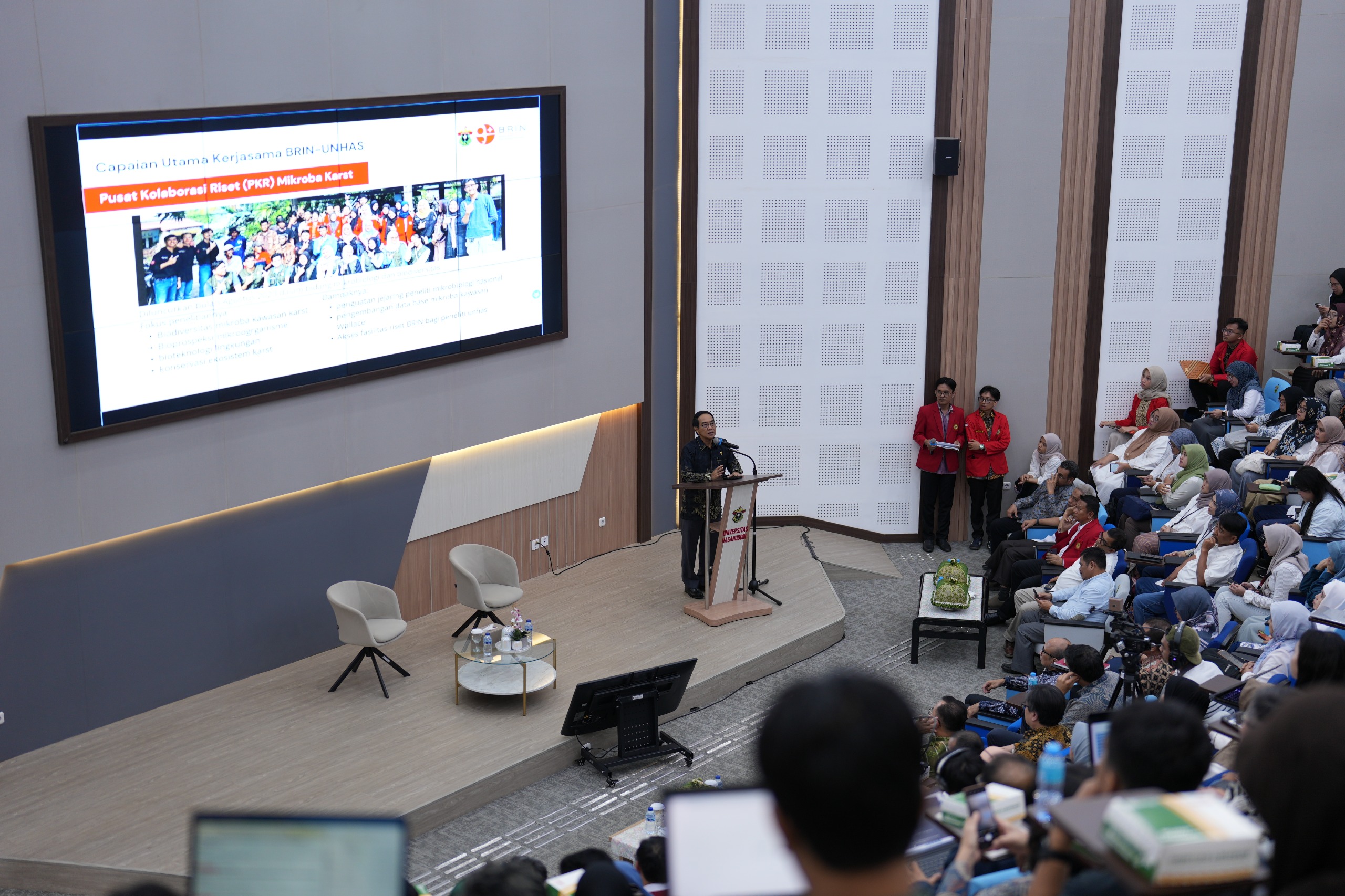
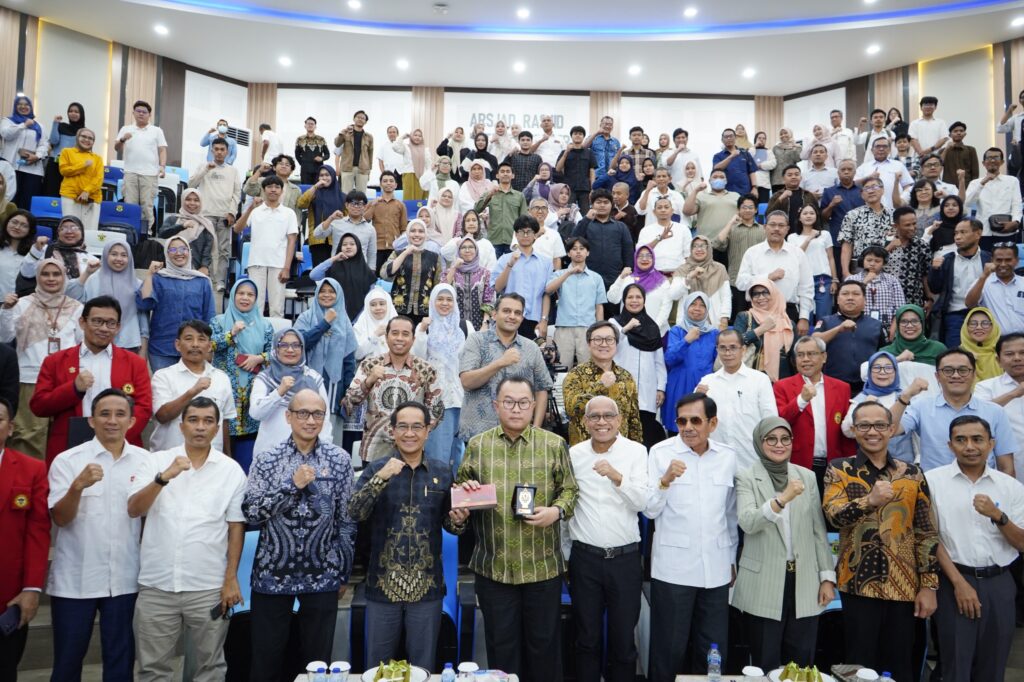
These ideas and commitments emerged at the BRIN Goes to Campus event, held in the Arsjad Rasyid Hall, Unhas Campus, on Monday (8 June). Under the theme “National Research Policy Direction in Supporting Impactful Regional Development,” the event served as a strategic dialogue between BRIN and the Unhas academic community to strengthen synergy in research, innovation, and technology downstreaming as a foundation for Indonesia’s development. (*/mir)
Editor : Ishaq Rahman
This article is an English translation of the original Indonesian report.