
MAKASSAR – Amid the growth of Indonesia’s Islamic finance industry, the challenge is no longer just expanding services but also preparing human resources who can connect sharia values with the needs of society and the business world. Investing in education is one important strategy for producing talent who not only master theory but can also deliver innovations and practical solutions.
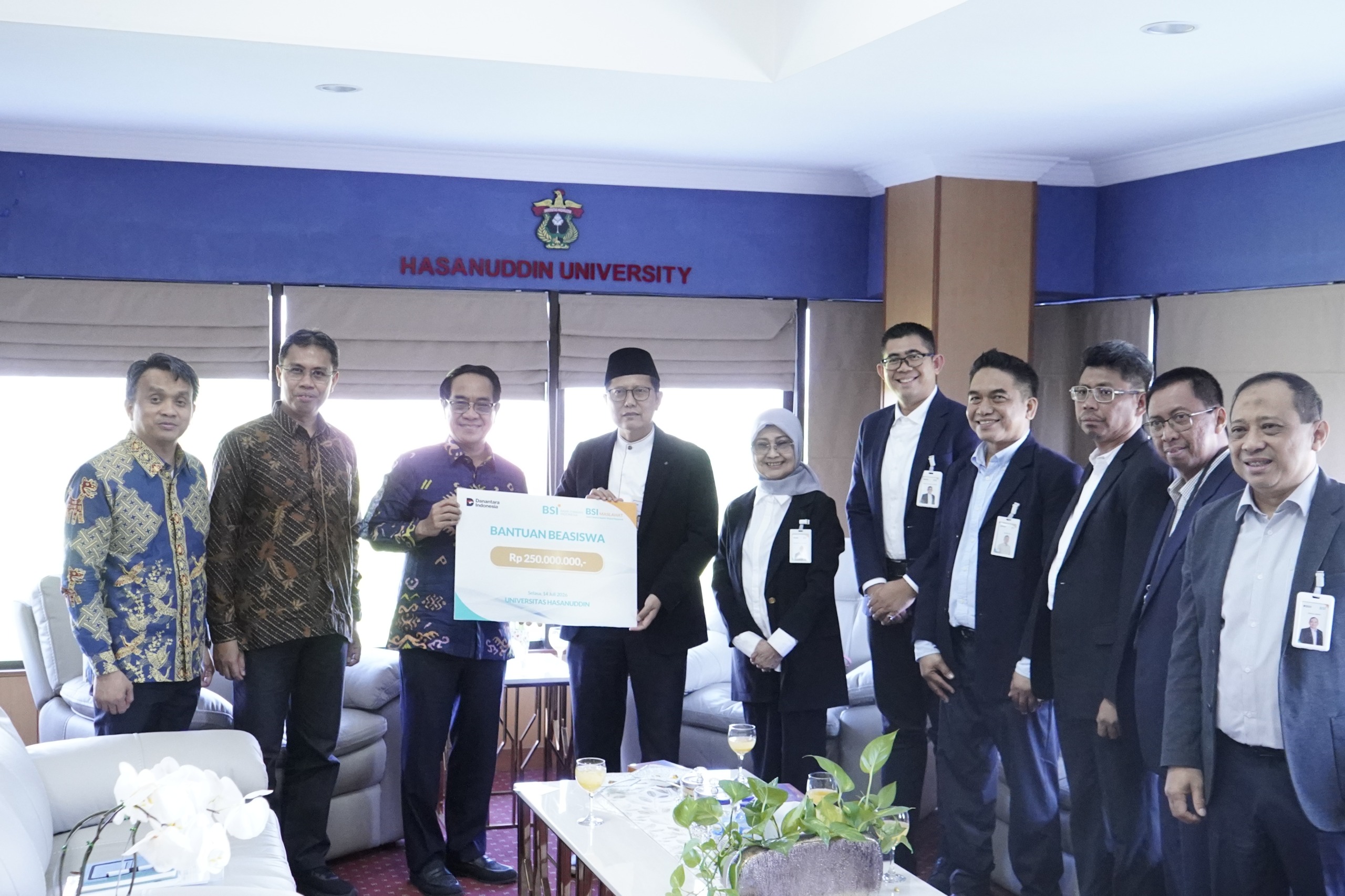
PT. Bank Syariah Indonesia (BSI) demonstrated this commitment by presenting scholarship assistance worth Rp250 million to Hasanuddin University. The assistance will be distributed to students in need as part of efforts to widen access to education and to prepare an outstanding generation expected to contribute to the development of Indonesia’s sharia economy.
Besides presenting the scholarships, BSI and Unhas also discussed strengthening collaboration to support the advancement of the national sharia economy. Both institutions see that developing the sharia economy requires close synergy between academia and industry in order to produce research, innovation, and human resources who can adapt to the dynamics of the Islamic finance sector.
BSI Independent Commissioner Felicitas Tallulembang explained that the cooperation already established with Unhas is part of BSI’s commitment to strengthening the development of the sharia economy in Indonesia. In Tallulembang’s view, universities hold a strategic position as centers for developing knowledge and as producers of the talent who will drive the transformation of the sharia economy in the future.
In BSI’s view, Unhas has strengths in developing the sharia economy that go beyond the conceptual level. The academic activities it runs connect theory with practice, producing graduates who are better prepared for the needs of industry and society.
“We see that Unhas does not only develop the sharia economy theoretically but also encourages its implementation in a more practical way. That spirit is a great strength in advancing Indonesia’s sharia economy,” Felicitas explained.
Tallulembang further explained that the sharia economy is now developing into an increasingly inclusive system. This is reflected in the makeup of BSI’s customers, who do not come only from the Muslim community. About 20 percent of BSI customers are non-Muslims who choose BSI’s services because it prioritizes transparency, good governance, and ethical values in managing finances.
In Tallulembang’s view, this development shows that the sharia economy has become a system accepted by the wider public, so the need for competent human resources will continue to grow.
Rector Prof. Dr. Ir. Jamaluddin Jompa, M.Sc., expressed appreciation for BSI’s trust through the scholarship support as well as its commitment to strengthening collaboration in developing the sharia economy. In the Rector’s view, the Islamic Economics and Business Study Program is an important asset for Unhas in delivering sharia economics education that is more operational, adaptive, and able to meet the needs of society and industry.
Prof. JJ stressed that developing the sharia economy cannot be built on mastery of knowledge and professional competence alone, but must also be supported by strengthening character and religious values. For that reason, besides strengthening education, research, and community service, Unhas consistently holds the Unhas Study and Congregational Prayer Movement (GUMSB) as part of students’ character building.
“The combination of academic competence, integrity, and spiritual values is the foundation for producing human resources who can contribute to the advancement of Indonesia’s sharia economy. That is why collaboration between universities and industry must continue to be strengthened to produce graduates who are not only academically outstanding but also have strong character,” explained Prof. JJ.
Through collaboration that continues to be strengthened, Unhas and BSI hope that the synergy they have built will not stop at awarding scholarships but will grow into other areas, such as research, innovation, talent development, and improving sharia economic literacy. By bringing together the strengths of universities and industry, the two institutions are optimistic they can produce more innovations and outstanding human resources who can strengthen the competitiveness of Indonesia’s sharia economy while providing broader benefits to society.
The scholarship presentation and the discussion on strengthening collaboration took place during a visit by the Board of Commissioners of PT Bank Syariah Indonesia (BSI), led by Independent Commissioner Felicitas Tallulembang and received directly by the Rector, at the Unhas Tamalanrea Campus, Makassar, on Tuesday (14 July). The meeting was part of efforts to strengthen ties and reinforce synergy between academia and industry in supporting the development of Indonesia’s sharia economy. (*/mir)
Editor: Ishaq Rahman


This article is an English translation of the original Indonesian report.