
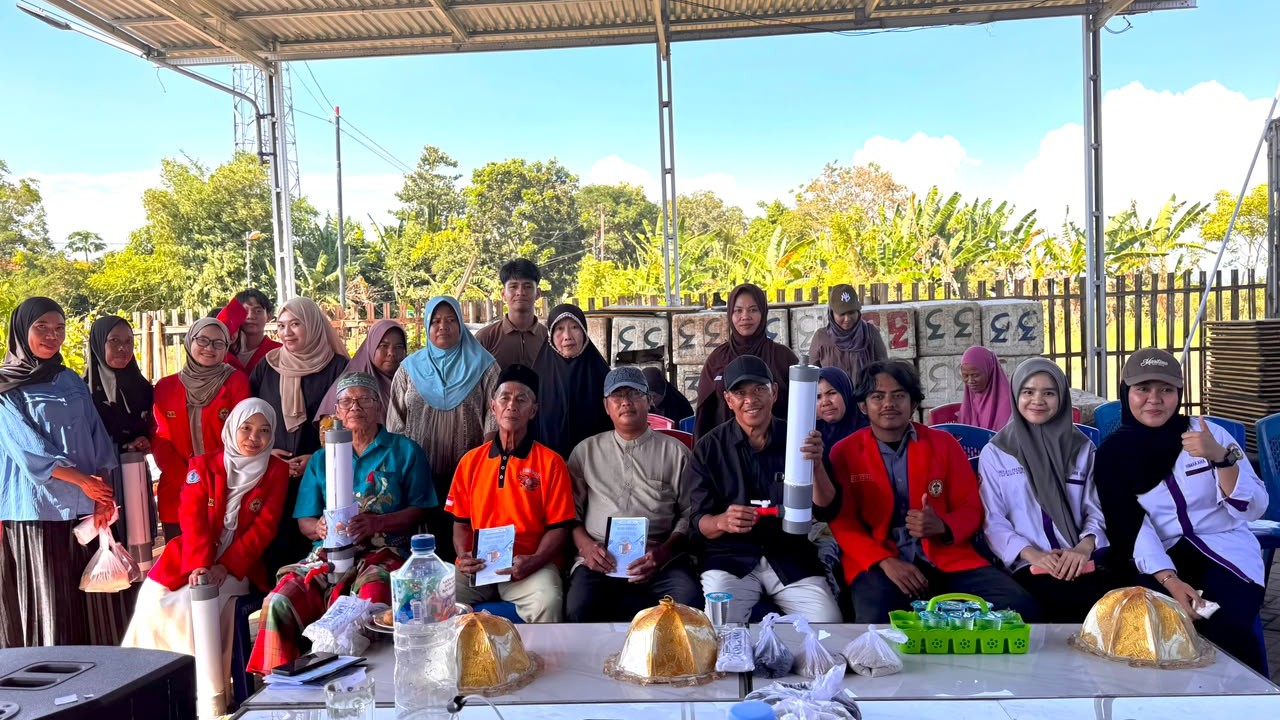
Access to clean water is an important factor in preventing disease and reducing the risk of stunting. Guided by this understanding, Veterinary Medicine students at Hasanuddin University’s Faculty of Medicine delivered simple filtration technology training for the coastal community of Popo Village, Takalar.
TAKALAR – Water that looks clear is not necessarily safe to use. Particles, microorganisms, and other contaminants can raise the risk of environment-based diseases that affect family health, especially for children. For this reason, providing clean water is an important intervention in efforts to prevent stunting.
This perspective underpinned the Student Organization Capacity Strengthening Program (PPK Ormawa) team of the Veterinary Medicine Student Association (HIMAKAHA) at the Faculty of Medicine, Hasanuddin University (FK Unhas), which held a Simple Water Filtration Outreach and Training in Popo Village, South Galesong District, Takalar Regency, on Saturday (18 July 2026). The activity took place at the office of the Kale Marewa Village-Owned Enterprise (BUMDes).
The training is part of the OCEANS (One Health Coastal Environment and Nutrition Sustainability) Program, an initiative that integrates human health, the environment, and sustainability as a strategy for controlling stunting risk factors in coastal areas.
The activity was attended by Popo Village residents, health cadres, Posyandu (integrated health post) cadres, community leaders, and the village government. Besides receiving an explanation of the link between water quality and health, participants also practiced making a simple water filter using materials that are easy to find locally.
In the training session, residents were introduced to the basic principles of filtration, the function of each layer of filter media, and maintenance techniques to keep the filter working optimally. This approach was designed so that the technology introduced does not depend on expensive equipment and can be replicated independently by residents.
Representing the Popo Village Head, the head of Kampung Parang hamlet, Syarifuddin Dg. Sore, praised the activity, which was seen as meeting the community’s need for access to clean water. Appreciation was also expressed for the presence of the HIMAKAHA FK Unhas PPK Ormawa Team.
“We hope that through this outreach and the provision of simple water filters, water quality in Popo Village can continue to improve so that it is more suitable for people’s daily use. We hope the knowledge and technology provided will not stop with this activity alone, but will continue to be applied and developed by the community so that the benefits can be felt over the long term,” said Syarifuddin.
The leader of the HIMAKAHA FK Unhas PPK Ormawa Team, Rahmat Satrio, explained that improving access to clean water is one of the main focuses of the OCEANS Program. Safer water supports the practice of Clean and Healthy Living Behavior (PHBS), reduces the risk of environment-based diseases such as diarrhea, and strengthens stunting prevention efforts.
“That is why the program does not stop at handing over equipment, but also builds the community’s capacity. Residents are equipped with the knowledge to make, use, and maintain the filtration system on their own so the benefits can continue to be felt after the community service program ends,” said Rahmat.
Through the One Health approach, this activity shows that public health problems cannot be separated from environmental quality. The collaboration among students, the village government, health cadres, and the community is an example of how simple science-based innovation can be translated into solutions relevant to local needs, while also supporting a healthier, more self-reliant, and more sustainable Popo Village.
Members of the HIMAKAHA FK Unhas PPK Ormawa Team:
1. Muhammad Rizky Isnayanto (Veterinary Medicine)
2. Rahmat Satrio (Veterinary Medicine)
3. Amanda (Environmental Health)
4. Berliana Rizki Kusuma Wardani (Nutrition Science)
5. Elsa Panggalo (Veterinary Medicine)
6. Farid Asshyddiq Sumartin (Veterinary Medicine)
7. Hidayat Nur Halid (Civil Engineering)
8. Husnul Khatimah Syarif (Nutrition Science)
9. M. Farel Alfarizi A. (Veterinary Medicine)
10. M. Zaky Muchdar Mappagassing (Communication Science)
11. Mayumi Almira Bhatari (Veterinary Medicine)
12. Muhammad Tri Argianto (Veterinary Medicine)
13. Ratu Mourizka Salsabella (Veterinary Medicine)
14. Rifki Kurniawan (Veterinary Medicine)
15. Andi Sophie Banuna Amrie (Information Systems)
Faculty Advisor: drh. Muhammad Ardiansyah Nurdin, M.Si. (*/hmkh/ir)
Editor: Ishaq Rahman


This article is an English translation of the original Indonesian report.