
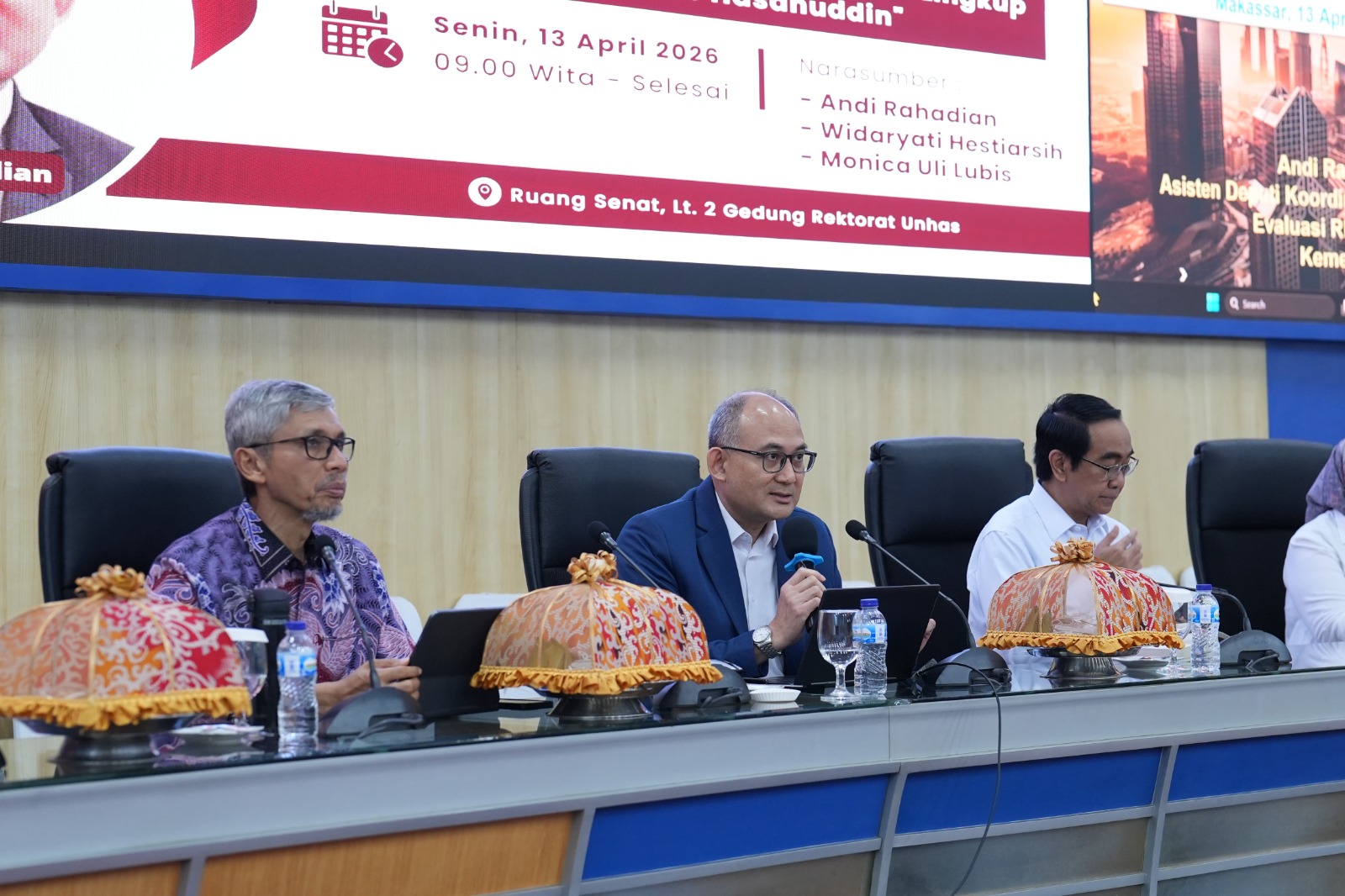
Assistant Deputy for Coordination of Policy Implementation and Evaluation of Bureaucratic Reform, Apparatus Accountability, and Regional Oversight III, Andi Rahadian, SH., LL.M., stressed the importance of strengthening integrity zones to close gaps for corrupt practices in higher education institutions.
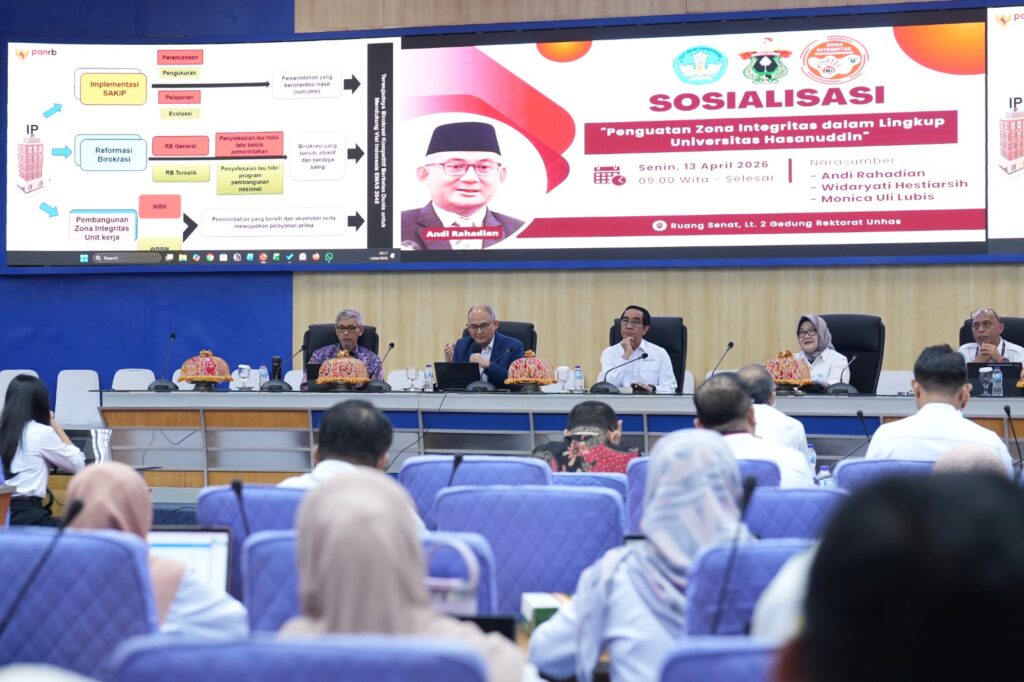
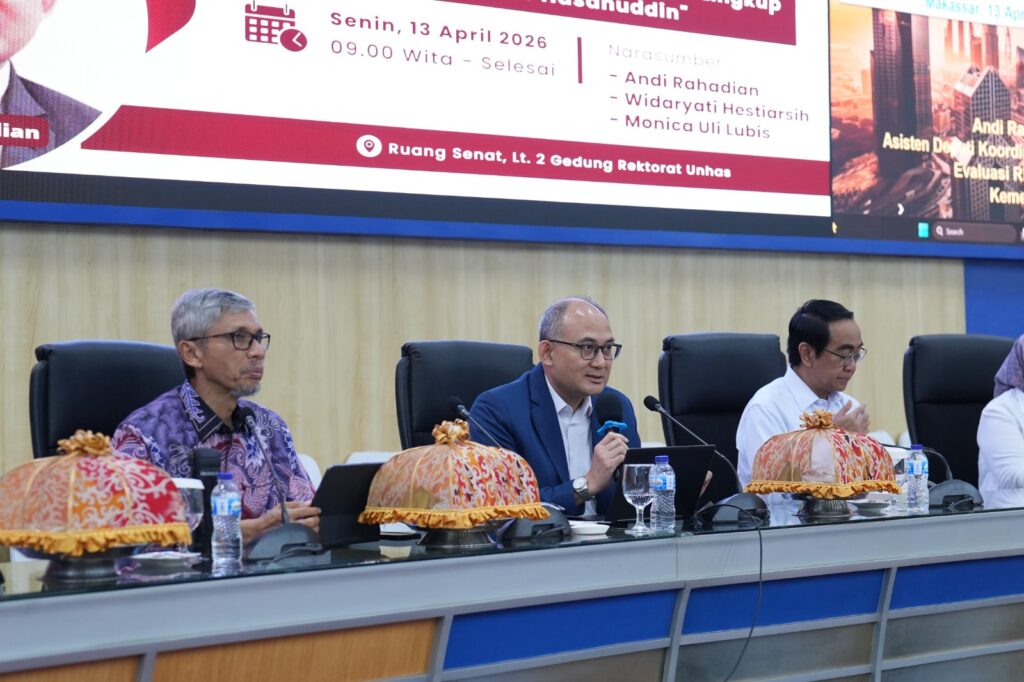
The remarks were delivered at the “Strengthening the Integrity Zone” socialization session held by Hasanuddin University (Unhas) on Monday (13 April), which also gave the academic community a strategic understanding of building clean and accountable campus governance.
Andi Rahadian explained the policies for building and evaluating integrity zones in government institutions, stressing that integrity challenges remain a crucial issue. Problems that often arise include corruption and abuse of authority, performance accountability that is not yet optimal, inefficient use of budgets, weak internal oversight, and poor public service quality.
“Based on data up to October 2025, 40 ministries and agencies were recorded as involved in corruption cases, with perpetrators dominated by echelon I to IV officials, totaling 61 cases. The most common types of offenses were gratification and abuse of authority, with a total of 44 cases,” said Andi Rahadian in the presentation.
In the context of higher education, Andi Rahadian identified three areas vulnerable to corrupt practices: publication, research, and community service; the procurement of goods and services; and financial management.
Andi Rahadian further stressed that building integrity zones is in line with President Prabowo Subianto’s Asta Cita, particularly point 7, which focuses on strengthening political, legal, and bureaucratic reform, as well as preventing and eradicating corruption and narcotics.
One important indicator can be seen in the survey results component, especially the Anti-Corruption Perception Survey. Efforts to accelerate the development of integrity zones must be carried out systematically and based on the real problems in each work unit.
“The strategy for accelerating integrity zone development must begin with innovation that starts from the root of the problem. Such innovation must be able to address the problems faced, and offer speed, ease, and real impact. By meeting these elements, innovation not only improves service quality and integrity but also drives better performance of the organization as a whole,” Andi Rahadian explained.
Nevertheless, Andi Rahadian acknowledged that a number of problems are still often encountered in implementation, among them the lack of a full understanding of integrity zones, and the fact that a mindset and work culture shift has not yet occurred across the whole organization.
As strengthening measures, there are six areas of change that are the focus of integrity zone development: change management, reform of work procedures, reform of the human resource management system, strengthening of performance accountability, strengthening of oversight, and improvement of public service quality.
Through this strengthening of the integrity zone, Unhas is expected to become a center for instilling the values of honesty, fairness, and anti-corruption. Anti-corruption education applied systematically is believed to shape students who are not only academically outstanding but also of strong character in upholding integrity and staying away from corrupt practices in the academic environment and in wider society.
The socialization session on strengthening Integrity Zone development, attended by heads of work units (deans, directors, heads of bureaus, and heads of institutes), was followed by a discussion on the ZI development evaluation process. Under Ministry of Administrative and Bureaucratic Reform Regulation (Permenpan RB) Number 90 of 2021, the evaluation of integrity zone development takes place in stages, starting with the process within government institutions by the Internal Assessment Team (TPI) through to the evaluation stage by the National Assessment Team (TPN).(*/dhs)
Editor: Ishaq Rahman
This article is an English translation of the original Indonesian report.