
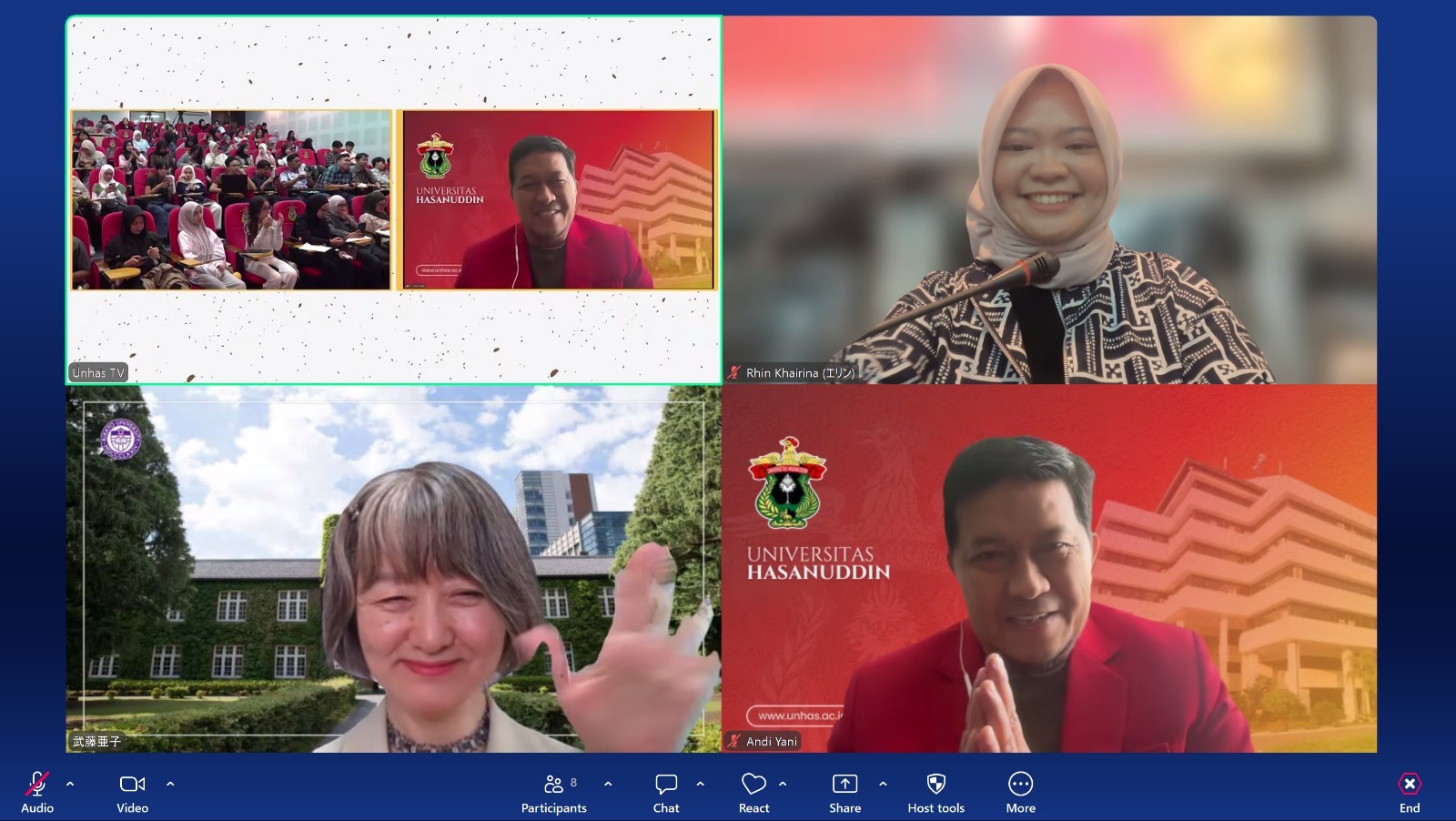
MAKASSAR – Peace is often imagined as a state in which there is no war and violence has ended. For societies that have just emerged from conflict, however, the end of violence can be the start of a much longer task. Peace can only be created by rebuilding institutions, repairing social relations, restoring the economy, and creating a sense of security.
This idea was at the heart of a public lecture titled “Peace, Peacebuilding, and Japan’s Cooperation in Peacebuilding,” organized by the International Relations Study Program of Hasanuddin University in cooperation with the Center for Peace, Conflict, and Democracy (CPCD) at Unhas.
The public lecture, held on Wednesday, 2 September 2026, was attended by more than 80 students taking the course Japan’s Political System and Foreign Policy. It was also attended by members of the academic community interested in peace issues and Japan’s foreign policy.
The keynote speaker, Prof. Ako Muto, Ph.D., Specially Appointed Professor in the Master of Social Development and Administration Course, Graduate School of Social Design Studies, Rikkyo University, Japan, invited participants to see how the concept of peace has developed from theory to the practice of Japan’s international cooperation in various post-conflict regions.
One of the concepts discussed was Johan Galtung’s (1969) thinking on negative peace and positive peace. Negative peace refers to the absence of direct violence, while positive peace demands a more just social condition. For this reason, lasting peace requires social repair, not merely an end to war.
Prof. Muto also explained the liberal peacebuilding approach, which places a free economy and good governance as part of the foundation of peace, along with various criticisms of that approach. The discussion also covered the four approaches in An Agenda for Peace (1992): preventive diplomacy, peacemaking, peacekeeping, and post-conflict peacebuilding.
This theoretical framework was then applied to Japan’s experience. One important actor is the Japan International Cooperation Agency (JICA), which through various programs contributes to building resilient state and society in post-conflict regions.
Mindanao in the Philippines is one example. According to Prof. Muto, Japan, through the Ministry of Foreign Affairs (MOFA) and JICA, has contributed to the peace process in the region, not only by facilitating negotiations but also by strengthening governance and developing the social and economic conditions of communities.
“Mindanao in the Philippines is an interesting example. In this region, Japan, through MOFA and JICA, has contributed to the peace process. That role is not only about facilitating negotiations, but also touches on more fundamental aspects, such as strengthening governance and developing the social and economic conditions of communities,” said Prof. Muto.
Japan’s historical experience has also contributed to this learning. Hiroshima, which was destroyed by the atomic bomb in 1945, provided important inspiration for Japan’s involvement in various reconstruction programs. This knowledge is then shared through various JICA training programs for participants from countries that have experienced conflict and need recovery.
The discussion became even more relevant when students linked Japan’s experience to Indonesia’s involvement in regional peace, particularly through the International Monitoring Team (IMT) in Mindanao. The IMT oversees the implementation of the ceasefire between the Philippine Government and the Moro Islamic Liberation Front (MILF). Japan is also part of that forum.
That experience shows that peace is work that crosses national borders. Countries that have not experienced conflict directly can play a role as mediators, monitors, or development partners.
Students then asked about the development of Indonesia-Japan relations, which now increasingly include security and defense dimensions. The question opened the perspective that peacebuilding is increasingly difficult to separate from issues of security, development, governance, and states’ strategic interests.
The public lecture was opened by Ishaq Rahman, S.IP., M.Si., Coordinator of the course Japan’s Political System and Foreign Policy at the Unhas International Relations Study Program. In the introduction, Ishaq explained the significance of the topic in relation to the challenges faced by countries around the world, including Indonesia.
“Peace is not merely a condition in which there is no war. Peace, especially from the Japanese perspective, extends into institutional reform, even to natural disaster response,” said Ishaq.
Meanwhile, Andi Ahmad Yani, S.Sos., M.Si., (representing CPCD Unhas) explained the importance of cross-institutional collaboration in broadening students’ perspectives on peace and conflict resolution. “We hope that more intensive and tangible collaboration can be built between Hasanuddin University and Rikkyo University on this issue,” said Andi Yani.
The discussion was moderated by Rhin Khairina Rahmat, S.IP., M.Si., a member of the course’s teaching team. Today’s theme showed that peacebuilding sits at the intersection of peace theory, history, diplomacy, development, governance, and security. Peace is not simply stopping war, but creating conditions so that conflict does not return.(*/hi/rhin)
Editor : Ishaq Rahman
This article is an English translation of the original Indonesian report.