
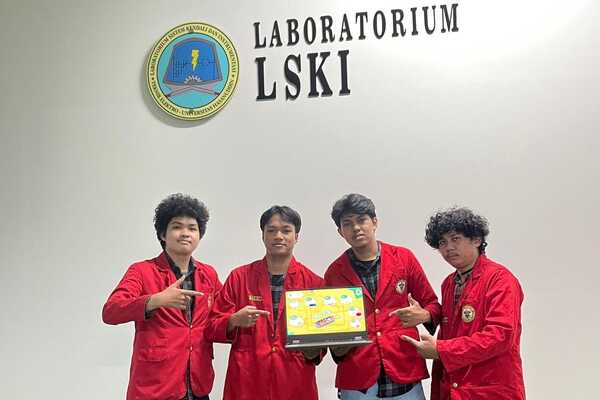
A team of Hasanuddin University students won the EcoBoss Greenpreneurship Pitch Challenge 2025 with an innovation called Aerotrak, a portable air pollution detection device built around environmental sustainability.
The Aerotrak team consists of Muhammad Al Mabrur G, Muhammad Farid Hidayat, Panji Bagus Satria, and Erland Gavril Rande. The four students collaborated to develop an innovation rooted in concern over the high health risks of air pollution, particularly exposure to PM2.5 fine particles.
The competition is part of the EcoBoss Greenpreneurship program, a collaboration between the Australian Government – Department of Foreign Affairs and Trade (DFAT), the Academy of Entrepreneurs Australia, and a number of universities in Indonesia. The program aims to develop students’ entrepreneurial spirit, oriented not only toward profit but also toward positive impact on the environment.
The competition selection began at the internal campus level. The Aerotrak team took first place and was chosen to represent Hasanuddin University. The team then passed the national selection and made it into the top six finalists to advance to the final stage of the pitch competition. In the final round, Aerotrak convinced the panel of judges and was crowned the winner.
Muhammad Al Mabrur, a team member, said the idea for Aerotrak came from the team’s concern about air pollution, which often goes unnoticed, is difficult to detect directly, and whose effects are not felt in the short term.
“Yet long-term exposure to air pollution can increase the risk of various serious diseases and even cause death. That is why Aerotrak was designed to help people monitor the air quality around them in real time and take preventive steps early,” Muhammad Al Mabrur said on Monday, 19 January 2026.
Through the win, the Aerotrak team received a prize of AUD 16,000, equivalent to around Rp170 million. The funds will be used to continue developing Aerotrak to the next stage, including technology refinement and production readiness.
Aerotrak is a small, practical, and easy-to-use tag-shaped device. It can be used as a keychain or attached to a bag or vehicle, making it suitable for people who often work outdoors, such as online motorcycle taxi drivers, field workers, and students.
“In terms of the system, Aerotrak is controlled by a microcontroller integrated with an air quality sensor and various other supporting components,” Muhammad Al Mabrur added.
Besides focusing on health, Aerotrak also emphasizes environmental sustainability. The device’s casing is made from recycled plastic waste, so it serves not only as an air pollution monitoring tool but also contributes to reducing plastic waste.
Unhas Vice Rector for Academic and Student Affairs, Prof drg Muhammad Ruslin MKes PhD SpBM(K), expressed appreciation and pride in the students’ achievement.
“This success is proof of the quality and competitiveness of Hasanuddin University students, and shows that the resulting innovation can address public health challenges and is in line with the commitment to environmental preservation,” said Prof. Ruslin.
After the competition, the Aerotrak team received various follow-ups from both the campus and the organizers. The team is encouraged to continue developing the innovation through the Greenpreneurship independent study program and is planned to take part in an expo next semester.
In addition, the team also received a one-year diploma and intensive mentoring from the Academy of Entrepreneurs to strengthen the development of its business model, product, and sustainability strategy.
The Aerotrak team is currently refining the product in terms of technical aspects, design, and production readiness, in the hope that Aerotrak can soon be commercialized and bring real benefits to the public in facing the threat of air pollution.(*/kmhs/fjr)
Editor: Ishaq Rahman
This article is an English translation of the original Indonesian report.