
MAKASSAR – Environmental change, increasingly evident in recent years, poses a serious challenge to Indonesia’s fisheries sector. Shifting seasonal patterns, increasingly unpredictable weather, fluctuating water quality, and changes in the distribution of fish resources have affected the productivity of both capture fisheries and aquaculture. These conditions call for adaptation strategies that are not only responsive but also science-based, so that the sustainability of fisheries resources and the welfare of coastal communities can be maintained.
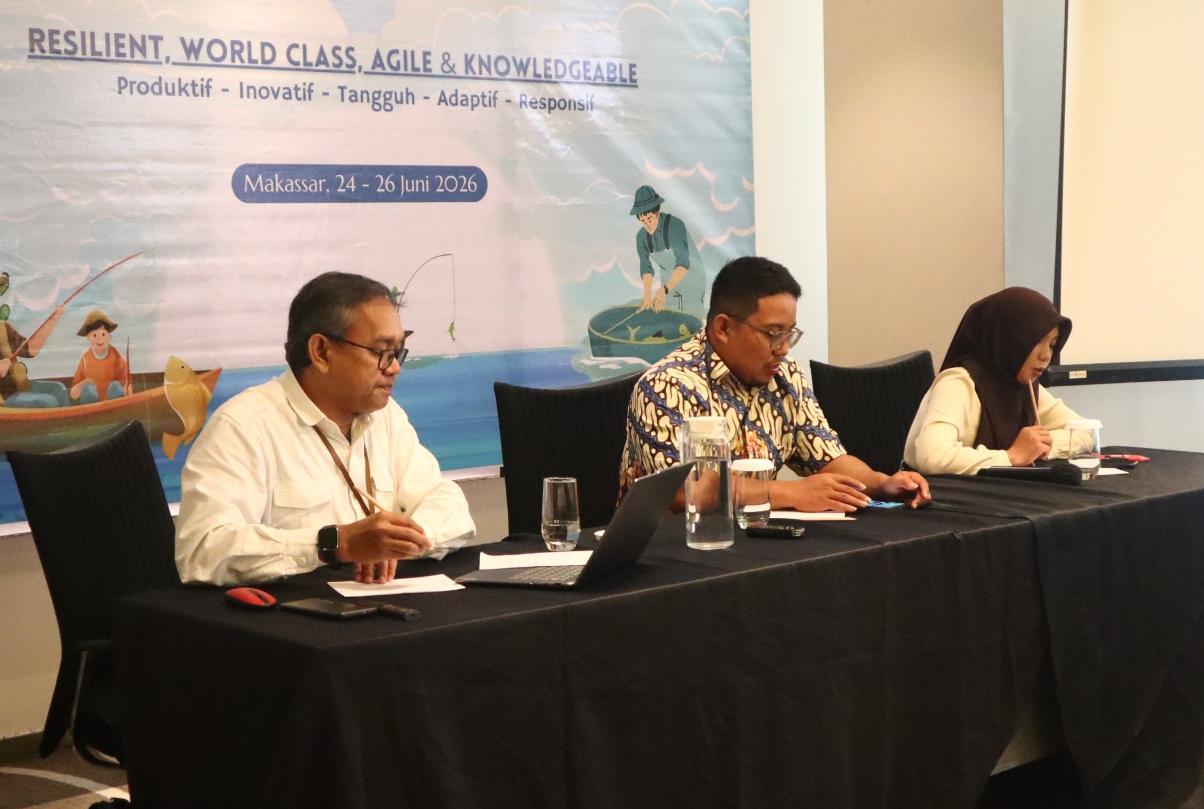
In response to these challenges, the Faculty of Marine Science and Fisheries (FIKP) of Hasanuddin University, together with Bank Indonesia and the Mattirotasi Mitra Lestari Foundation, initiated training and mentoring on risk management and adaptation to environmental change in sustainable fisheries management. The activity, held on Thursday (26 June) at the Novotel Makassar Hotel, was attended by about 22 fishers and fish farmers from various parts of South Sulawesi.
At the event, Muhammad Kurnia, a lecturer in the Fisheries Resource Utilization Study Program (PSP), FIKP Unhas, served as the main speaker, delivering material on risk management and adaptation strategies for environmental change in sustainable fisheries management.
In an interview on Monday (29 June), Muhammad Kurnia explained that environmental change has become an unavoidable challenge in developing the fisheries sector. Strengthening the capacity of fishers and fish farmers is one strategic step so that coastal communities can anticipate various risks while sustaining their livelihoods amid increasingly dynamic environmental conditions.
“Environmental change is no longer an issue to be faced in the future, but a reality felt directly by fishers and fish farmers. That is why the ability to adapt is an important factor in keeping the fisheries sector productive and sustainable,” Muhammad Kurnia explained.
Each impact of environmental change has its own characteristics and level of risk, and therefore requires a specific response. Fisheries management can no longer follow a uniform approach; it must be designed adaptively based on the ecological, social, and economic conditions of each area.
“Adaptation efforts aim not only to sustain fisheries production, but also to safeguard the sustainability of fish resources, improve fishers’ welfare, and strengthen the food security of coastal communities,” Kurnia added.
Kurnia further said that the various impacts of environmental change can be minimized through early risk identification, comprehensive risk assessment, and the application of systematically designed and sustainable adaptation strategies. An ecosystem-based approach to fisheries management is an important instrument for strengthening the resilience of the fisheries sector against environmental dynamics, while maintaining a balance between productivity and resource conservation.
Meanwhile, the Director of the Mattirotasi Mitra Lestari Foundation, Muh. Ikhsan Idrus, said the training provided a highly relevant learning space for coastal communities, who increasingly feel the impact of environmental change on their economic activities.
“We hope this educational activity can improve fishers’ and fish farmers’ understanding of the adaptation strategies that can be applied according to conditions in the field. That way, business productivity can be maintained while safeguarding the economic sustainability of coastal communities,” Ikhsan explained.
The training was interactive, with discussion sessions, case studies, and experience sharing between participants and the speaker. The problems fishers and fish farmers face in the field became shared learning material for formulating adaptive solutions suited to the characteristics of each area, so that the material was not only conceptual but also applicable.
The activity also reflects Hasanuddin University’s commitment to disseminating the results of academic research to the public through capacity building and science-based mentoring. Synergy among universities, government, community organizations, and the business sector is expected to be further strengthened to realize a fisheries system that is more adaptive to environmental change, economically productive, and sustainable in safeguarding Indonesia’s fisheries resources. (*/fikp/mir)
Editor: Ishaq Rahman
This article is an English translation of the original Indonesian report.