
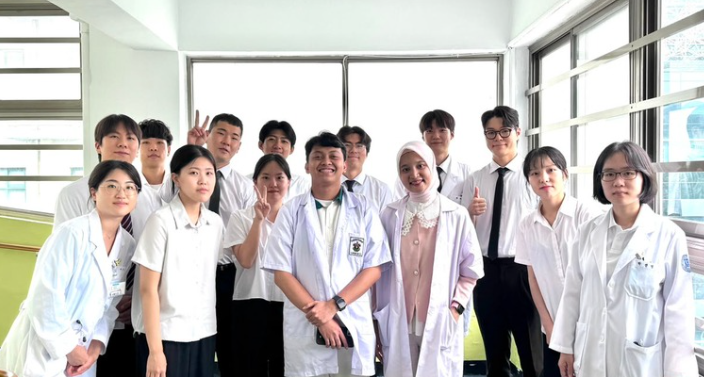
The Faculty of Medicine, Hasanuddin University (UNHAS) has once again demonstrated their commitment to global academic outreach by conducting an International Community Engagement (KKN) program at Chosun University, South Korea. The program took place from13 – 31 July, 2026, and involved four undergraduate medical students; Aldrich Benedict Sunjaya, Fadiyah Firdaus Hafid, Firyal Fadhilah Arif, and Giovanny Aprillio Putra Meringgi.
This initiative not only provided students with opportunities to deepen their clinical knowledge and skills, but also broadened their understanding of South Korea’s healthcare system, professional workplace culture, and multidisciplinary approaches to patient care. Throughout the program, participants engaged in clinical observations and learning across several specialized departments, including the Department of General Surgery, the Department of Neurosurgery, and the Department of Plastic, Reconstructive, and Facial Surgery. Through these activities, students gained direct, hands-on experience observing patient management, participating in case discussions with medical staff, and understanding the application of advanced technologies and modern surgical approaches at Chosun University Hospital.
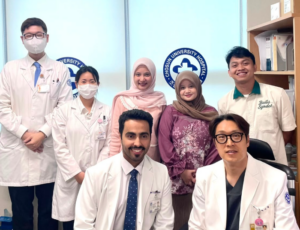
This International KKN program forms part of the ongoing international cooperation between the Faculty of Medicine, UNHAS, and Chosun University, South Korea, established through various academic and capacity-building ventures. This initiative directly aligns with SDG 3: Good Health and Well-Being by strengthening medical training and clinical exposure to advance global healthcare delivery, as well as SDG 4: Quality Education by offering students transformative international learning opportunities. Additionally, it supports SDG 17: Partnerships for the Goals by fostering cross-border academic collaboration between higher education institutions in Indonesia and South Korea.
The Faculty of Medicine, UNHAS, remains committed to expanding their global partnerships to produce outstanding, adaptable, and internationally competitive graduates capable of advancing medical science and healthcare delivery in the future.