
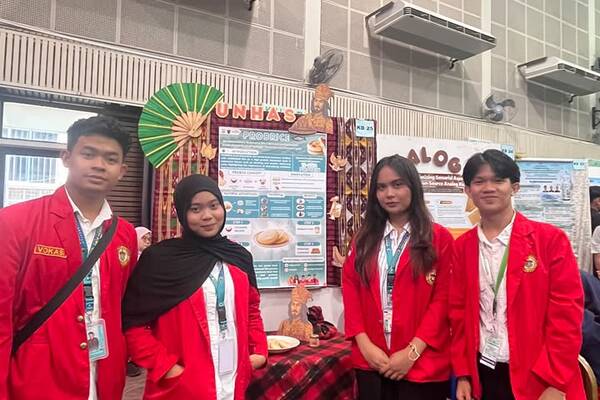
MALAYSIA – Rice bread, a traditional Sulawesi food, has great potential for development. However, rice-based products like this are generally still dominated by carbohydrate content and have not been widely developed as foods with higher functional value. Amid the need for food diversification and the development of local protein sources, product innovation can open opportunities to raise both the nutritional and economic value of traditional foods.
Starting from this problem, students of the Faculty of Vocational Studies at Hasanuddin University developed ProBRice, a Sulawesi-style rice bread fortified with snakehead fish as a protein source. The innovation won a Bronze Medal at the International Agrofood and Biotechnology Festival & Special Education Needs 2026, organized by Politeknik Sultan Ahmad Shah, Malaysia.
Team leader A. Muh. Nurfadil explained that ProBRice was developed to raise the nutritional value of local food products. Rice bread was chosen because it has cultural roots in Sulawesi and makes use of rice, one of the region’s main commodities.
“Rice bread is generally used as a source of carbohydrates. We tried adding snakehead fish as a substitute ingredient to provide protein content and better added value,” Fadil explained.
The innovation is titled “ProBRice: A Sulawesi-Style Rice Bread Innovation Fortified with Snakehead Fish as a High-Protein Functional Food.” The team chose snakehead fish for its protein, albumin, essential amino acids, and minerals.
Through this formulation, the Unhas vocational student team raised the nutritional value of rice bread, which has long been known only as a source of carbohydrates. In developing ProBRice, the team faced several challenges. Fadil said the team had to adjust the formulation so that local rice flour could replace wheat flour, while the addition of snakehead fish still produced a product with good characteristics and flavor.
The development stages included cleaning and grinding the ingredients, mixing, fermentation, molding, and cooking. Preparing for the competition also involved drafting the innovation concept, designing the exhibition booth, designing the packaging, and conducting laboratory testing.
“All these stages are part of the process of translating the potential of local food into an innovation that can be introduced in an international forum,” Fadil said.
The opportunity to join the competition came while the team was taking part in a Student Exchange program in Malaysia through Unhas’s cooperation with Politeknik Sultan Haji Ahmad Shah (POLISAS). During their academic and cultural activities, the team had the chance to take part in this international competition.
Fadil hopes ProBRice can continue to be developed as a functional food alternative based on local ingredients. The product’s development is also expected to open opportunities for using rice and snakehead fish in the regional economic chain, including for farmers and raw material suppliers.
The development of ProBRice is relevant to achieving the Sustainable Development Goals (SDGs), particularly SDG 2 (Zero Hunger) through food diversification and the development of products with better nutritional value. The innovation also supports SDG 3 (Good Health and Well-Being), SDG 8 (Decent Work and Economic Growth) through the potential to raise the economic value of local raw materials, and SDG 9 (Industry, Innovation, and Infrastructure) through developing food innovation based on local resources.
The vocational student team involved was:
1. A.Muh.Nurfadil
2. Nur Rahma Yasin
3. Sulham Achmad
4. Irene Renata Simanjuntak
5. Dirga Amrul Muslimin
(*/MIR)
Editor: Ishaq Rahman
This article is an English translation of the original Indonesian report.