
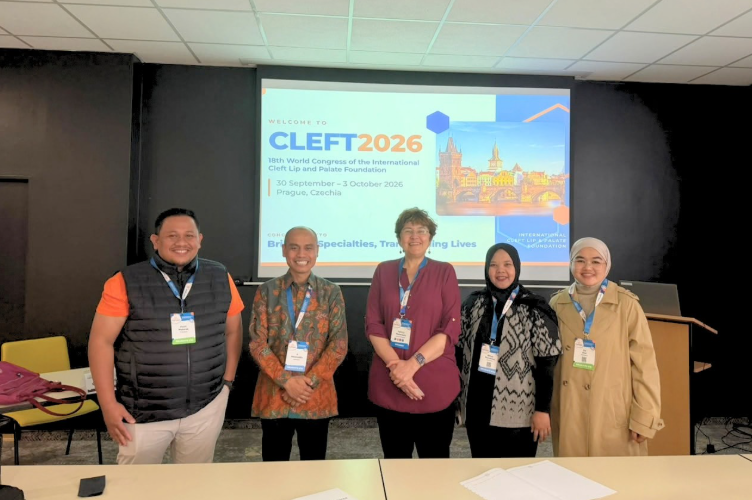
Four lecturers from the Faculty of Dentistry Hasanuddin University, representing four different disciplines, presented their research on cleft lip and palate (CLP) at the 18th World Congress of the International Cleft Lip and Palate Foundation (CLEFT 2026), held on 30 September–3 October 2026 in Prague, Czech Republic. Organized by the international foundation, the congress carried the theme “Bridging Specialties, Transforming Lives,” emphasizing cross-specialty collaboration. It brought together researchers and clinicians from 46 countries across five continents, including the United States, the United Kingdom, Japan, India, Brazil, and South Africa. Also in attendance were non-profit organizations that provide free CLP treatment, such as Smile Train as the main sponsor, the Cleft Prevention International Foundation, the Noordhoff Craniofacial Foundation, CLAPA from the United Kingdom, and the Celebes Cleft Center (CCC) from Makassar.
CLP is the most common congenital facial and oral anomaly in the world, occurring in about 1 in 700 births. In Indonesia, the 2024 Indonesian Health Survey (SKI) recorded 240 cases per 100,000 births. That is twice the 2018 rate, or about 7,500 babies a year. Without comprehensive treatment, CLP impairs a child’s feeding, speech, hearing, and psychosocial well-being. With around 17,380 islands, access to health services in Indonesia remains difficult. A 2024 study by the Unhas team showed that the main barriers are parents’ lack of knowledge, concerns about the safety of procedures, and the cost of inter-island transport and accommodation. High family mobility also often breaks the referral chain, while specialists remain concentrated in urban areas.
Thus, in response to these challenges, Prof. Muhammad Ruslin, drg., M.Kes., Ph.D., Sp.B.M.Mf., Subsp.Ortognat-D, and Dr. Andi Tajrin, drg., M.Kes., Sp.B.M.Mf., Subsp.C.O.Mf., together with their team, founded the CCC Foundation in 2011. The foundation brings together specialists from various fields, speech therapists, and funding partners. Through this collaborative approach, they provide comprehensive, research-based CLP care free of charge, reaching communities in remote areas of eastern Indonesia.
Building on this commitment to evidence-based care, Husni Mubarak, drg., Sp.B.M.Mf., presented findings on risk factors for CLP in eastern Indonesia based on a study involving 497 participants. The study found that maternal age under 20, low maternal education, the use of cold medicine during pregnancy, and drinking well water were associated with a higher risk of CLP. Conversely, milk consumption, vitamin intake during early pregnancy, and regular physical activity were associated with a lower risk.
While understanding risk factors is essential for prevention, early clinical intervention is equally important. In this regard, Rifaat Nurrahma, drg., Sp.Pros.(K), presented the use of presurgical nasoalveolar molding (PNAM) appliances and lip taping in newborns at RSGMP Unhas. These methods help narrow the lip cleft and improve nasal symmetry before surgery, thereby facilitating subsequent treatment. However, their effectiveness depends largely on parental compliance.
Beyond early intervention, the congress also highlighted treatment possibilities for patients who receive care later in life. Ita Purnama Alwi, drg., Sp.Ort., presented a poster on orthodontic treatment without jaw surgery for a 19-year-old patient who had never undergone palatal surgery. Using the MEAW (Multiloop Edgewise Archwire) technique, the crossbite was corrected and the patient’s smile improved. This case demonstrates that even patients who present for treatment at a later stage may still have viable treatment options.
However, individual treatment options must be considered within the broader challenges of accessing CLP care. Hasanuddin, M.Sc., presented barriers to CLP treatment and strategies to address them, based on an analysis of 1,610 cases from CCC surgical missions. In addition to financial and geographical constraints, the study identified a cultural belief that CLP cannot be treated. Furthermore, the shortage of specialists often results in lip surgery being prioritized over palatal surgery, despite the greater functional importance of palatal repair. To address these interconnected challenges, the CCC model emphasizes cross-sector collaboration involving NGOs, universities, and government institutions, including the Indonesian National Police (Polri) and the Indonesian National Armed Forces (TNI), which provide logistical support. Complementing these scientific and clinical discussions, the congress also featured a fundraising event, Run for Cleft Prevention, aimed at supporting efforts to prevent CLP and raise public awareness of the condition.