
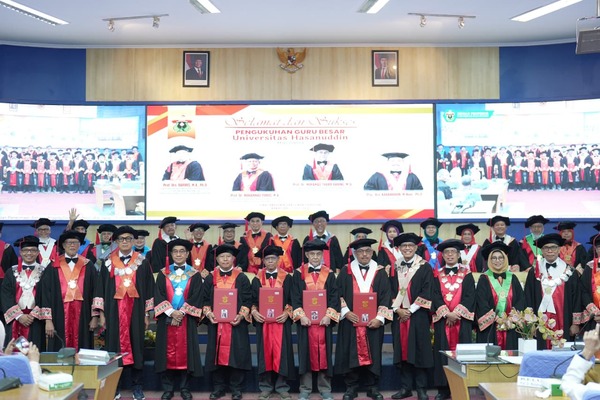
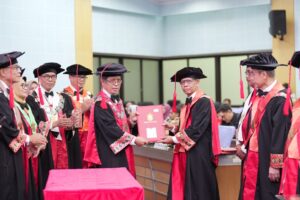
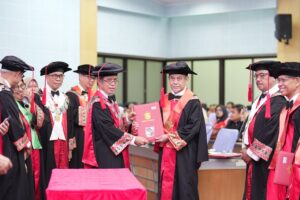
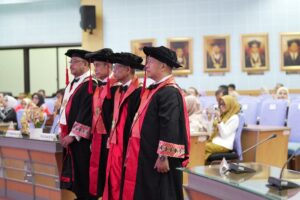
MAKASSAR – Global geopolitical dynamics, bureaucratic reform, the strengthening of public organizations, and the preservation of regional languages were the focus of studies by four Hasanuddin University professors at the Limited Plenary Meeting of the Academic Senate for the Professor Acceptance Ceremony, held in the Academic Senate Room, 2nd Floor of the Rectorate Building, Tamalanrea Campus, Makassar, on Friday (17 July).
In their scientific addresses, the professors presented research findings that offer an academic foundation for strengthening public policy, government administration, and the preservation of Indonesia’s linguistic heritage.
The four professors who delivered scientific addresses were:
1. Prof. Drs. Darwis, M.A., Ph.D. – Professor of Indonesian Foreign Policy, Faculty of Social and Political Sciences.
2. Prof. Dr. Muhammad Yunus, M.A. – Professor of Public Management, Faculty of Social and Political Sciences.
3. Prof. Dr. Mohamad Tahir Haning, M.Si. – Professor of Development Administration, Faculty of Social and Political Sciences.
4. Prof. Drs. Kaharuddin, M.Hum., Ph.D. – Professor of Phonology, Faculty of Cultural Sciences.
Below is a summary of the professors’ acceptance speeches, which can also be watched on the Unhas Academic Senate YouTube channel.
Prof. Drs. Darwis, M.A., Ph.D.
The scientific addresses began with a presentation by Prof. Darwis titled “Recalibrating Indonesia’s Foreign Policy in ASEAN amid Indo-Pacific Geopolitical and Geostrategic Dynamics: Regional Security Complex and Neoclassical Realism Perspectives.”
Prof. Darwis explained that changes in the global geopolitical context have influenced the direction of Indonesia’s foreign policy in the ASEAN region. The rivalry between the United States and China has pushed middle powers, including Indonesia, to adjust their diplomatic strategies by recalibrating their foreign policy.
In the presentation, Prof. Darwis outlined that, through the Two-Level Game concept introduced by Putnam (1988), foreign policy is the result of simultaneous interaction between international pressures and domestic political dynamics.
“Based on this analysis, Indonesia’s foreign policy has shifted from a Cycle Centris Foreign Policy to an Intermestic Foreign Policy,” Prof. Darwis explained.
Prof. Darwis added that this shift is understood through the lens of Regional Security Complex Theory (RSCT) and Neoclassical Realism, with ASEAN remaining the cornerstone of Indonesia’s foreign policy. Therefore, Indonesia needs a more adaptive and proactive foreign policy to maintain strategic autonomy and regional stability.
Prof. Dr. Muhammad Yunus, M.A.
On the same occasion, Prof. Muhammad Yunus delivered a speech titled “Organizational Restructuring: Realizing an Adaptive Public Bureaucracy.” The topic describes how a changing environment, shaped by technological developments, regulation, public demands, and globalization, requires public organizations to restructure so that they can respond to change quickly, innovatively, and responsively.
Prof. Muhammad Yunus explained that organizational restructuring is not merely a slimming down of bureaucratic structures but a process of improving work systems through strengthening human resources, organizational digitalization, decentralization of authority, and multi-stakeholder collaboration.
“These four aspects form the foundation for building an adaptive public organization that can support the implementation of good public governance,” said Prof. Muhammad Yunus.
According to Prof. Muhammad Yunus, an adaptive public organization will deliver services that are more effective, efficient, transparent, accountable, and sustainable, in line with the demands of a continually evolving society.
Prof. Dr. Mohamad Tahir Haning, M.Si.
The next scientific address was delivered by Prof. Mohamad Tahir Haning in a study titled “Building Public Trust in Government Policy through Bureaucratic Reform in Indonesia.”
Prof. Tahir Haning explained that in the era of globalization and digitalization, the discipline of development administration is expected to produce policies that are adaptive, inclusive, and sustainable as a prerequisite for building public trust.
According to Prof. Tahir Haning, bureaucratic reform is oriented not only toward improving government administration but also toward strengthening public confidence in the government’s integrity, transparency, and accountability in formulating and implementing development policy.
“From the perspective of New Public Governance, trust becomes an important mechanism that strengthens coordination among stakeholders and determines the effectiveness of public policy implementation,” Prof. Tahir Haning explained.
Prof. Tahir Haning added that public trust is built through continuous interaction between government and society, supported by tangible policy performance and people’s experience of the benefits of development. Therefore, bureaucratic reform needs to strengthen fairness, legitimacy, and public participation so that it can support the achievement of development goals in the social, economic, and political fields.
Prof. Drs. Kaharuddin, M.Hum., Ph.D.
Meanwhile, Prof. Kaharuddin delivered a scientific address titled “Phoneme Correspondence in the Bugis–Makassar Language.” The address explains that phonology plays an important role in understanding sound patterns, syllable structure, stress, intonation, and the processes of sound change in various languages and dialects. Phonological study is not only a basis for understanding language systems but also supports the development of language technology, learning, documentation, and the preservation of regional languages.
Through the research findings, Prof. Kaharuddin found phoneme correspondences between the Bugis and Makassar languages in word-initial, word-medial, and word-final positions.
“These phoneme correspondences do not occur by chance but are caused by sound laws that operate in the Bugis–Makassar language,” Prof. Kaharuddin explained.
One of the rules identified is the change of the phoneme /ɔ/ in Bugis to /a/ in Makassar in a number of words with the same meaning. The finding enriches phonological studies while supporting efforts to document and preserve regional languages as part of Indonesia’s cultural heritage.
The Academic Senate Plenary Meeting for the Professor Acceptance Ceremony proceeded smoothly and solemnly until the entire program was complete. (*/dhs)
Editor: Ishaq Rahman
This article is an English translation of the original Indonesian report.