
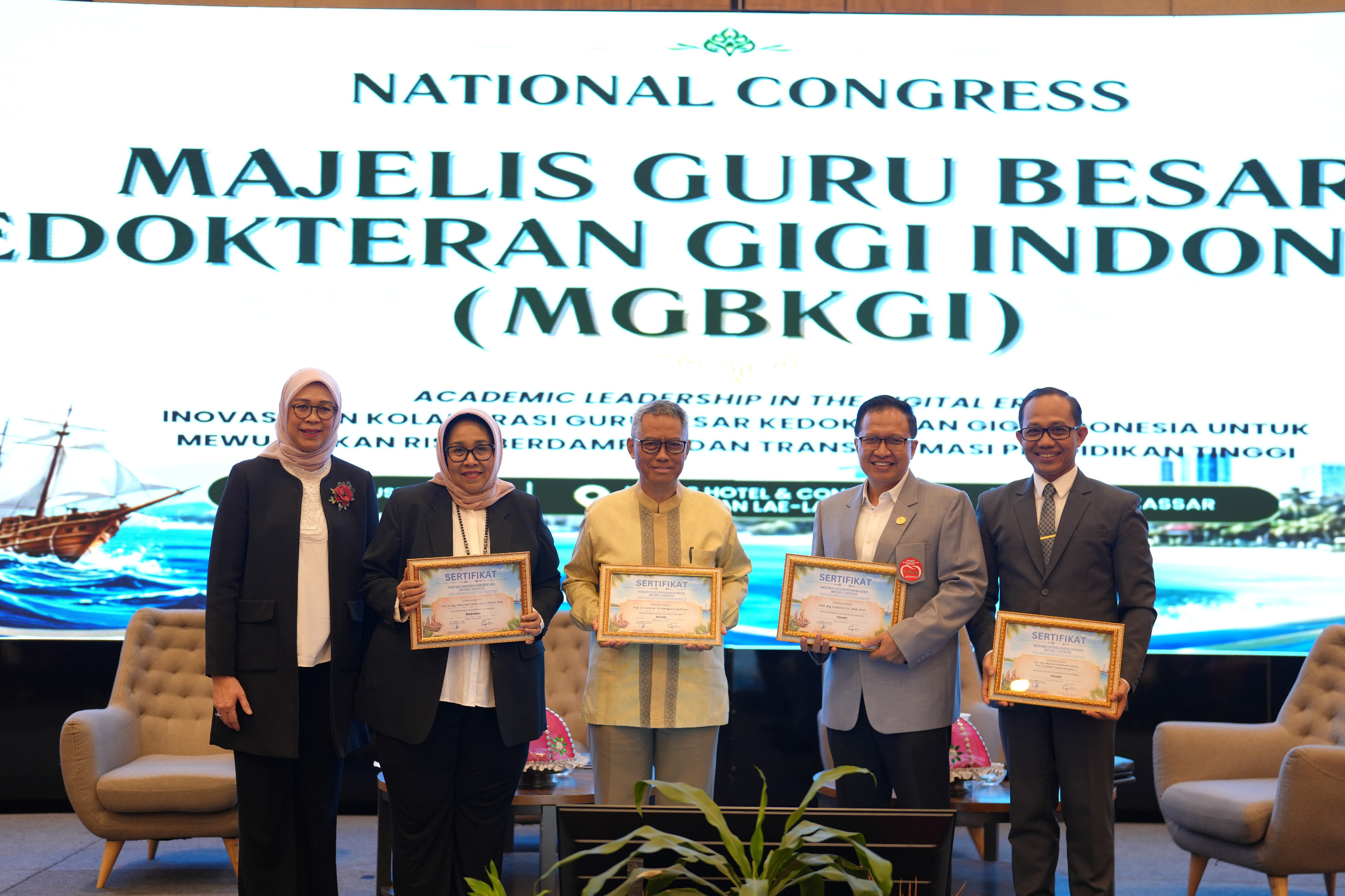
” Professors do not merely represent the highest academic achievement. Behind that title lies the responsibility to steer the commercialization of research, strengthen internationalization, and uphold professionalism in the development of higher education.” (Prof. Muhammad Ruslin, Chair of MGBKGI)
MAKASSAR – Advances in digital technology continue to change the face of dental education. At the same time, Indonesia still faces long-standing problems, such as unequal access to dental health services, uneven distribution of medical personnel, and research results that do not yet fully address society’s needs. These challenges were the focus of the scientific panel session at the first National Congress of the Indonesian Council of Dentistry Professors (MGBKGI).
The panel discussion featured three speakers:
1. Prof. Dr. med. Tri Hanggono Achmad., from Padjadjaran University (Unpad), Expert Staff to the Minister of Higher Education, Science, and Technology,
2. Prof. drg. Suryono, S.H., M.M., Ph.D., Chair of AFDOKGI, from Gadjah Mada University.
3. Prof. drg. Muhammad Ruslin, M.Kes., Ph.D., Sp.BMMf., Subsp.Ortognat.D., Chair of MGBKGI, from Hasanuddin University.
The panel discussion was moderated by Prof. Dr drg Yulita Hendrartini. MKes, FISDPH, FISPD from Gadjah Mada University,
Prof. Tri Hanggono Achmad explained that higher education in health needs to be oriented toward improving access, quality, relevance, and impact. These four aspects are in line with the direction of national development, which encourages the production of high-quality health workers while accelerating the commercialization of research to strengthen the health care system.
“Educational institutions play an important role in accelerating health innovation by strengthening technology transfer, developing clinical research, and conducting research relevant to Indonesia’s health needs,” said Prof. Hanggodo.
Another perspective was offered by Prof. drg. Suryono, S.H., M.M., Ph.D., who reminded the audience that science cannot be separated from humanitarian values. Universities must be present as problem-solvers for the nation, while academics are expected to actively offer solutions rather than merely observe challenges.
Several problems remain in the health sector, particularly dental health. Dentists and specialist dentists are unevenly distributed, and access to services is limited by financing and geographic conditions, especially in frontier, outermost, and disadvantaged (3T) regions. In addition, standards for the facilities and infrastructure of health care providers are not yet fully even, while most dental materials and equipment still depend on imported products.
“Technological developments also open new opportunities. Adapting to artificial intelligence, 3D printing technology, and teledentistry needs to be part of dental education curriculum development so that graduates can keep pace with scientific progress and the needs of modern health care,” said Prof. Suryono.
MGBKGI Chair Prof. Muhammad Ruslin views professors as having a strategic responsibility to raise the value of the academic community. This role can be carried out by mentoring young lecturers toward scientific publications and patents, opening international research networks for students, and strengthening a research-to-impact culture within departments. Professors also play a role in expanding the internationalization of universities by increasing the visibility of scientific publications, running visiting professorship programs, and pursuing cross-country research collaboration.
“Professors are leaders in the digital era. Amid technological disruption, universities must be able to provide spaces that encourage the academic community to keep innovating. The MGBKGI forum opens opportunities to expand collaboration with the government, industry, and various strategic partners,” said Prof. Ruslin.
Professors do not merely represent the highest academic achievement. Behind that title lies the responsibility to steer the commercialization of research, strengthen internationalization, and uphold professionalism in the development of higher education.
The series of discussions showed that the transformation of dental education cannot rely on technological progress alone. Strengthening human resources, cross-sector collaboration, research commercialization, and equitable access to health services remain the main foundations so that academic innovation can bring wider benefits to society. (*/dhs)
Editor : Ishaq Rahman
This article is an English translation of the original Indonesian report.