
Hasanuddin University (UNHAS), in collaboration with the University of Newcastle (UoN), Australia, and the Sidenreng Rappang (Sidrap) Regency Government, implemented Harvesting the Future 2026: Smart Farming for Climate Resilience, an international program designed to strengthen climate-resilient agriculture through digital technologies, data-informed farming, and farmer capacity building.
Supported by the Australian Government through the Australia-Indonesia Institute (AII), the program brought together academics, government representatives, agricultural professionals, students, farmers, and extension officers through a series of activities held in Makassar and Sidrap in August 2026.
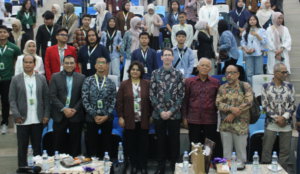
The program began with the International Seminar on Smart Farming for Climate Resilience at the Arsjad Rasjid Lecture Theatre, UNHAS, on August 3. Approximately 130 participants attended in person, while around 250 joined online.
Speakers included Prof. Hasil Sembiring; Associate Professor Lisa Lobry de Bruyn; Australian Consul-General in Makassar Todd Dias; Prof. Dr. Ir. Aris Pramudia, M.Si., from Indonesia’s National Research and Innovation Agency (BRIN); and Prof. Omer Rana from Cardiff University. Discussions covered climate change, smart agriculture, digital technologies, and opportunities to deepen Australia-Indonesia cooperation in agriculture.
Representing the University of Newcastle, Dr. Shaleeza Sohail emphasized that technological sophistication alone does not make an agricultural innovation useful.
«“Smart agriculture should not simply introduce sophisticated technologies, but ensure that farmers are able to adopt and benefit from them,” she said.»
The partnership therefore emphasizes technologies that are practical, adaptive, affordable, and responsive to farmers’ actual needs.
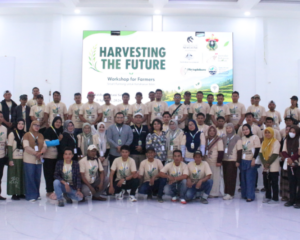
Following the seminar, the program moved from academic discussion to community-level application through a four-day workshop series in Sidrap from August 5–8. Around 300 farmers and agricultural extension officers participated in training on artificial intelligence, the Internet of Things, sensors, and data-informed decision-making.
Participants examined how real-time field information could improve decisions on fertilization, irrigation, pest and disease management, and other farming practices.
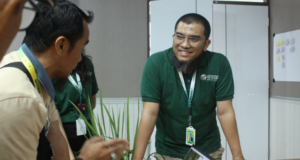
Muhammad Junaid, S.P., M.P., Ph.D., Head of the UNHAS Subdirectorate for Network Strengthening and Chair of the Harvesting the Future team, explained that the initiative builds on approximately two years of engagement with farming communities in Sidrap. Rather than replacing farmers’ experience, the program encourages the integration of local knowledge with measurable field data to support more precise and efficient decision-making.
The workshops combined presentations, discussions, technology demonstrations, and problem identification. The initiative continued with an international symposium and poster competition at the Faculty of Agriculture, UNHAS, extending the conversation to emerging research and practical applications, including drone technology and digital agriculture.
Harvesting the Future 2026 demonstrates how an international university partnership can move from research and discussion into practical application. By connecting farmers’ knowledge with accessible technologies, scientific expertise, and government support, the program seeks to improve agricultural decision-making while helping farming communities respond to climate uncertainty and food-production challenges. Its inclusion of farmers, extension officers, students, women, and young people also broadens participation in shaping more resilient agricultural systems in Eastern Indonesia.