
The Graduate School of Hasanuddin University (UNHAS) hosted an international guest lecture on Tuesday, 29 September 2026, featuring Assoc. Prof. Mansoor Abdul Hamid from Universiti Malaysia Sabah (UMS), Malaysia. Under the theme “Food Innovation from Underutilized Agriculture Materials: Food Security Solution Approach,” the lecture explored how underutilized agricultural resources could be transformed into value-added food products to support food security and sustainable food innovation.

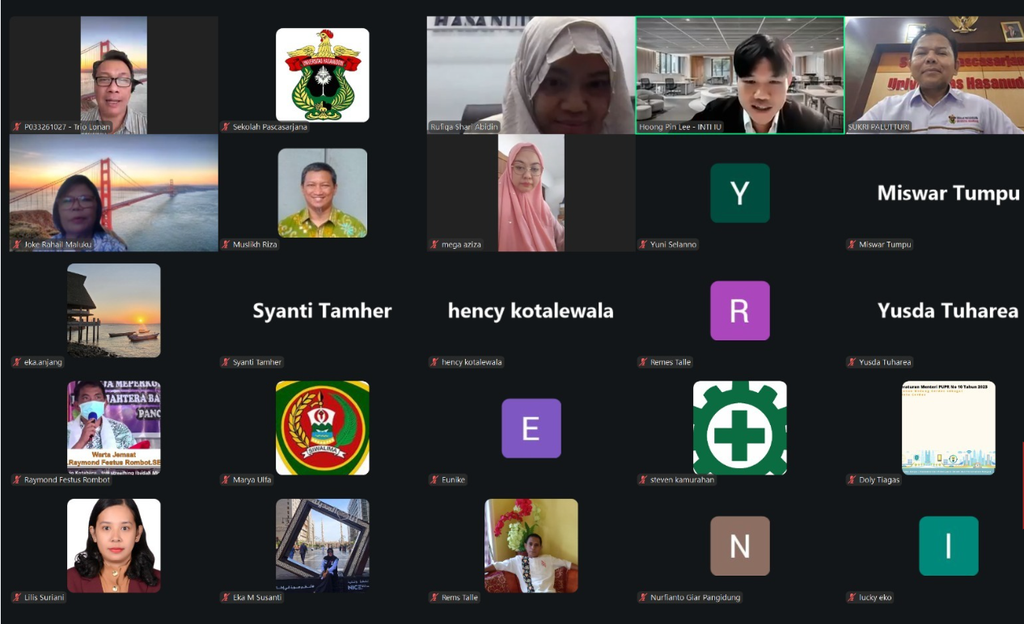
Held in a hybrid format at the Prof. Dr. Ir. Fachruddin Hall, UNHAS Graduate School, and via Zoom, the event brought together academics, researchers, and students to discuss food product development and opportunities for international research collaboration. The session was moderated by Dr. Andi Muliarni Okasa, S.P., and officially opened by Prof. dr. Marhaen Hardjo, M.Biomed., Ph.D., Vice Dean responsible for research, innovation, and cooperation, representing the Dean of the UNHAS Graduate School.
In his opening remarks, Prof. Marhaen emphasized the relevance of food innovation in addressing food security challenges, particularly through the scientific exploration of agricultural materials that remain underutilized. He highlighted the potential for transforming these resources into valuable food products through research and appropriate technologies. He also encouraged stronger academic cooperation between UNHAS and UMS in research, innovation, joint publications, and academic exchanges.
During his presentation, Assoc. Prof. Mansoor discussed the relationship between food availability, accessibility, and utilization, emphasizing that sufficient food production alone does not guarantee food security. He noted that accessibility, food safety, and nutritional adequacy must also be considered when developing sustainable food solutions. Drawing on his research in food science and product development, he highlighted opportunities to convert agricultural resources and processing by-products into innovative food products.
Using jackfruit and mango as examples, Mansoor explained that conventional processing often focuses on the edible flesh, leaving other parts of these fruits relatively unexplored. These underutilized materials could offer opportunities for further investigation into their nutritional properties and potential applications in food production. He also highlighted Indonesia’s agricultural diversity as an advantage for developing locally sourced food innovations, while noting challenges related to raw material availability, collection, processing technologies, and the practical application of research findings.
The lecture provided a platform for knowledge exchange between Indonesia and Malaysia on food innovation, agricultural resource utilization, and food security. Through this academic engagement, the UNHAS Graduate School continues to strengthen international collaboration while encouraging research that transforms local agricultural potential into practical and sustainable food solutions.