
Prof. Sukri Palutturi, S.KM., M.Kes., M.Sc.PH., Ph.D., Dean of the Graduate School at Hasanuddin University (UNHAS), served as a featured speaker at “the 6th East Borneo Health International Conference (EBHIC) 2026”, organized by the Health Polytechnic of the Ministry of Health of East Kalimantan. At the conference, Prof. Sukri delivered a presentation entitled “Creating a Healthy City for Community Well-being.” In his presentation, he emphasized that cities should not be viewed merely as collections of buildings, roads, bridges, and physical infrastructure. Instead, cities are living systems that connect people, environments, institutions, public services, and opportunities. For this reason, the success of urban development should be measured not only by economic growth or infrastructure expansion, but also by the extent to which people can live healthy, safe, connected, and fulfilling lives. “A developed city is not simply one with tall buildings and modern infrastructure. Real progress can be seen in how well people are able to live, access services, feel safe, build social connections, and participate in development,” Prof. Sukri said. He stressed that the healthy city concept places people and well-being at the center of urban policy and planning.
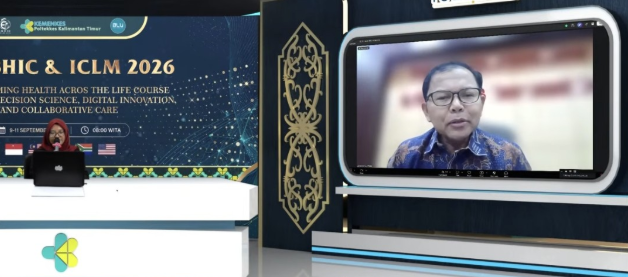
According to him, health is shaped not only in hospitals, community health centers, clinics, and other healthcare facilities. It is also influenced by the places where people are born, grow, study, work, live, interact, and age. Housing quality, education, income, employment, transportation, public spaces, access to healthy food, environmental conditions, safety, and social relationships all play important roles in determining community health. “Health professionals may encourage people to exercise regularly, but that advice becomes difficult to follow when neighborhoods lack safe sidewalks, parks, or accessible public spaces,” he explained. “Creating healthy communities therefore requires environments and policies that make healthy choices easy, safe, and affordable.”
He also highlighted current urban health challenges, including rapid urbanization, population growth, noncommunicable diseases, mental health concerns, social isolation, environmental pollution, climate change, disasters, and unequal access to basic services. He noted that these challenges do not affect all groups equally, with low-income communities and vulnerable populations often facing greater health burdens. He further emphasized that green and public spaces should be recognized as part of health infrastructure. Parks, pedestrian paths, playgrounds, community gardens, and waterfront areas can promote physical activity, reduce stress, strengthen social interaction, and help cities adapt to climate change. Urban planning and transportation policies, he said, should therefore support environments that are healthy, inclusive, safe, and accessible to people of all ages and abilities.
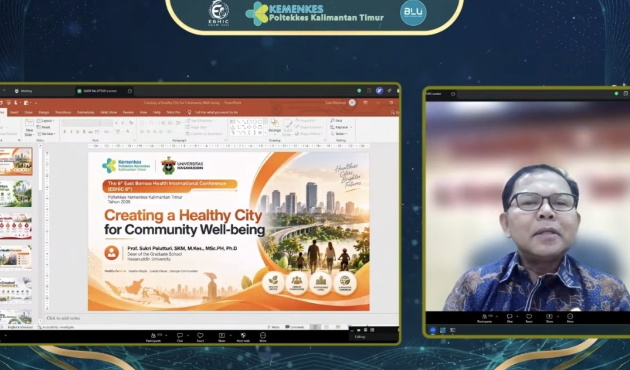
Additionally, to advance healthy city development, he introduced the “Pentahelix Plus Community” approach, which combines whole-of-government and whole-of-society principles. The model brings together national and local governments, health and non-health sectors, universities, professional associations, the private sector, civil society, media, and community and religious leaders. “No single institution can create a healthy city alone. The collaborations we build today are the foundation for healthier, more resilient, equitable, and sustainable cities in the future,” he said.
Prof. Sukri’s participation in the 6th EBHIC 2026 highlighted Hasanuddin University’s contribution to advancing the healthy cities agenda in Indonesia. The conference also provided an opportunity to strengthen collaboration among universities, government institutions, health professionals, researchers, and communities in promoting healthier, more inclusive, equitable, resilient, and sustainable urban development.
Furthermore, he also introduced the “Urban Health and Healthy Cities Research Group”, a multidisciplinary research group under his leadership that examines urban health challenges and develops evidence-based solutions. The group integrates perspectives from public health, urban planning, governance, environmental health, and social sciences through research, scientific publications, education, community engagement, and national and international collaboration. Concluding his presentation, he called on stakeholders to move from discussion toward collective action. He emphasized that decisions related to housing, transportation, public spaces, education, the environment, climate action, and economic development are ultimately also decisions about health and equity.