
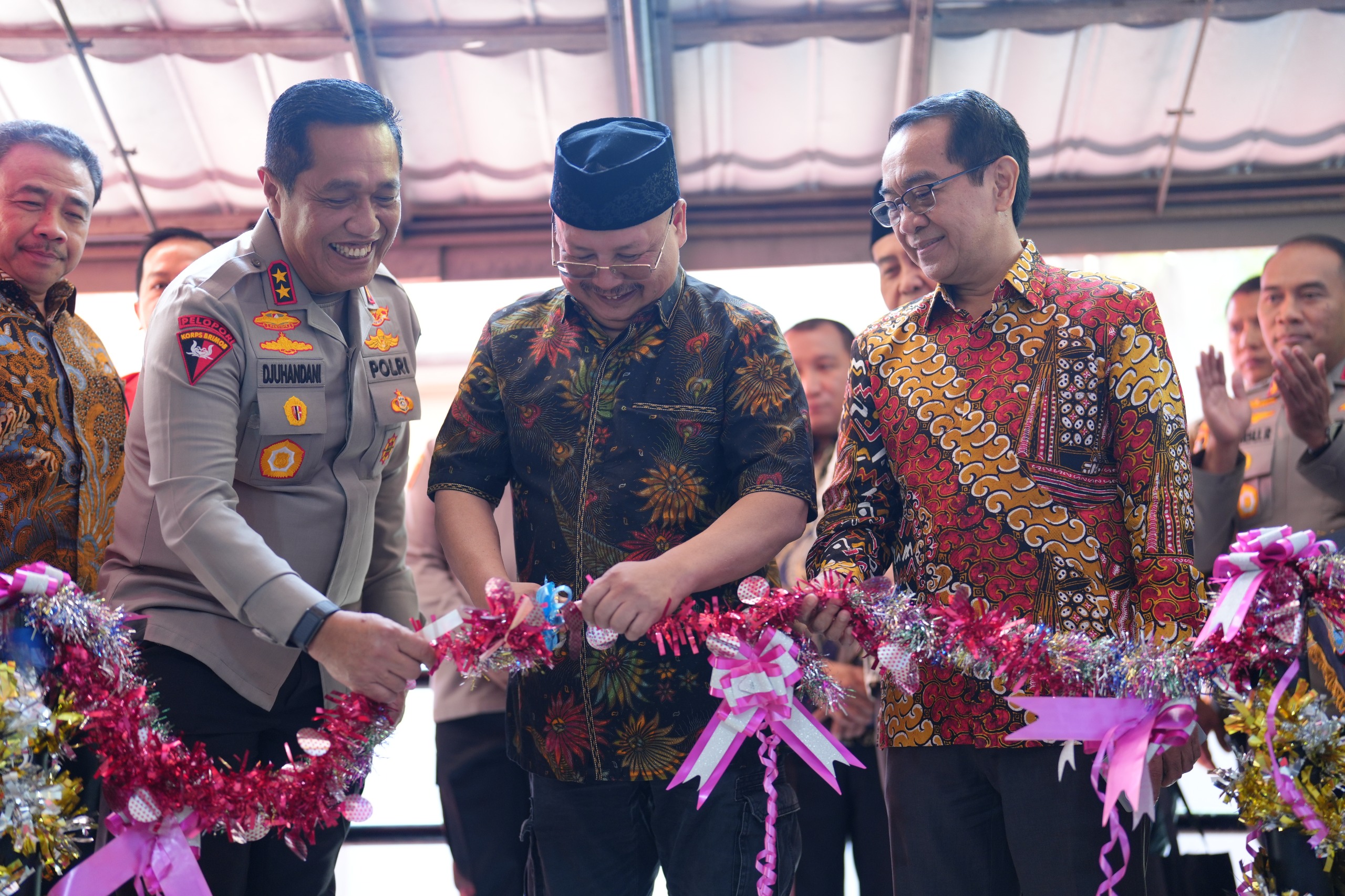
MAKASSAR – Hasanuddin University now officially has a Police Studies Center. The center is expected to develop as a space for collaboration between academics and the police in studying various security and social issues based on research.
The Unhas Police Studies Center was officially launched together with the signing of a Cooperation Agreement between Unhas and the South Sulawesi Regional Police. The event took place at the Prof. Dr. H. Baharuddin Lopa Hall (Baruga), Unhas Faculty of Law, on Wednesday, 9 September 2026.
The launch was attended by Hasanuddin University Rector Prof. Dr. Ir. Jamaluddin Jompa, South Sulawesi Regional Police Chief Insp. Gen. Djuhandhani Rahardjo Puro, and several officials of the Indonesian National Police Headquarters, among them Comr. Gen. Prof. Dr. Chryshnanda Dwilaksana, Insp. Gen. Gatot Repli Handoko, Insp. Gen. Dr. Susilo Teguh Raharjo, and Insp. Gen. Dr. Umar Efendi.
The center is intended to integrate the strength of academic research with the needs of police practice. Its studies cover not only legal aspects but also social issues, security, and increasingly complex challenges of digital crime.
Hasanuddin University Rector Prof. Dr. Ir. Jamaluddin Jompa said the establishment of the Police Studies Center is an important achievement for Unhas, which was the first to initiate a police studies center within a campus.
The Unhas Faculty of Law has been entrusted as the main base for the studies, but the approach used is cross-disciplinary and involves various fields of knowledge.
Prof. JJ went on to give examples of issues that require a cross-disciplinary approach, such as juvenile delinquency, illegal street racing, and various environmental and security problems in coastal waters. One issue that has drawn the Rector’s particular attention is the practice of blast fishing.
Prof. JJ explicitly asked that the issue of blast fishing be one of the first tasks studied by the Unhas Police Studies Center.
“How can we resolve blast fishing in our waters? We are not only studying the legal articles, but how this study center can make the problem its main focus of study and seek solutions using disciplinary and cross-disciplinary approaches,” Prof. JJ stressed.
Meanwhile, South Sulawesi Regional Police Chief Insp. Gen. Djuhandhani Rahardjo Puro hoped that research results from the center can become a reference in policy-making and in carrying out police duties.
“Every research result from the center will be our reference. So we will not rely only on routine and experience, but will race ahead on data and research results,” said Djuhandhani.
Insp. Gen. Djuhandhani said violations in coastal waters, including blast fishing, are a rather complex problem. Various steps have been taken, from outreach to monitoring, but in the police chief’s view joint thinking is still needed to find more effective solutions.
Djuhandhani therefore considers collaboration between the police and academics essential for producing data-based policy.
In the same vein, Head of the Education and Training Institute (Kalemdiklat) of the National Police Headquarters, Comr. Gen. Prof. Dr. Chryshnanda Dwilaksana, said study centers are a fundamental part of driving a police force that is increasingly precise (presisi) and responsive to society’s needs.
“A good police force is one that fits its society. That is why the police are required to be precise. What is said needs to be studied, so the role of a police studies center becomes fundamental,” said Comr. Gen. Chryshnada.
Furthermore, Comr. Gen. Chryshnanda stressed that the Unhas Police Studies Center will in future be a space to bring academic and police perspectives together in reading society’s various problems. The collaboration is expected to contribute not only to the police institution but also to strengthen public security and welfare more broadly.(*/ams)
Editor : Ishaq Rahman


This article is an English translation of the original Indonesian report.