

The 14th Indonesia–France Joint Working Group (JWG) agrees on Makassar as host of the 2028 JWG. Unhas Rector: “This is proof of global recognition of the capacity of Unhas and Makassar”
ANGERS, FRANCE – Amid global knowledge-based competition, relations between countries are no longer built only through political and trade diplomacy. Universities have become important actors that connect scientists, students, industry, and governments to seek solutions together to global challenges, from climate change to digital transformation. This phenomenon is known as science diplomacy, in which knowledge becomes a bridge for international cooperation.
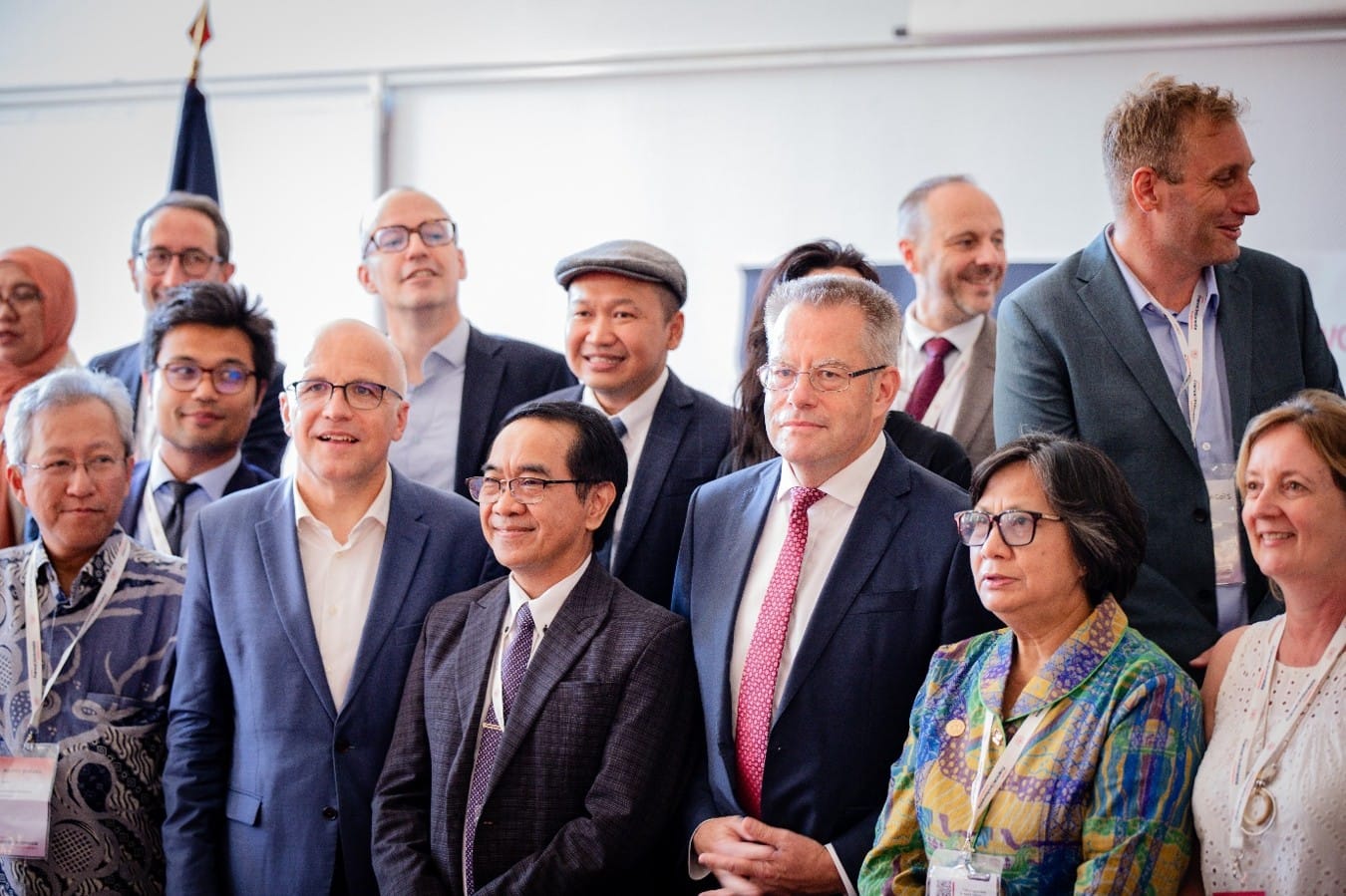
That spirit marked the 14th Indonesia–France Joint Working Group (JWG) on Higher Education, Research, Innovation, and Entrepreneurship, held in Angers, France, on 1–3 July 2026.
A total of 350 participants from 38 Indonesian state universities and 58 French universities gathered to chart a new direction for academic collaboration between the two countries.
Hasanuddin University (Unhas) emerged as one of the main actors. Unhas Rector Prof. Dr. Ir. Jamaluddin Jompa, M.Sc. led the delegation of the Indonesian Council of State University Rectors (MRPTN) and also spoke as a resource person at a maritime workshop discussing sustainable marine resource management, maritime security, and blue economy development in the Indo-Pacific region.
Unhas’s presence carried more meaning than institutional representation. As a university in the heart of the Coral Triangle (the region with the highest marine biodiversity in the world), Unhas’s experience in marine research offers a highly relevant perspective for the development of global science. The sea is no longer seen only as an economic resource but also as a natural laboratory for understanding climate change, biodiversity conservation, and food security.
At this year’s Indonesia–France JWG there were 12 thematic workshops. The Unhas delegation took part in the maritime theme, where Unhas Rector Prof. JJ spoke as a resource person alongside Sébastien Reymond (ENSTA) and François-Régis Boulvert (Naval Group). Also in the Unhas delegation were Prof. Dr. Amir Ilyas, SH, MH, Dr. Ansariadi, and Dr. Sawedi Muhammad.
“This forum shows how modern research increasingly demands cross-border collaboration. Challenges such as the energy transition, artificial intelligence, cybersecurity, and nuclear technology cannot be solved by a single institution or a single country alone,” said Prof. JJ in the presentation.
On this occasion, the Unhas Rector used the meetings with dozens of leading French universities to expand collaboration. One concrete achievement was the signing of a memorandum of understanding with IMT Atlantique, a leading engineering institution in France. The cooperation opens up opportunities for joint research, academic exchanges, and the development of technology that can be used by society.
The discussions at this year’s Indonesia–France JWG did not focus only on academia. The triple helix concept, that is, collaboration among universities, government, and industry, ran like a common thread through nearly all the discussions. The involvement of technology companies, funding agencies, and government shows that innovation will only have real impact if research results can be translated into solutions used by society and the business sector.
“That is why we are pushing for agreements to strengthen double degree programs, doctoral programs with joint supervision, exchanges of students and researchers, and the building of joint laboratories and innovation centers,” said Prof. JJ, as the Unhas Rector is familiarly known.
In Indonesia’s context, this approach is important for speeding up the downstreaming of research. Knowledge born in the laboratory needs to grow into technologies, products, and public policies that can raise the nation’s competitiveness.
Good news also came at the closing of the forum. Hasanuddin University was officially named host of the 2028 Indonesia–France Joint Working Group. The appointment is an honor and also international recognition of Unhas’s capacity as an increasingly respected hub of academic collaboration.
More than that, holding the JWG in Makassar will send an important message that the center of Indonesia’s scientific cooperation is no longer concentrated on Java Island. Eastern Indonesia has substantial scientific assets, especially in marine science, tropical biodiversity, health, agriculture, and sustainable development.(*/anc/ir)
Editor : Ishaq Rahman


This article is an English translation of the original Indonesian report.