
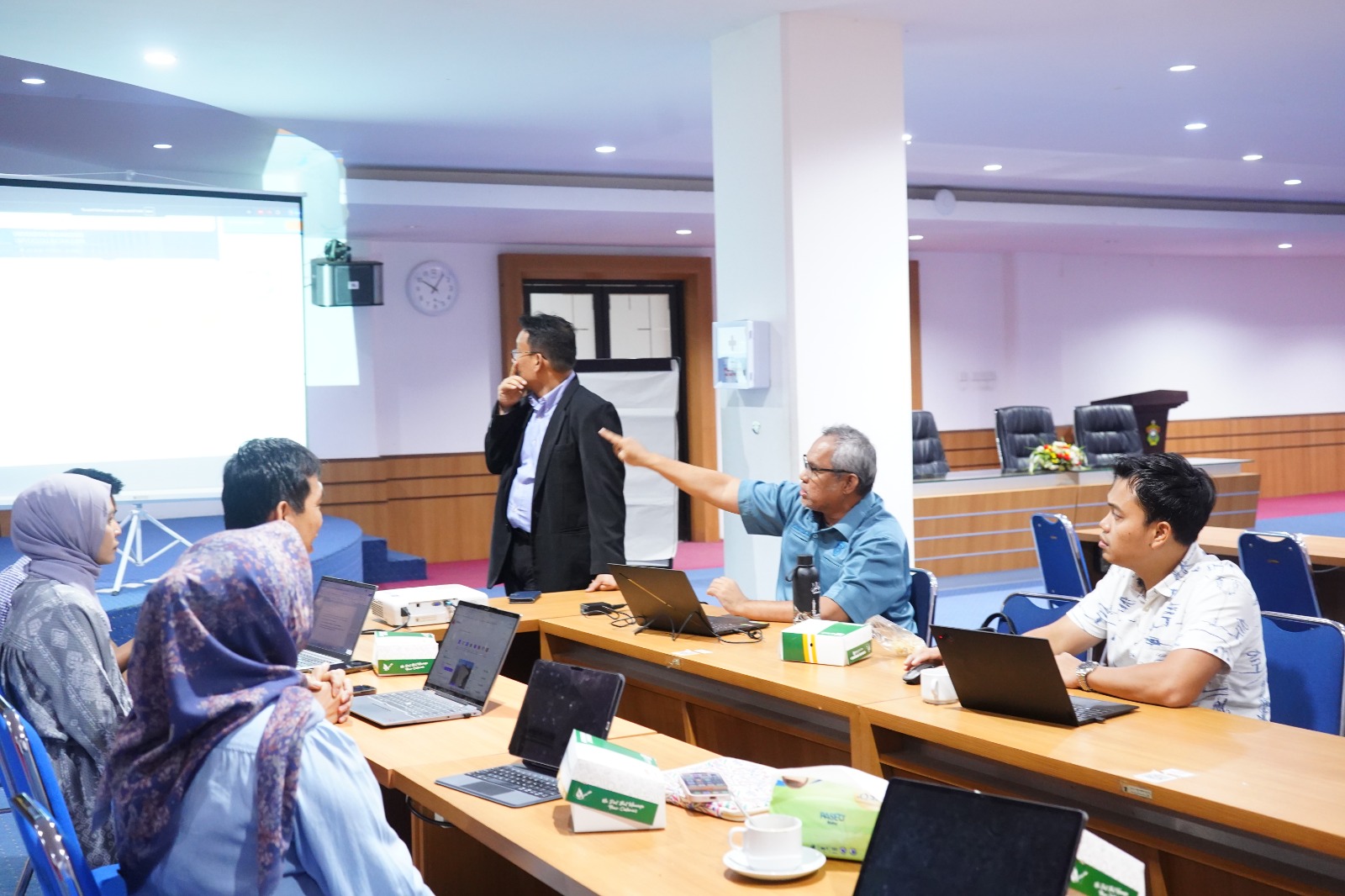
MAKASSAR – Hasanuddin University (Unhas) has begun preparing its Higher Education Performance Report (LKPT) and Self-Evaluation Report (LED) as part of its preparation for institutional reaccreditation. The process is aimed not merely at meeting administrative requirements or maintaining its Excellent accreditation status, but also at serving as a space for reflection to measure, document, and demonstrate the achievements and impact Unhas has delivered to society, the region, and the nation.
This was discussed at focus group discussions (FGDs) on drafting the LKPT and outlining the LED, held in parallel in several LPMPP meeting rooms on Wednesday (26 August).
Unhas’s institutional accreditation will expire in December 2027. Under the regulations, universities must submit their reaccreditation proposal no later than six months before the accreditation period ends. With new standards now applied to institutional accreditation, Unhas needs to prepare the documents required for the LKPT and LED early.
Unhas Secretary Prof. Amiruddin explained that a university’s Excellent status needs to be understood more broadly than an accreditation achievement alone. Accreditation can be used as an instrument for looking back at how much benefit and impact Unhas’s contributions have delivered to society.
“As an excellent university, we need to pay attention not only to accreditation. We also need to look at what impact Unhas has made. That is why this process is important for identifying and gathering again the many contributions and impacts we have produced,” said Prof. Amiruddin.
Prof. Ir. Sumbangan Baja, M.Phil., Ph.D., a member of the Unhas LKPT and LED Drafting Team, explained that the document drafting process should be used to document Unhas’s journey and achievements more comprehensively. Contributions through education, research, community service, innovation, downstreaming, and the involvement of academics in strategic agendas need to be compiled as evidence of the institution’s performance.
“So this activity is not only for reaccreditation. It is also an opportunity for us to gather again the data, evidence, and achievements that show Unhas’s contributions,” said Prof. Sumbangan.
Meanwhile, the Head of the Institute for Quality Assurance and Education Development (LPMPP) at Unhas, Prof. Rini Rachmawaty, S.Kep., Ns., M.N., Ph.D., explained that drafting the LKPT and LED requires the involvement of various work units. The data collected must not only describe the number of programs and activities, but also show the results and impact they have produced.
“The data we collect must be able to explain more than just the number of activities or achievements. We need to show the results and impact produced, and how Unhas’s contributions can be felt by society, the region, and even at the national scale,” explained Prof. Rini.
The process of drafting Unhas’s LKPT and LED will continue periodically through January 2027. Through this process, various documents and data sources will be compiled and analyzed to give a fuller picture of the institution’s performance. The process is expected to strengthen the narrative about Unhas’s development direction, its character as a research university, and its contribution to the development of South Sulawesi, Eastern Indonesia, and Indonesia more broadly. (*/aya)
Editor: Ishaq Rahman
This article is an English translation of the original Indonesian report.