
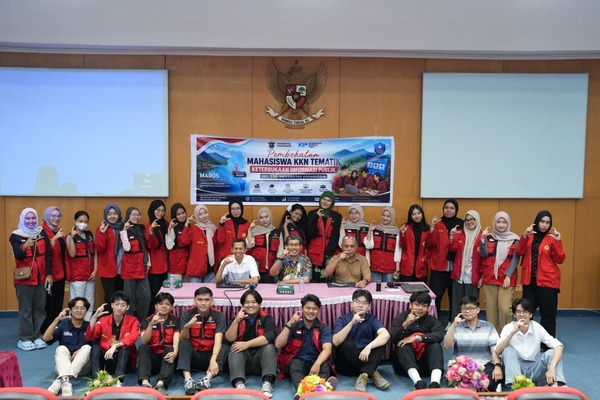
MAKASSAR – Hasanuddin University (Unhas) has initiated a Thematic Community Service Program (KKN) on Public Information Disclosure as an effort to foster informative villages. The program is being carried out for the first time in KKN Wave 116, involving students working with village governments to implement the principle of information transparency.
The briefing for KKN participants took place at the IPTEKS Building of Unhas, Makassar, on Saturday (27 June). The event was the first stage before students are deployed to service locations in Maros Regency, covering three villages and three sub-districts: Samangki Village, Kurusumange Village, Lekopancing Village, Adatongeng Sub-district, Boribellaya Sub-district, and Turikale Sub-district. The students will be accompanied by thematic KKN supervising lecturers who are also Unhas Implementing Information and Documentation Officers (PPID), namely Dr. Ahmad Bahar and Ishaq Rahman, S.IP, M.Si.
One of the KKN villages, Samangki Village, was rated “moving toward informative” in a 2025 assessment by the South Sulawesi Provincial Information Commission. This thematic KKN is expected to raise that village’s status and, at the same time, encourage higher information disclosure ratings for the other villages and sub-districts.
Through this program, students are directed to work with village and sub-district stakeholders across various dimensions of information disclosure, including strengthening institutions and governance, public information services, and digitalization, as well as promoting literacy in public information transparency.
In the remarks, Dr. Ahmad Bahar explained that information disclosure is a basic principle of accountable governance. KKN students are expected to become facilitators in supporting good governance through public information disclosure.
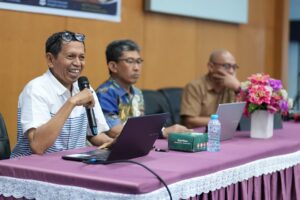
In the briefing session, Unhas Communication Studies lecturer Dr. Muliadi Mau explained that the Information and Documentation Management Officer (PPID) is an important instrument for realizing open information.
“Information disclosure is the foundation of popular sovereignty, because every citizen has the right to obtain information through the various communication channels available. The PPID is a strategic element within a public body,” said Muliadi.
Students can play a strategic role by developing various media for disseminating information, such as village websites, social media, and other communication channels, to widen public access to information on village governance.
Meanwhile, Dr. Ahmad Bahar also introduced how the Unhas PPID is managed as a reference that village governments can adapt in building a public information service system. However, Dr. Bahar stressed that information disclosure does not depend on digital technology alone.
“Conventional media such as bulletin boards, posters, and other easily accessible information media still play an important role, especially in areas with limited internet access,” Ahmad explained.
This thematic KKN is also part of strengthening Unhas’s community service role in spreading good practices in public information governance down to the village level. The initiative is in line with Unhas’s vision as an impactful campus.
Developing information media will not be effective unless officials and communities are aware of the importance of transparency. Education and outreach are therefore the first steps that must be prioritized in building a culture of information disclosure at the village level.
Editor: Ishaq Rahman

This article is an English translation of the original Indonesian report.