
MAKASSAR – Public health challenges continue to evolve, from controlling infectious diseases and rising non-communicable diseases to climate change and preparedness for health disasters. These conditions call for public health professionals who not only have a command of theory but also the professional competence to translate science into real solutions in the field.
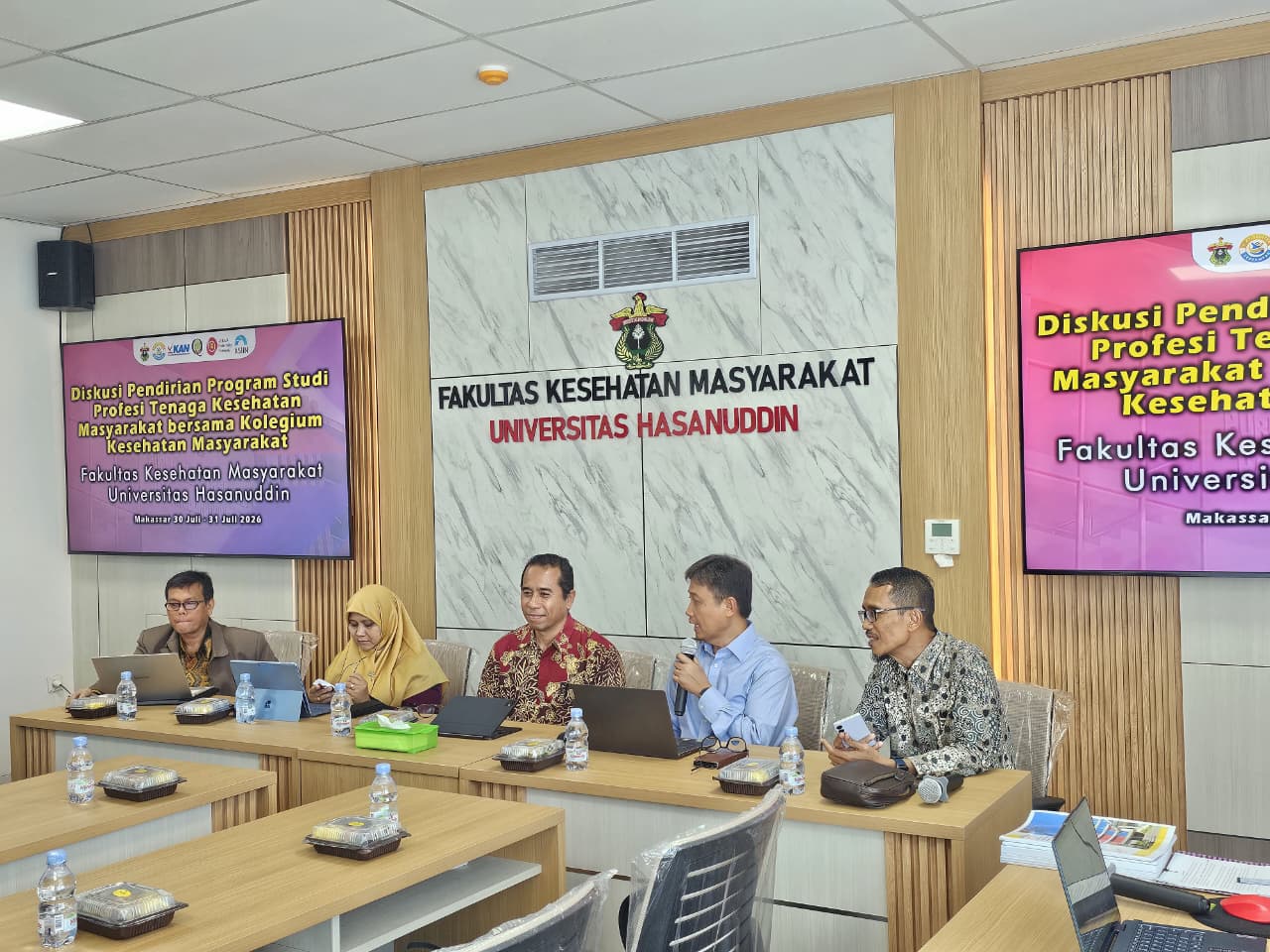
Responding to that need, the Faculty of Public Health (FKM) at Hasanuddin University is strengthening its preparations to open the Public Health Professional Study Program with guidance from the Public Health Collegium.
The Public Health Collegium’s visit is part of a professional development process that aims to ensure professional education meets national competency standards. The process covers strengthening the curriculum, academic governance, the learning system, and education quality assurance so that graduates have competencies suited to the needs of health development in Indonesia.
Chair of the Public Health Collegium Prof. Dr. Ede Surya Darmawan, SKM., MDM., explained that professional education is an important stage in forming public health professionals who can integrate scientific knowledge with professional practice. Every professional study program must therefore be built on competency standards, a learning system, and measurable evaluation mechanisms.
In the discussion with the leadership of FKM Unhas, a number of strategic aspects received attention. Besides academic readiness, other aspects discussed included study program governance and the fulfillment of professional standards as a prerequisite for offering professional education. The whole process is directed so that graduates can later practice public health in a professional, adaptive, and evidence-based way.
FKM Unhas Dean Ansariadi, SKM.,M.Sc.PH.,Ph.D. said that opening the Public Health Professional Study Program is a strategic step in strengthening the quality of health human resources in Indonesia. Increasingly complex public health challenges require graduates who not only understand the concepts of epidemiology, health promotion, environmental health, and health policy, but can also implement that knowledge professionally in the community.
“The Public Health Professional Study Program is a strategic need to strengthen graduates’ competencies so they can meet increasingly complex public health challenges. The Collegium’s visit is an important part of ensuring that all our preparations meet the established standards,” Ansariadi said.
The professional program will complement the levels of education FKM Unhas has offered to date and strengthen the implementation of the tridharma of higher education by developing public health professionals who have professional competence, uphold professional ethics, and can contribute to improving public health.
Ansariadi further explained that the various inputs provided by the Collegium are an important reference in refining the curriculum, academic governance, and quality assurance system. The Public Health Professional Study Program is thus expected to produce graduates who meet national standards and are adaptive to developments in science and the needs of the future health system.
The Public Health Collegium delegation was led by Collegium Chair Prof. Dr. Ede Surya Darmawan, SKM., MDM., accompanied by Collegium Secretary Fajar Ariyanti, SKM., M.Kes., Ph.D.; Treasurer Dr. drh. Siti Riptifah Tri Handari, M.Kes.; Head of Division 4 Prof. Dr. Besral, SKM., M.Sc.; and Division 2 Member Dr. Ir. Suyatno, M.Kes.
The event took place on Friday, 31 July, at the Faculty of Public Health, Unhas Tamalanrea Campus, Makassar. The visit is part of the Public Health Collegium’s guidance for institutions preparing to offer the Public Health Professional Study Program.
The series of activities is scheduled to continue through Saturday, 1 August, with the main agenda of drafting a Follow-Up Plan (RTL) as a strategic step to refine various aspects of readiness for opening the professional study program. (*/cal/mir)
Editor: Ishaq Rahman
This article is an English translation of the original Indonesian report.