
BULUKUMBA – In the coffee industry, public attention often turns to roasting techniques, brewing methods, or the flavor in the cup. Yet the true quality of coffee begins to be determined just hours after the cherries are picked. At this stage, separating the fruit skin (pulp) from the bean is the main determinant of coffee quality. Even a slight delay can trigger uncontrolled fermentation and lower the quality of the harvest.
This is where simple technological innovation plays a big role. The pulper machine is certainly not new technology, but for many smallholder coffee businesses in Indonesia, it can change the way they work, improve efficiency, and maintain product quality.
A Simple Innovation with Real Impact
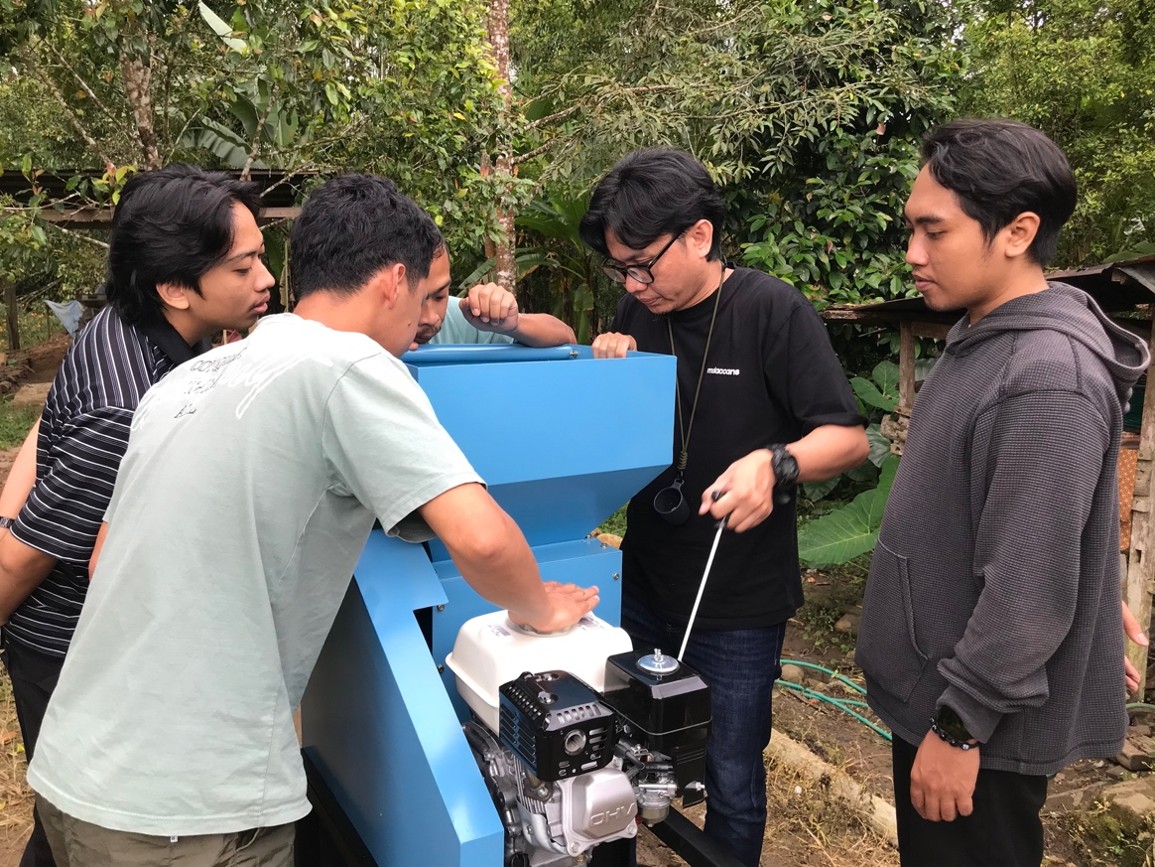
The experience at CV. Kawali Coffee Farm in Kindang District, Bulukumba Regency, is an example of how appropriate technology can solve real problems for farmers and business owners. Through a community service program carried out by lecturers and students of Hasanuddin University (Unhas), the partner received a motorized pulper machine with a capacity of about 200 kilograms of coffee cherries per hour, designed to be easily moved to harvest sites.
More important than simply handing over the equipment, however, was the knowledge transfer that came with it. The community service team did not just hand over the machine; it also provided intensive training to the operators and workers of CV. Kawali Coffee Farm. In the training, participants were introduced to the working principles of the pulper machine, safe operating procedures, capacity settings suited to the condition of the coffee cherries, and routine maintenance techniques so that the machine’s performance stays optimal over the long term.
The training also emphasized the importance of shortening the time between harvest and pulping. Participants were encouraged to understand that coffee quality is influenced not only by plant variety or land conditions but also by the speed of post-harvest handling. The shorter the time coffee cherries wait before being processed, the smaller the risk of unwanted fermentation, so the flavor character of the coffee can be better preserved.
This approach shows that innovation is not only about delivering technology but also about building the capacity of the people who operate it. After all, even the most sophisticated machine will not deliver maximum benefit without the knowledge and skills of its users.
The program was then complemented by training in drawing up a Business Model Canvas (BMC) through focus group discussions. Together with the Hasanuddin University team, the managers of CV. Kawali Coffee Farm mapped the nine key elements of the business, from customer segments, value propositions, and distribution channels to cost structure and revenue streams. The result was a BMC document that serves as a roadmap for business development and a more focused marketing strategy.
The combination of technological innovation and stronger management shows that improving the competitiveness of coffee takes more than a faster machine. Productivity must go hand in hand with a business strategy that can create added value for the product.
How the Community Service Idea Was Born
The idea for this community service program began with a problem faced by CV. Kawali Coffee. The company’s leader, Andi Abdillah Suardi, described how low the business’s capacity was for pulping coffee cherries.
“The post-harvest process takes relatively long, so the quality of the raw material declines. We also do not yet have a business model and marketing strategy integrated with a strong brand identity,” said Andi Abdillah.
Head of the Unhas Community Service Team, Dr. Februadi Bastian, explained that, starting from this problem, Dr. Februadi and several lecturers and students took the initiative to submit a community service proposal under the Community-Based Empowerment Scheme, within the scope of Community Partnership Empowerment, funded through a grant from the Ministry of Higher Education, Science, and Technology.
“The problem faced by CV. Kawali Coffee is also one faced by the farmer groups we mentor. Moreover, this issue is highly relevant to the Sustainable Development Goals, which are a national and global concern,” Februadi explained.
Dr. Februadi was referring to sustainable development issues, or the Sustainable Development Goals (SDGs), in particular SDG 1 (No Poverty) through higher incomes for coffee farmers, SDG 8 (Decent Work and Economic Growth), and SDG 12 (Responsible Consumption and Production).
The Unhas lecturers and students on the team held field activities (namely Training and a Focus Group Discussion) in Bulukumba on Saturday, 20 June 2026.
This story from Bulukumba is a reminder that innovation in the agricultural sector does not always have to take the form of artificial intelligence or high-tech machinery. Often, the biggest change comes from technology that is simple, easy to operate, and suited to the needs of the community. Unhas, with its strength in research and innovation, is here to answer real problems in society.
Unhas Community Service Team:
Head: Dr. Februadi Bastian, S.Tp., M.Si
Members:
1. Dr. rer.nat. Zainal, S.Tp., M.FoodTech
2. Rahmat Nurul Prima Nugraha, S.E., M.Sc
Students:
1. Irham Rasyid,
2. Febrio Rynaldo,
3. Andi Arnan,
4. Harum Bunga Cinta,
5. Nurhanifauziah Wijaya,
6. Insani Lathifah
7. Shabrina Rafidah Harun
Program target partner:
– CV. Kawali Coffee (led by Andi Abdillah Suardi).(*/ir)
Editor : Ishaq Rahman
This article is an English translation of the original Indonesian report.