
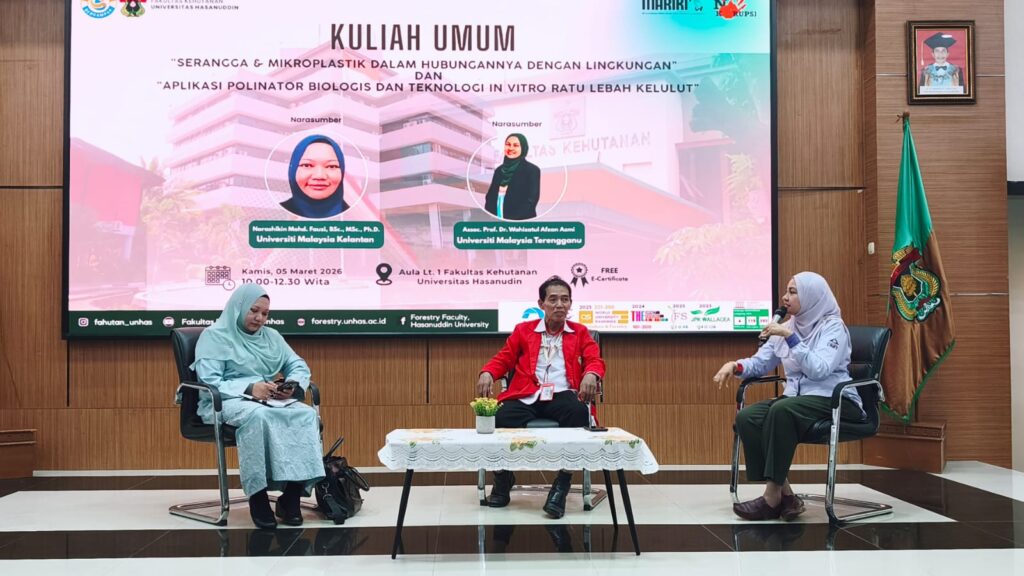
The Hasanuddin University Faculty of Forestry held an international public lecture featuring two academics from Malaysia, namely:
- Norashikin Mohd. Fauzi, BSc., MSc., Ph.D. (Universiti Malaysia Kelantan)
- Assoc. Prof. Dr. Wahizatul Afzan Azmi (Universiti Malaysia Terengganu).
The event, held on Thursday (5 March) in the 1st Floor Hall of the Unhas Faculty of Forestry, was officially opened by the Dean of the Faculty of Forestry, Prof. Dr. Ir. A. Mujetahid M., S.Hut., M.P., IPU.
In the opening remarks, Prof. Mujetahid welcomed the two professors who came to share insights and academic experience with the Faculty of Forestry academic community. According to Prof. Mujetahid, the presence of international speakers is an important moment to broaden students’ perspectives on global environmental issues and to encourage research collaboration in forestry, insects, and ecology.
Norashikin Mohd. Fauzi presented on the relationship between insects and microplastics in the environment. Microplastics are plastic particles smaller than 5 millimeters that are increasingly found in various environmental compartments, on land and in water. Microplastics can come from primary or secondary sources and have the potential to pollute ecosystems widely.
Various recent studies show that insects can interact directly with microplastics through consumption, accumulation in the body, and even the potential degradation of plastic by certain species. This indicates that insects serve not only as indicators of environmental pollution but also have the potential to influence the biological cycle of microplastics in nature.
Further research and the development of more accurate identification methods are therefore needed to understand the impact of microplastics on ecosystems.
Meanwhile, Assoc. Prof. Dr. Wahizatul Afzan Azmi presented on the application of biological pollinators and in vitro technology in stingless bee (kelulut) queens. Wahizatul Afzan Azmi explained how the kelulut queen plays an important role in leading the colony and regulating its reproductive system. The research also covers the development of queen larvae, the differences in characteristics among worker bees, drones, and queens, and the selection of high-quality drones to be mated with queens to produce healthy and productive colonies in the field.
At the end of the public lecture, Vice Dean for Partnerships, Research, Innovation, and Alumni of the Faculty of Forestry, Prof. Syahidah, S.Hut., M.Si., Ph.D., urged students to start minimizing single-use plastic through simple steps such as using a tumbler, in support of the faculty’s plastic-free program and as a reinforcement of its commitment to the Integrity Zone. The event ended with a group photo session. (*/fhut)
Editor: Ishaq Rahman

This article is an English translation of the original Indonesian report.