
A blue economy ecosystem is an economic development model that uses marine and aquatic resources sustainably, with the aim of improving community welfare without damaging marine ecosystems. The concept emphasizes that the sea is not merely a source of economic exploitation but also an ecosystem whose balance must be maintained.
Conceptually, the blue economy grew out of the ideas of sustainable development and the green economy. One global reference is the approach popularized by the United Nations Environment Programme (UNEP), which emphasizes that marine economic activity must: generate economic growth; improve social welfare; and preserve the sustainability of marine ecosystems.
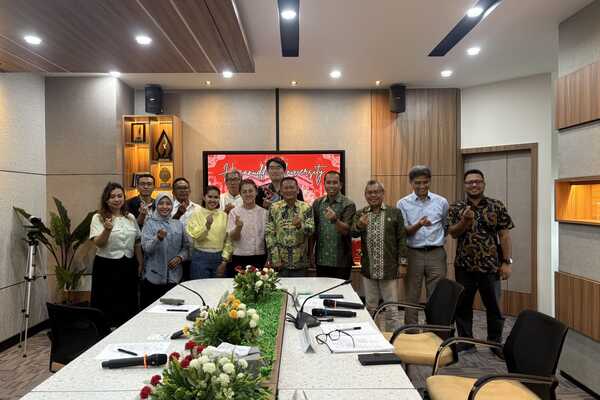
Hasanuddin University (Unhas) received a visit from the South Korean company Woolim Co., Ltd., to explore research cooperation in the Blue Economy on Friday (27 February). The visit followed up on initial communication initiated directly by Woolim after seeing Unhas’s academic capacity and reputation.
The cooperation focuses on developing seaweed as a priority blue economy commodity. Woolim plans to develop a seaweed-based industry, ranging from producing environmentally friendly packaging to using seaweed as a raw material for fish and shrimp feed to increase nutritional content and immunity.
The collaboration model adopts practices in South Korea, where universities conduct industry-needs-driven research (demand-driven research) with funding and co-funding schemes supported by corporate partners.
Unhas Vice Rector for Partnerships, Innovation, Entrepreneurship, and Business, Prof. Dr. Eng. Adi Maulana, S.T., M.Phil., stressed that the cooperation is designed as a structured academic collaboration model oriented toward measurable outputs.
“We are not talking about research cooperation in a narrow sense, but about building an integrated innovation ecosystem. The university acts as a knowledge producer, while industry is a knowledge user and a strategic partner in the downstreaming process,” Prof. Adi stressed.
The research results will then move on to downstreaming through prototype development, pilot-scale trials, and commercialization of products by industry. In the initial stage, the collaboration is also planned to involve a Korean academic partner, Pukyong National University.
“Every stage of the research will be carried out using measurable methodologies that are academically documented. In this way, the collaboration will not only produce products but also enrich the body of knowledge and reputable publications,” Prof. Adi explained.
Woolim Co., Ltd. CEO Mrs. Woojung Yun, in her remarks, stressed the company’s commitment to building long-term research collaboration with Unhas oriented toward developing a blue economy-based industry.
“Our focus is to develop high-value-added seaweed derivative products, including environmentally friendly packaging and fisheries feed raw materials that can improve nutritional quality and immunity,” said Mrs. Woojung Yun.
Mrs. Woojung Yun further said that Woolim will seek research funding support, including grant opportunities from the South Korean government.
“We will explore various financing schemes to ensure the sustainability of this project and open opportunities for further testing in Korea if needed,” she added.
The cooperation is expected to become a model of international research collaboration that not only strengthens academic capacity and technological innovation but also encourages the creation of a sustainable seaweed-based industrial value chain. (*/gie/aya)
Editor: Ishaq Rahman
This article is an English translation of the original Indonesian report.