
Unhas Rector: “The commitment to an impactful campus that we have long voiced is not just a slogan. Unhas is building a rapid-response system to respond to emergency situations in the community.”
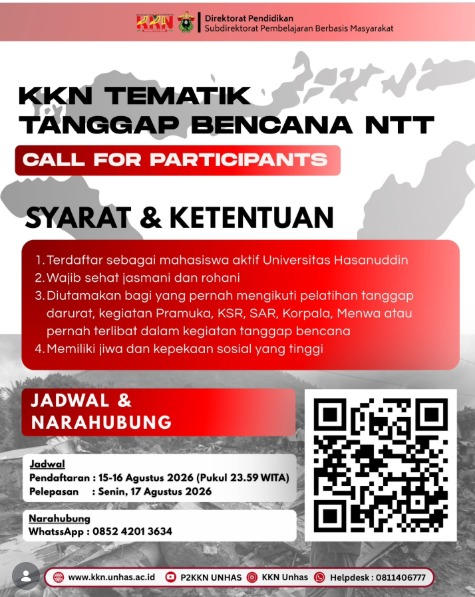
MAKASSAR — Hasanuddin University (Unhas) is preparing a Disaster Response Thematic Community Service Program (KKN) to support the response and recovery of communities affected by the earthquake that struck East Nusa Tenggara (NTT) on Saturday, 14 August 2026.
Soon after news of the disaster spread, the Community-Based Learning Subdirectorate (which manages Unhas’s Community Service Program) coordinated with the Unhas Disaster Studies Center. After analyzing the situation, it was decided that same day to activate the Disaster Response KKN. The program is a form of Unhas’s involvement in helping communities through the contributions of students with skills suited to needs on the ground.
Head of the Unhas Community-Based Learning Subdirectorate, Dr. Ir. Sulaeha, SP., M.Si., said the Disaster Response KKN is an implementation of the Tri Dharma of Higher Education, particularly community service. The program aims to strengthen the capacity and resilience of communities in disaster-prone areas.
“This program aims to deliver the university’s real contribution to supporting post-disaster response and recovery, to strengthen community capacity and resilience, and to provide students with contextual learning experience through direct involvement in humanitarian and community empowerment activities,” explained Ir. Sulaeha.
In the initial phase, Unhas prepared a quota of seven students to be sent to the affected area. The students prepared have diverse disaster response skill backgrounds, including health, Search and Rescue (SAR), Korpala, and emergency rescue. The target of seven students was set given the very short preparation time.
“It turns out there is considerable interest. As of Sunday (16 August) morning, 47 people had registered. Some students have no disaster response experience, but they come from the disaster area. We are taking that into account as well,” said Ir. Suleha.
Students’ involvement in disaster response is not merely part of academic activity. Their presence is also a form of humanitarian solidarity and of Unhas’s commitment to contributing to the recovery of communities affected by the disaster.
“In the various Disaster Response KKN deployments, Unhas affirms that students’ presence in affected areas is not just an academic activity, but also a form of humanitarian solidarity to help communities rise from the disaster,” explained Ir. Sulaeha.
Before going to the site, students will receive a briefing from the Unhas Disaster Studies Center. The briefing covers understanding the limits of students’ role, safety procedures, coordination patterns, and the conditions they may face while in the affected area.
Head of the Unhas Disaster Studies Center, Dr. Ir. Ilham Alimuddin, M.Sc., explained that besides preparing the students who will go to the field, building collaboration with the disaster response ecosystem already in place at the site is equally important.
“We are coordinating with the local National Disaster Management Agency (BNPB), Cencana University, and the Disaster Management Center of the Engineering Alumni Association (DMC IKATEK) team to prepare the mechanism for carrying out the activity. With this approach, students’ contributions are placed as part of the disaster response network, not as a team working separately,” said Dr. Ilham.
Unhas Rector Prof. Dr. Ir. Jamaluddin Jompa, M.Sc., stressed that the campus’s commitment to making a real impact on society does not stop at slogans or institutional narratives. That commitment is realized through concrete steps that allow the university’s resources to move when communities face emergencies.
“A campus has a broader social responsibility than carrying out the functions of education and research. Universities also need to be present as part of the solution when humanitarian problems occur, including in disaster situations that require a quick, coordinated, and expertise-based response,” said Prof. JJ.
For that reason, Unhas has begun building a rapid-response system that enables the university to deploy resources in a more structured way when emergencies arise in the community. The system involves academic capacity, human resources, institutional networks, and students with competencies relevant to field needs.
The students selected as participants in this NTT Disaster Response Thematic KKN will receive a briefing before being sent to the disaster site. The official send-off will be held on Monday, 17 August 2026, on the sidelines of the ceremony marking the 81st anniversary of Indonesian independence.
The students are scheduled to depart for the disaster site on Wednesday (19 August). They will be accompanied by the Head of the Unhas Disaster Studies Center and will be on site for about two weeks. (*/mir)
Editor : Ishaq Rahman
This article is an English translation of the original Indonesian report.