
The Graduate School of Hasanuddin University (UNHAS) held an international guest lecture entitled “Temporal and Spatial Changes of Water Temperature during the Past 50 Years due to Global Warming in the Enclosed Inner Bay and Its Inflowing River in Kyushu, Western Part of Japan” on Thursday, 10 September 2026. The session featured Prof. Dr. Eng. Hideo Oshikawa of Saga University, Japan. The lecture was conducted in a hybrid format at Prof. Dr. Ir. Fachruddin Hall, Graduate School of Hasanuddin University, and online via Zoom. Beginning at 14:00 WITA, the session was moderated by Ir. Evi Aprianti, S.T., Ph.D., and attended by students, faculty members, researchers, and participants interested in climate change, aquatic environments, and natural resource management.
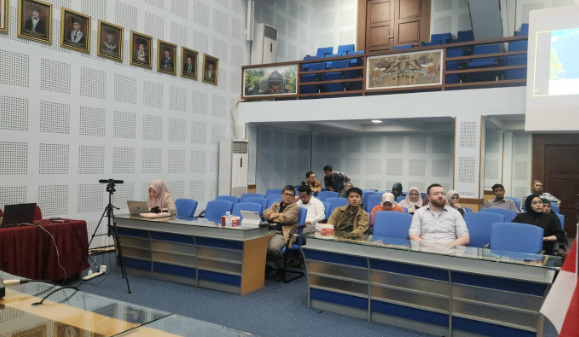
Dean of the Graduate School, Prof. Sukri Palutturi, S.KM., M.Kes., M.Sc.PH., Ph.D., expressed his support for the program as part of UNHAS’s efforts to strengthen internationalization and multidisciplinary research. He emphasized that climate change is a global challenge that requires contributions from multiple disciplines and higher education institutions.“Climate change is not only about rising air temperatures. It also affects aquatic ecosystems, environmental health, coastal communities, and sustainable development,” Prof. Sukri said. He added that universities have an important role in promoting research that can provide scientific evidence to support effective policymaking.
In addition, Prof. Oshikawa in his presentation discussed temporal and spatial changes in water temperature over approximately five decades in an enclosed inner bay and its inflowing river in Kyushu, western Japan. The long-term study provided insight into how global warming can influence the thermal characteristics of interconnected river, estuarine, and coastal environments. Prof. Oshikawa explained that changes in water temperature do not occur uniformly across locations or time periods. They are influenced by several factors, including geographical characteristics, river flow, seawater exchange, seasonal conditions and broader environmental temperature changes. He emphasized the importance of long-term monitoring in distinguishing natural variability from changes associated with global warming.
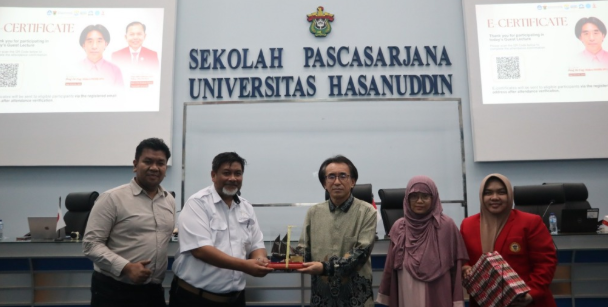
The lecture also highlighted the potential impacts of changing water temperatures on water quality, ecosystem balance, aquatic species distribution, and the productivity of coastal resources. Enclosed bays, in particular, require careful attention because limited water circulation can make them more vulnerable to environmental pressures. Prof. Oshikawa stressed the importance of examining rivers, estuaries, bays, and coastal waters as interconnected systems. The discussion further explored the importance of sustained environmental monitoring, historical data management, and spatial and temporal approaches in climate change research. Participants also gained insight into how findings from Japan may provide relevant lessons for Indonesia as an archipelagic country with extensive coastal areas that face increasing climate-related risks.
Prof. Sukri expressed hope that the lecture would encourage future joint research between Hasanuddin University and universities in Japan, particularly in the areas of climate change, coastal management, environmental quality, and sustainable development. He emphasized that environmental challenges extend beyond national boundaries and require international collaboration to share data, methods, experiences, and innovations in developing stronger solutions.