
MAKASSAR – In the digital economy era, geographic boundaries should no longer be a barrier for business owners reaching consumers. With a smartphone, products from all over the world can now be marketed in a matter of seconds. Yet for many communities on Indonesia’s small islands, this opportunity has not been fully realized. Limited access to technology, low digital literacy, and weak marketing skills remain challenges that make it hard for many local products to break into wider markets.
Ironically, the problem does not lie in product quality. Many micro-enterprises in island regions have strengths that other areas lack: rich marine resources and an authentic range of seafood-based cuisine. What they need is a way for consumers to find these products.
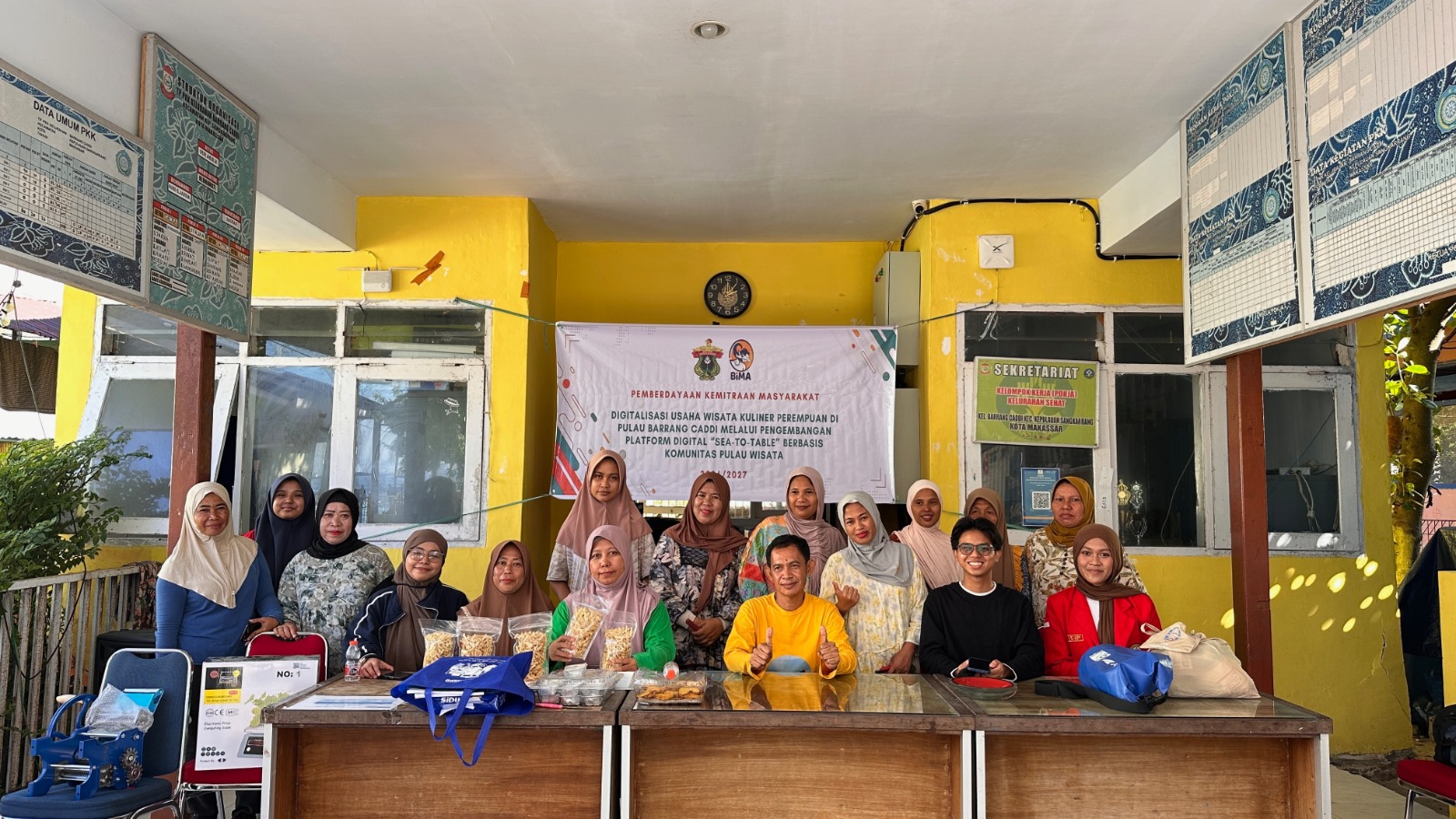
This is the situation the Hasanuddin University (Unhas) community service team encountered on Barrang Caddi Island, Sangkarrang Islands District, Makassar. On this tourist island, the Mentari Group, made up of ten women and housewives, has long processed marine products into various goods of economic value. The activity is an additional source of income for fishing families, but the growth of the business is still held back by limited market access, weak business management, and minimal use of digital technology.
Technology That Connects Local Potential with the Market
Starting from these conditions, the Unhas community service team developed a digital platform called “Sea-to-Table,” a community-based approach designed to connect coastal communities’ seafood culinary products with consumers more easily and efficiently. Besides providing a digital marketing space, the idea also builds a business ecosystem that brings together local potential, micro, small, and medium enterprises (UMKM), and market opportunities in one mutually supportive value chain.
Head of the Community Service Team, Prof. Dr. Seniwati, S.Sos.,M.Hum., explained that coastal communities in fact have a core asset in abundant marine resources and the skills to process fishery products into marketable goods. The biggest challenge arises when those products must compete amid changing consumption patterns, with people increasingly relying on digital technology.
“We see that the main problem is not product quality but limited market access. That is why we designed Sea-to-Table as an empowerment effort that helps the community use technology to expand marketing while increasing the economic value of local products,” explained Prof. Seniwati.
Digital Transformation Begins with Capacity Building
For Unhas, technology is only one part of the empowerment process. Before introducing the digital platform, community members were first equipped with a range of skills that form the foundation of business development, from marketing strategy, pricing, and branding to product packaging techniques, improving the quality of processed seafood, and using social media and marketplaces for promotion. This approach was designed so that digital transformation goes hand in hand with building human resource capacity.
Besides transferring knowledge, the Unhas community service team also strengthened production capacity by providing supporting equipment, such as a freezer, production woks, digital scales, and manual scales.
This support is expected to improve work efficiency, maintain the quality of raw materials, and increase the production capacity of the women’s business group on Barrang Caddi Island.
According to Prof. Seniwati, the success of digital transformation is determined not by how advanced the technology is, but by the community’s ability to use it in a sustainable way.
“What we want to build is community self-reliance. When women have the skills to manage a business, understand market needs, and are able to use technology as a tool to grow, the benefits of the program will continue to be felt even after the community service activities are over,” explained Prof. Seniwati.
Boosting Women’s Economic Activity in Island Regions
Evaluation results show that members of the Mentari Group improved their ability to process marine products, draw up marketing strategies, improve product packaging, and use digital media for promotion. The program also strengthened cooperation among group members and encouraged women’s entrepreneurial spirit as a driver of the family economy in small island areas.
That said, the team noted that challenges remain that need attention, especially limited internet connectivity and the need for ongoing assistance in managing digital marketing. These efforts are considered important so that the transformation that has begun can continue to grow and have a wider economic impact on coastal communities.
This community service program, funded through the BIMA Program of the Ministry of Higher Education, Science, and Technology for Fiscal Year 2026, shows that digital innovation does not always have to come from complicated technology. Change begins when science can answer community needs through solutions that are simple, relevant, and easy to apply.
The community service activities were carried out on Saturday (6 June) on Barrang Caddi Island, Sangkarrang Islands District, Makassar.
Unhas Community Service Team:
Head : Prof. Dr. Seniwati, S.Sos.,M.Hum.,
Members :
1. Prof. Rahmatia
2. Munif Arif Ranti,S.IP, MA.,
3. Andi Annisar, S.IP., MA.,
Students :
1. Rhin Khairina Rahmat, S.IP., MA
2. Muhammad Fajhriyadi Hastira, S.IP., M.H.I
3. Tarhiza Aurelia Qur’ani
4. Andi Sri Wahdaniyah
5. Andi Khadijah Syifa Ramadani.
(*/mir)
Editor : Ishaq Rahman

This article is an English translation of the original Indonesian report.