
MAKASSAR – New research findings can be trusted only when they go through a rigorous scientific process. Before becoming a reference for academics, government, or the public, an article must pass peer review, editing, and journal management that meets national and international standards.
For this reason, the quality of a scientific journal is measured not only by the number of articles it publishes, but also by governance that safeguards the integrity and credibility of knowledge.
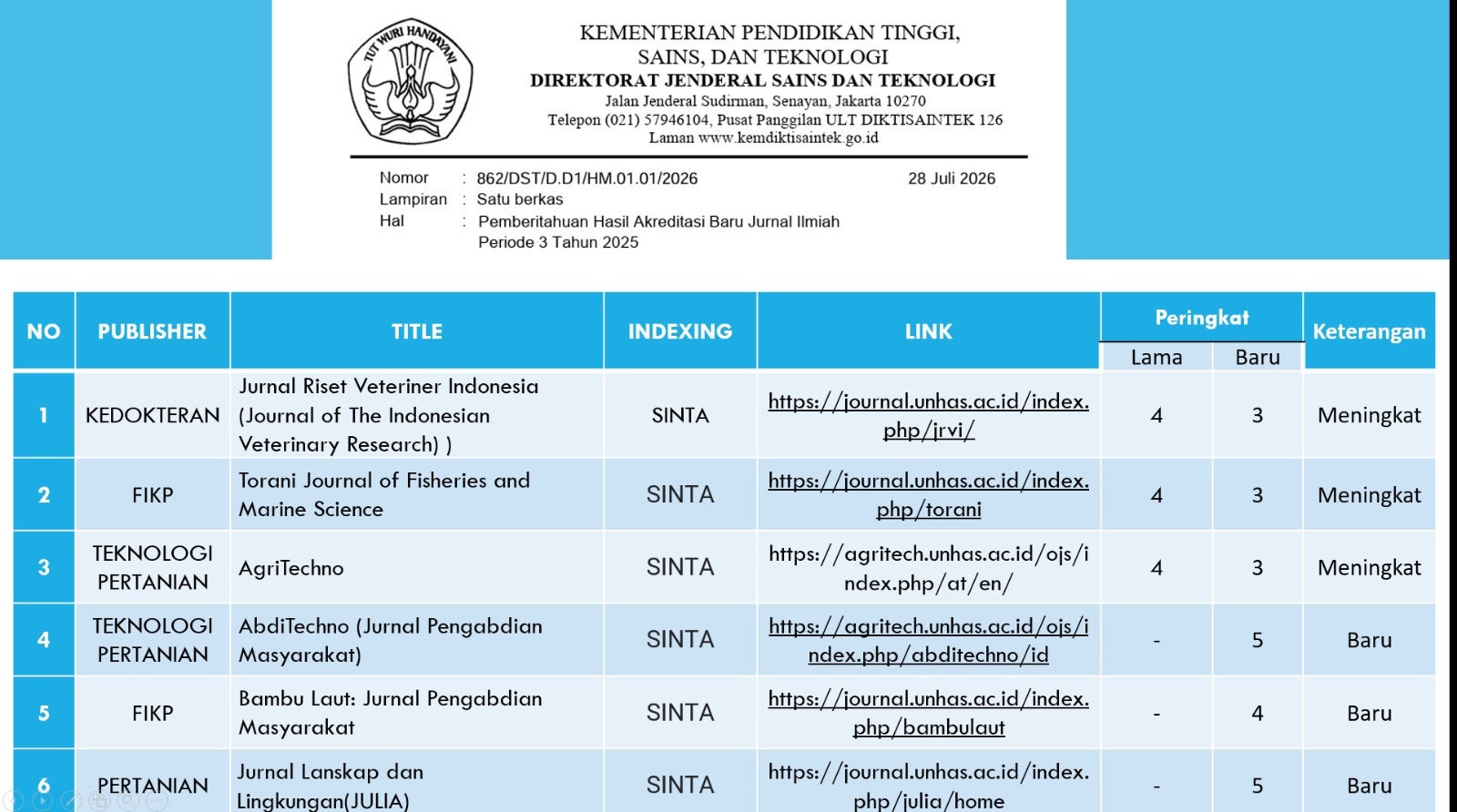
Hasanuddin University (Unhas) has shown that commitment once again through the results of the Scientific Journal Accreditation, Period 3 of 2025, announced by the Directorate General of Science and Technology, Ministry of Higher Education, Science, and Technology. Six Unhas journals received the latest accreditation results: three journals that moved up from SINTA 4 to SINTA 3, and three that earned accreditation for the first time.
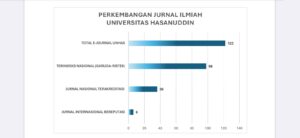
This adds to the list of Unhas journals with national accreditation. Currently, 122 journals are published by various units at Unhas. Of these, 98 are nationally indexed (Garuda-Ristek), 36 are indexed in SINTA, and 6 are internationally indexed
Director of Publication Management Prof. Dr. Andi Dirpan, STP., M.Si., said the achievement is the result of the collective work of journal managers in maintaining the quality of scientific publications on an ongoing basis.
“We express our high appreciation to all journal managers. For us, this achievement is not just a ranking number. Accreditation is an indicator of the health of a journal’s governance, while the ultimate goal remains the scholarly reputation and real impact of Unhas research on society,” said Prof. Dirpan.
According to Prof. Dirpan, the achievement also shows that the strengthening of the scientific publication ecosystem at Unhas is taking place evenly across disciplines. The improvements in ranking did not occur in just one field, but span medicine and veterinary science, marine science and fisheries, and agricultural technology. This shows that a culture of maintaining publication quality has developed across faculties.
The accreditation of two community service journals is an important development. It opens wide space for innovations born from community service to become a source of scientific knowledge that others can study, test, and apply again.
“Two of the newly accredited journals are community service journals. This is important, because it means the results of community service are now documented scientifically and can be replicated, rather than ending as activity reports,” Prof. Dirpan added.
Behind this achievement, Prof. Dirpan said, Unhas Publication Management applies a system of ongoing mentoring. All journals are mapped by their level of development, from emerging journals and journals ready to apply for accreditation to journals with the potential to move up in rank. Each group receives a different development strategy so that quality improvement can proceed more effectively.
Mentoring is also carried out through evaluation based on the ARJUNA instrument, coaching clinics, training in managing Open Journal System (OJS), stronger use of DOI and ORCID, manuscript similarity checks, and improvements to the quality of the peer review process.
In addition, the university is strengthening regular publication discipline, documentation of editorial processes, mentoring among journal managers, and routine monitoring of each journal’s progress.
“Our approach rests on structured mentoring, not just appeals. All journals are mapped into several clusters so that each manager receives mentoring suited to their needs. In this way, weaknesses can be identified and fixed well before the accreditation process takes place,” Prof. Dirpan added.
In Prof. Dirpan’s view, maintaining journal quality is a process that requires consistency. A journal can move up in rank only if it can sustain timely publication, the quality of its peer review process, and the quality of the manuscripts it publishes. Accreditation is therefore seen not as an end goal, but as a benchmark that scientific governance is running well.
Going forward, Unhas aims for all of the journals it manages to have national accreditation status, while increasing the number of journals at SINTA 1 and SINTA 2. In the long term, the university also encourages its leading journals to be indexed in internationally reputable databases by strengthening substantive quality, the professionalism of editorial teams, and publication consistency.
“In the end, we want Unhas journals to be credible channels for disseminating research, especially on strategic issues for eastern Indonesia such as marine science, tropical agriculture, health, and the environment. That way, scientific work is not only accredited, but also read, cited, and widely used,” Prof. Dirpan concluded.
Six Journals Earn New Accreditation
1. Jurnal Riset Veteriner Indonesia (Journal of The Indonesian Veterinary Research) from the Faculty of Medicine, from SINTA 4 to SINTA 3.
2. Torani Journal of Fisheries and Marine Science from the Faculty of Marine Science and Fisheries (FIKP), from SINTA 4 to SINTA 3.
3. AgriTechno from the Faculty of Agricultural Technology, from SINTA 4 to SINTA 3.
4. Bambu Laut: Jurnal Pengabdian Masyarakat, new accreditation at SINTA 4,
5. AbdiTechno (Jurnal Pengabdian Masyarakat), new accreditation at SINTA 5.
6. Jurnal Lanskap dan Lingkungan (JULIA), new accreditation at SINTA 5.(*/mir)
Editor: Ishaq Rahman
This article is an English translation of the original Indonesian report.