
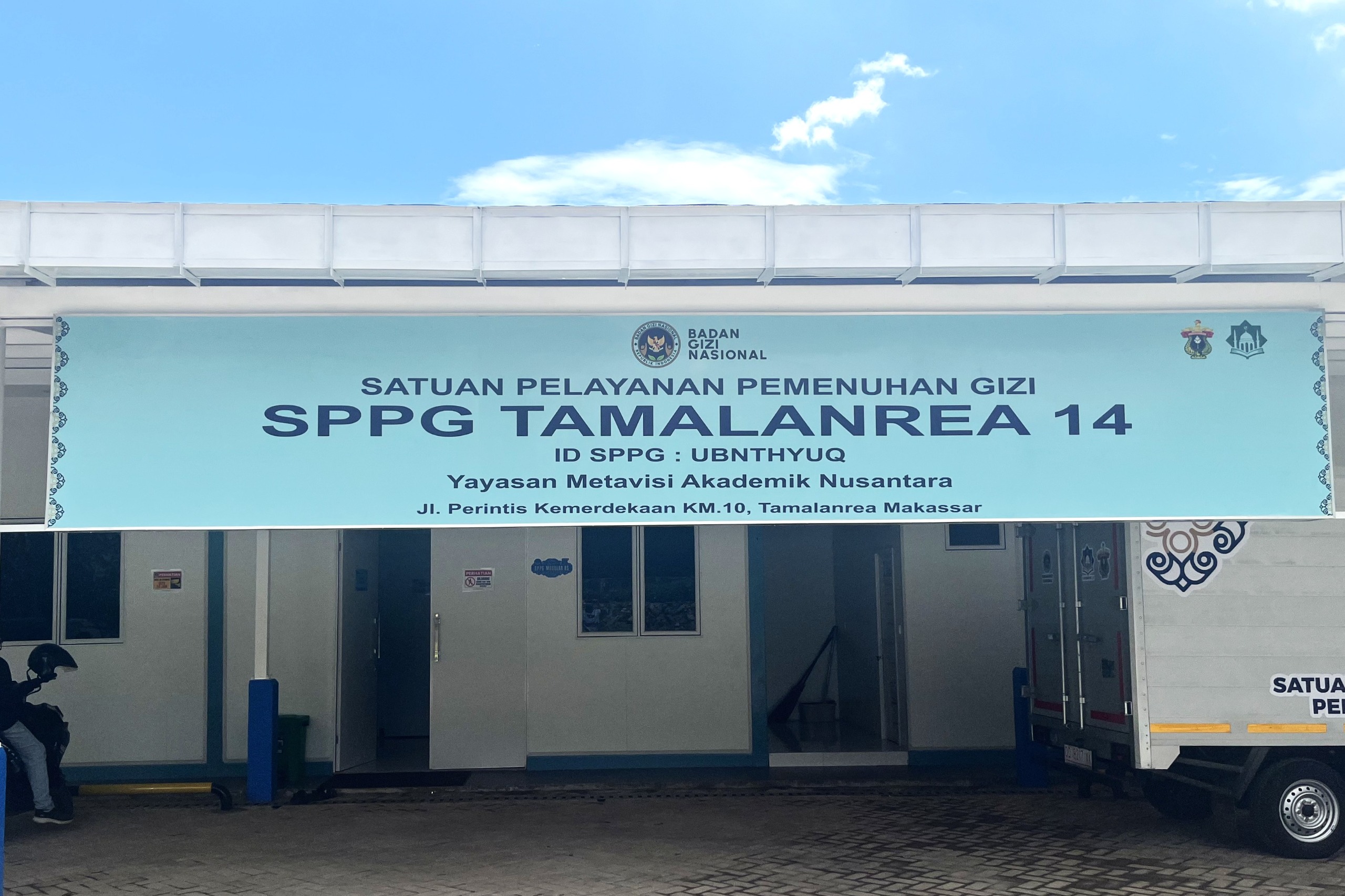
The Unhas SPPG also serves as a learning and innovation laboratory that can generate best practices and smart practices to support the sustainability of the MBG program.
MAKASSAR – Hasanuddin University (Unhas) has affirmed that its involvement in the Free Nutritious Meals (MBG) Program, through the construction and management of a Nutrition Fulfillment Service Unit (SPPG), is a real contribution by a university to supporting a national strategic program while meeting community needs.
Unhas views universities as no longer able to act merely as academic institutions detached from social reality. Campuses are expected to transform from an “ivory tower” paradigm into agents of change that are present among the people and actively contribute to national development. Its involvement in the SPPG is therefore part of carrying out the tridharma of higher education, particularly in addressing public issues related to meeting the community’s nutritional needs.
As a government strategic program, MBG aims to improve the quality of Indonesia’s human resources through better nutrition. Its implementation requires the support of many parties, including universities. In this context, Unhas has taken a direct role as an expression of its Impactful Campus (Kampus Berdampak) vision: delivering real benefits to society.
The Unhas SPPG is designed as a pilot model that integrates governance, nutrition standards, food safety, and human resource development. It functions not only as a production and distribution unit for nutritious meals but also as a learning and innovation laboratory that can generate best practices and smart practices to support the sustainability of the MBG program.
The Unhas SPPG is managed professionally, applying strict standards in menu planning, quality control, food safety, operational management, and monitoring and evaluation. Unhas also opens space for public participation, criticism, and oversight. Students, academics, and civil society are encouraged to take part through research, scientific studies, policy evaluation, and oversight of the program’s production, distribution, and governance processes. This openness is part of the commitment to transparency and accountability.
The management of the SPPG is not a form of campus commercialization. The program is oriented toward academic and social contribution, not economic profit. Through the involvement of the academic community and the public in research, evaluation, and oversight, the Unhas SPPG is a tangible expression of an impactful campus that mobilizes its academic capacity to support public welfare and the national development agenda.
What Makes the Unhas SPPG Unique
The Unhas SPPG is administratively managed by Yayasan Metavisi Akademika, a non-profit organization owned by Unhas. The foundation was established 20 years ago and focuses on managing social activities (such as the Campus Mosque, Early Childhood Education, and Basic Education).
The Unhas SPPG kitchen was built on vacant land within the campus. Construction of the building and supporting facilities also involved Unhas partners, including through private-sector Corporate Social Responsibility (CSR) schemes. Under this scheme, the kitchen’s construction budget does not burden Unhas.
Besides attending to production, the Unhas SPPG kitchen is also very strict about its supporting facilities and infrastructure. One area of attention is the waste treatment mechanism. The Unhas SPPG is equipped with a wastewater treatment plant (IPAL) with a capacity of 10 cubic meters using the latest technology, even though a kitchen of similar capacity requires only 3 cubic meters.
The presence of the Unhas SPPG has also encouraged the formation of a unique nutrition supply chain ecosystem. Since it was inaugurated on 28 April 2026, units at Unhas have participated according to their respective capacities. For food raw materials, vegetables are supplied by the Faculty of Agriculture and oyster mushrooms by the Faculty of Forestry.
Meanwhile, the Faculty of Animal Science supplies broiler chicken meat, native chicken and commercial chicken eggs, and processed beef. The Faculty of Marine Science and Fisheries is preparing to take part by supplying tilapia and processed products in the form of fillets.
With this approach and mechanism, the Unhas SPPG is a tangible expression of the role of an impactful campus. The hope is that the campus’s presence will be felt in supporting the implementation of the national priority program, for the sake of improving the quality of Indonesia’s human resources.(*/ir)
Editor : Ishaq Rahman
This article is an English translation of the original Indonesian report.