
Makassar — Mental health screening in schools can help identify psychosocial problems among children and adolescents earlier. The challenge is that screening results require a clear follow-up system so that identification can be connected to support, monitoring, and health services as needed.
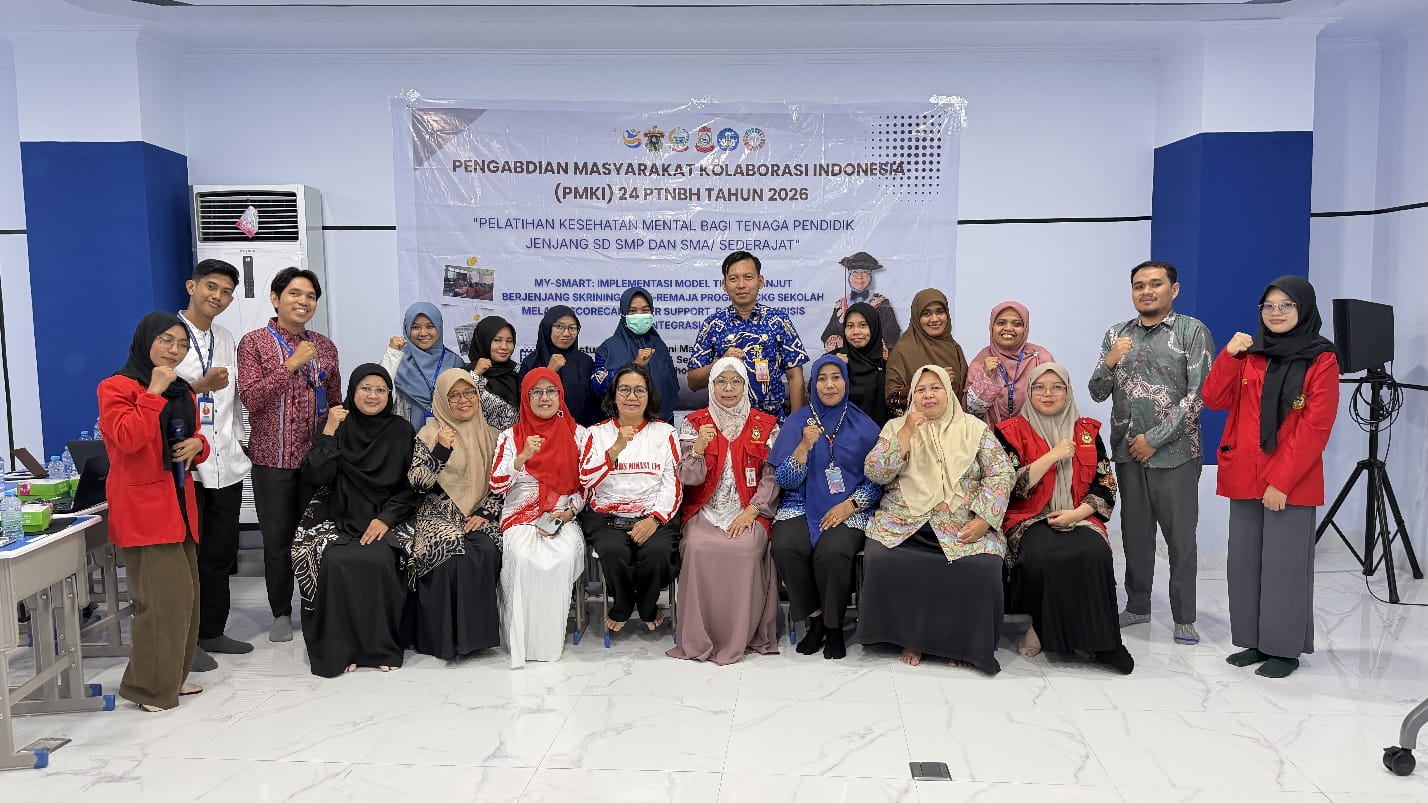
To meet this need, the Indonesian Collaborative Community Service (PMKI) implemented MY-SMART, a tiered follow-up model for child and adolescent health screening results. The activity, titled “MY-SMART: Implementation of a Tiered Follow-Up Model for Child and Adolescent Screening in the School Health Check-Up (CKG) Program through Scorecards, Peer Support, and an Integrated Crisis Pathway,” took place at Al-Biruni Mandiri Senior and Junior High School on Friday (14 August).
The activity featured Prof. Dr. Ariyanti Saleh., S.Kp., M.si., as resource person and introduced an approach designed to strengthen the link between the school environment and health care facilities.
“Through MY-SMART, we are encouraging that screening results do not stop at finding or identifying problems. There must be a clear follow-up mechanism, from monitoring and support within the school environment to referral when a child or adolescent needs further treatment,” Prof. Ariyanti explained.
A total of 20 participants, consisting of teachers and health workers from several schools and community health centers (Puskesmas), took part in the activity. The educational institutions involved included Al Biruni Mandiri Integrated Islamic Elementary, Junior High, and Senior High Schools, Minasa Upa Elementary School, and 14 Gowa Senior High School. From the health care sector, the activity involved health workers from the Somba Opu, Kassi-Kassi, Minasa Upa, and Paccelekang Puskesmas.
According to Prof. Ariyanti, the involvement of these two groups is important because children’s and adolescents’ mental health issues require a response that cannot be left to a single party. Schools offer daily interaction with students, while health workers play a role in ensuring that more specific needs are addressed through appropriate services.
MY-SMART develops three main components: a scorecard, peer support, and an integrated crisis pathway. The scorecard is used as an instrument to help with monitoring and determining follow-up. Peer support strengthens initial support through the circle of friends, while the integrated crisis pathway is prepared to ensure coordination and referral for conditions that require a faster response.
“Every child has different needs. Therefore, follow-up needs to be tiered and proportionate. Some conditions can be supported through monitoring and strengthening the school environment, but others require the involvement of health workers and a referral mechanism,” said Prof. Ariyanti.
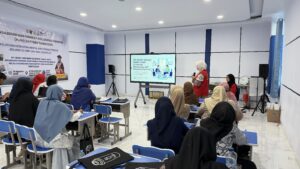
In addition to the presentation of materials, participants took part in role play simulations with various scenarios that may be encountered in the school environment. Through these simulations, teachers and health workers practiced how to respond to screening results, provide initial support, make the best use of the role of peers, and coordinate when a condition requiring follow-up is found.
An interactive discussion also gave participants space to talk about their experiences and challenges in carrying out child and adolescent health screening. The exchange of experiences showed the importance of communication among all parties, especially in building monitoring and referral pathways that can be applied sustainably.
The implementation of MY-SMART through PMKI is expected to strengthen the capacity of teachers and health workers to respond to children’s and adolescents’ mental health needs more systematically. Collaboration between schools and Puskesmas also forms a foundation for a support network that allows screening results to be translated into concrete follow-up steps.
Through this approach, schools are expected to have a system that is more responsive to psychosocial problems, while ensuring that children and adolescents receive support appropriate to their level of need. These efforts also support the strengthening of children’s and adolescents’ health and well-being, in line with the achievement of Sustainable Development Goals (SDGs) Goal 3 on Good Health and Well-Being.
Editor: Ishaq Rahman
This article is an English translation of the original Indonesian report.