
Climate change is no longer a future threat but today’s reality. Floods, droughts, and extreme weather are becoming more frequent, demanding responses that are not only fast but also precise. This is why building science-based climate resilience matters.
A science-based approach ensures that every policy and action is grounded in data. With the support of climate modeling, meteorological data, and empirical research, governments can map risks accurately and design effective adaptation measures. Without it, policies tend to be reactive and costly without optimal results.
In addition, a scientific approach helps direct limited resources to the most vulnerable regions and groups. This is important to ensure that adaptation efforts are not only effective but also fair. In the context of development, science-based climate resilience also ensures that economic growth does not end up magnifying environmental risks.
To support a scientific approach to responding to climate change, the Climate Change Study Center of Hasanuddin University (Unhas) and the Directorate of Resource Mobilization for Climate Change Control at the Ministry of Environment are building a collaboration to produce measurable, applicable, and sustainable interventions at the local level.
The cooperation is designed to integrate academic strengths with public policy needs, particularly in responding to increasingly complex climate change challenges. This approach places science as the foundation for formulating mitigation and adaptation actions.
Head of the Unhas Climate Change Study Center Ir. Rijal M. Idrus, M.Sc., Ph.D explained that one of the main focuses of the collaboration is strengthening climate change education based on scientific evidence that is accessible to the wider public. This education is expected not only to improve literacy but also to encourage behavior change with a direct impact on the environment.
In addition, capacity-building programs are an important component of the cooperation, targeting various stakeholders at the local level. These efforts include training, mentoring, and strengthening competencies in implementing climate action.
“Integrating the program into the Thematic Community Service Program (KKN) is also one of the key strategies for expanding the reach of the intervention. Students are expected to act as agents of change who can implement science-based solutions in the community,” said Rijal Idrus.
Meanwhile, Director of Resource Mobilization for Climate Change Control Irawan Asaad, S.T., M.Sc., Ph.D., said the collaboration with Unhas can be strengthened through the exchange of data and information as a foundation for more accurate decision-making. According to Irawan Asaad, the availability of integrated data is important in designing policies that are responsive and evidence-based.
Irawan Asaad further mentioned support for research activities, which are an important part of strengthening the scientific basis of every program carried out. Research is expected to produce innovations relevant to the needs of climate change mitigation and adaptation in Indonesia.
“Mentoring for the implementation of climate change mitigation and adaptation actions at the local level can be carried out jointly, including sustainable waste management, which is expected to have a real impact and become a model for replication in other regions,” said Irawan.
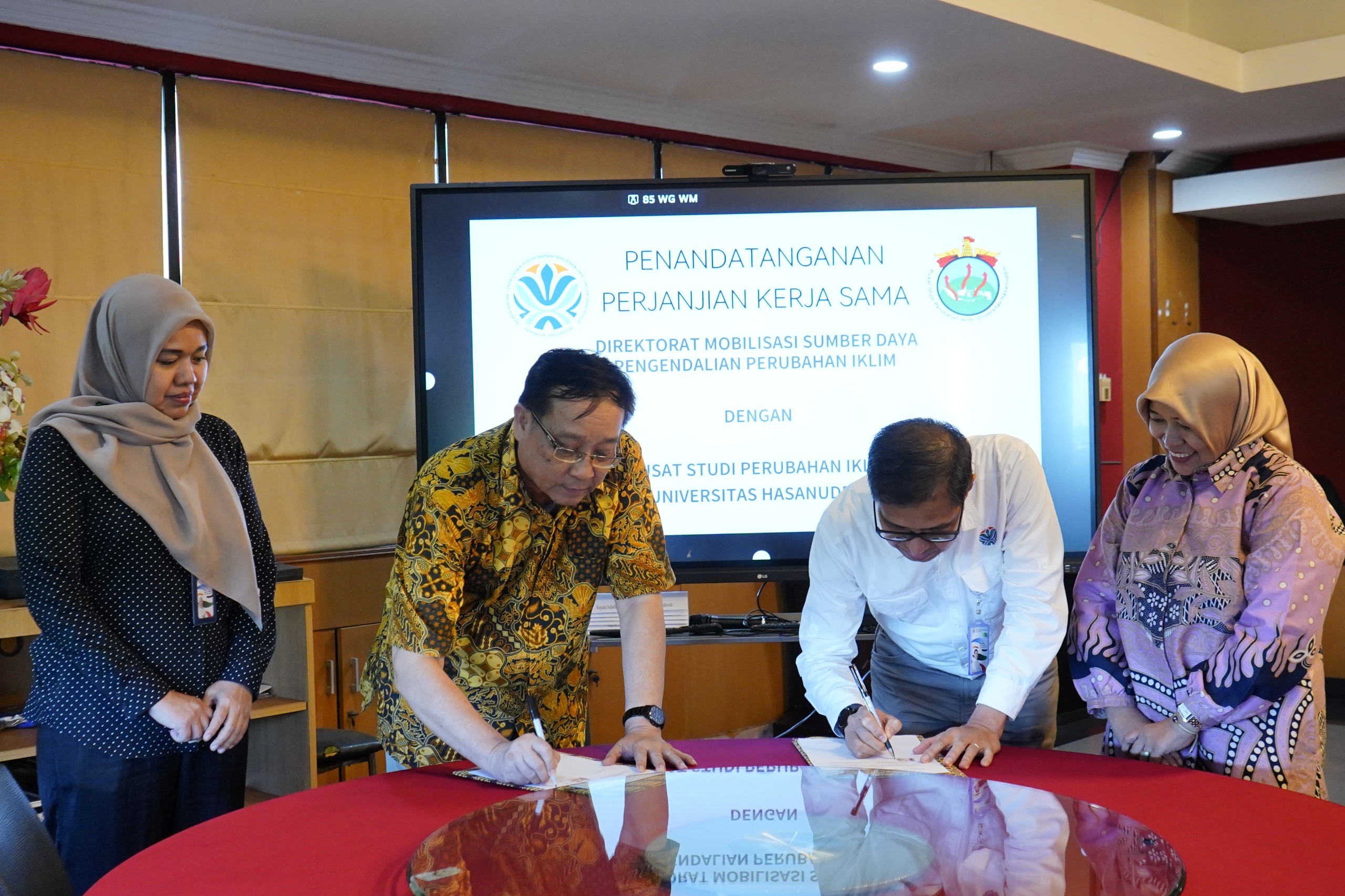
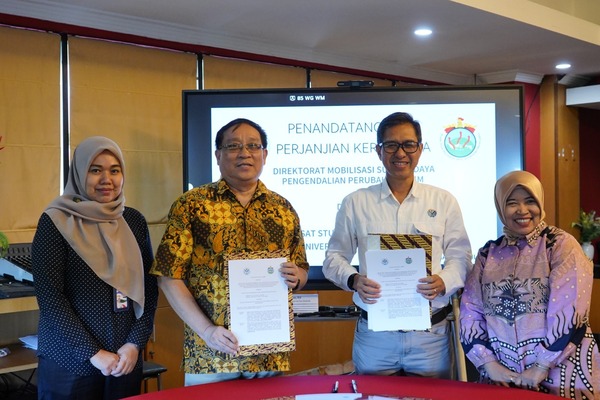
Through this collaboration, both parties are also opening opportunities to develop joint programs under international grant schemes. This is expected to broaden the scope and improve the quality of the science-based programs produced. The collaboration was marked by the signing of a Cooperation Agreement between the Director of Resource Mobilization for Climate Change Control and the Head of the Unhas Climate Change Study Center on Thursday (9 April) at 17:00 WITA (Central Indonesia Time) in the 8th Floor Lounge, Unhas Tamalanrea Campus, Makassar.
Overall, through synergy between academics and government, innovative solutions are expected to emerge that can sustainably strengthen Indonesia’s climate resilience. Climate resilience is not merely about surviving a crisis, but about how to make decisions today by understanding the future scientifically. Without science, we only guess; with science, we plan. (*/mir/ir)
Editor: Ishaq Rahman
This article is an English translation of the original Indonesian report.