
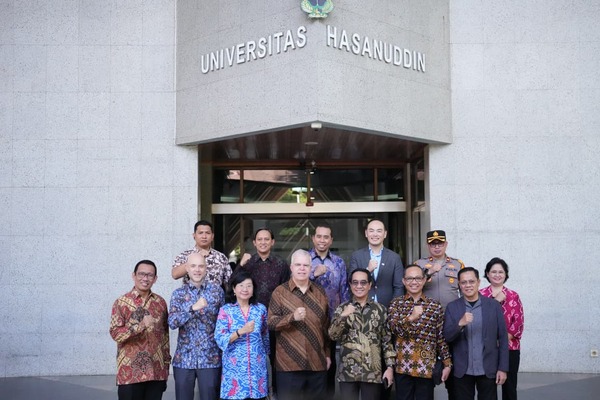
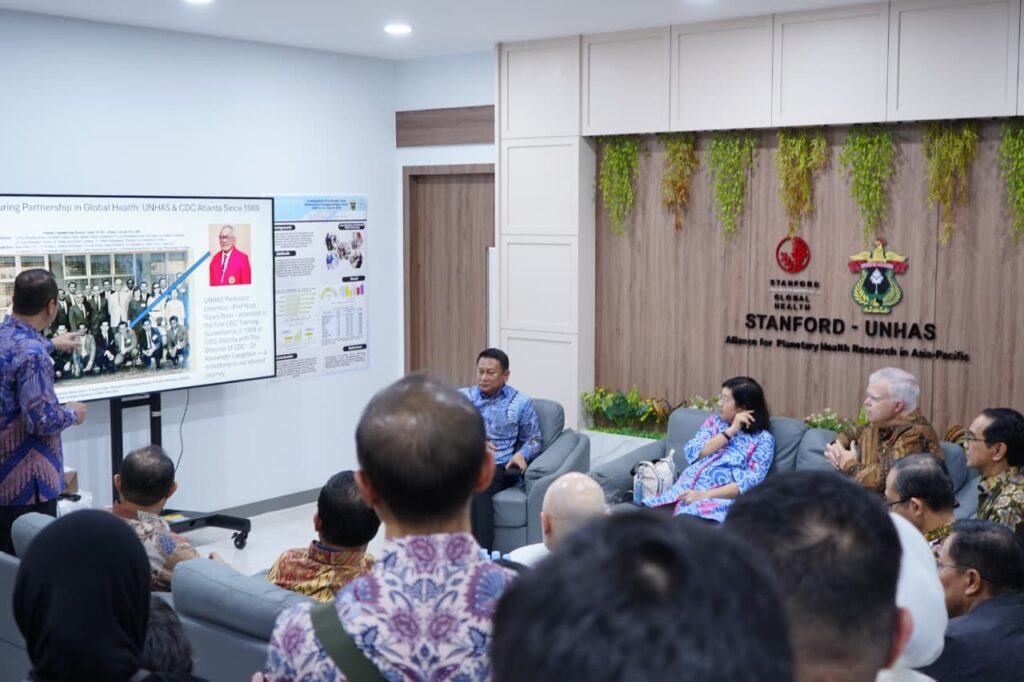
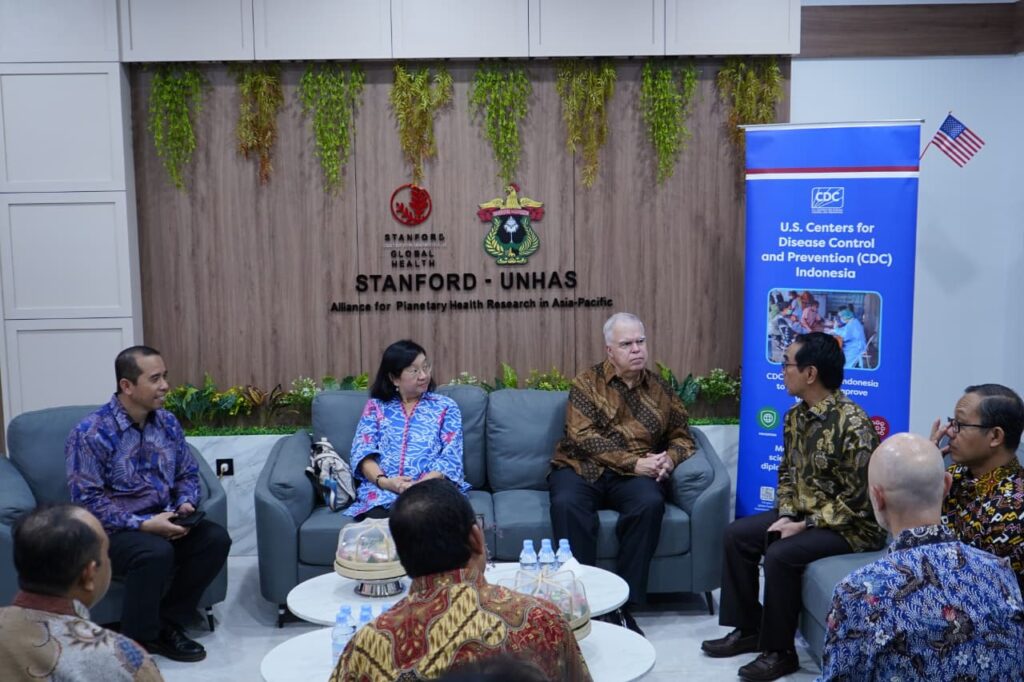
Hasanuddin University (Unhas) is strengthening the direction of its international collaboration in global health and human resource capacity building through a strategic meeting with the United States Ambassador to Indonesia, H.E. Peter M. Haymond. The meeting, a forum for deepening cooperation based on strategic needs and long-term impact, took place at the Stanford US-Unhas Center on the Unhas Tamalanrea Campus in Makassar on Saturday (28 March).
The main focus of the cooperation includes improving preparedness for disease threats and strengthening public health systems that are adaptive to global dynamics. In this context, universities play an important role as producers of knowledge, innovation, and competent human resources.
Unhas Rector Prof. Dr. Ir. Jamaluddin Jompa, M.Sc. positioned planetary health as one of the main pillars in developing future collaboration. The approach emphasizes the links among human health, the environment, and sustainable development, which require synergy across disciplines and sectors.
Within that framework, Unhas takes on the role of a connector to promote the integration of policy, research, and program implementation, particularly in strengthening the contribution of Eastern Indonesia to the global health agenda.
“Through the various strategic programs being developed, Unhas is committed to continuing to optimize its contribution,” said Prof. JJ.
The Rector also highlighted the importance of more equitable development of science and research, which has so far tended to be concentrated on Java Island. Strengthening international collaboration is seen as a strategic step to broaden Unhas’s role in the global academic ecosystem.
Ambassador H.E. Peter M. Haymond explained that the cooperation is seen as having a clear direction, with a number of priority programs that can be implemented soon. Support is directed at strengthening collaboration that is oriented toward results, sustainability, and long-term impact.
“Unhas has the capacity to be a driving force that can involve other universities. We see great opportunity for Unhas to lead collaboration and become a reference in developing academic research in this region,” said Ambassador Haymond.
One of the main pillars of the collaboration is the continuation of cooperation with the U.S. Centers for Disease Control and Prevention (US CDC), particularly through the Field Epidemiology Training Program (FETP). The program has played an important role in producing competent epidemiologists and strengthening public health response capacity in Indonesia.
In addition, the strengthened collaboration includes developing grant schemes to encourage partnerships between institutions in the United States and universities, with Unhas as the main driving institution in expanding the collaboration network.
Overall, the initiative is directed at strengthening global connectivity, improving the quality of research and education, and building sustainable institutional capacity to face health challenges at the national and global levels. (*/mir)
Editor : Ishaq Rahman
This article is an English translation of the original Indonesian report.